@NewtonProtocol I don't know... maybe I've just become a little harder to impress.
A few years ago, anything that combined blockchain with automation would immediately grab my attention. Now I usually slow down before forming an opinion. I've seen too many ideas look convincing on paper only to struggle once real people started using them. Sometimes the technology works exactly as intended, but the incentives don't. Sometimes the opposite happens. Either way, it has made me realize that building infrastructure is usually much harder than building a good story around it.
The more I spend time around this industry, the more I think one problem keeps showing up in different forms. Financial systems are becoming increasingly automated, but the people using them are still expected to keep up with every decision. Markets never sleep, transactions happen instantly, opportunities appear and disappear within minutes, yet users are somehow expected to watch everything themselves. That never felt sustainable to me. Human attention has limits, even if software doesn't.
For a while, I honestly believed automation would naturally solve that problem. Looking back, I think I was simplifying it too much. Automation isn't difficult anymore. Trust is. The real challenge isn't teaching software how to make decisions. It's making sure those decisions stay inside boundaries that users actually understand and accept. Without those boundaries, automation starts feeling less like a helpful tool and more like something you're constantly hoping won't make the wrong move.
That was probably the first thing that made me pay attention to Newton Protocol. Not because it talks about AI, but because it seems to spend more time thinking about the limits of AI than the capabilities of it. That difference may sound small, but I think it changes the entire direction of the project.
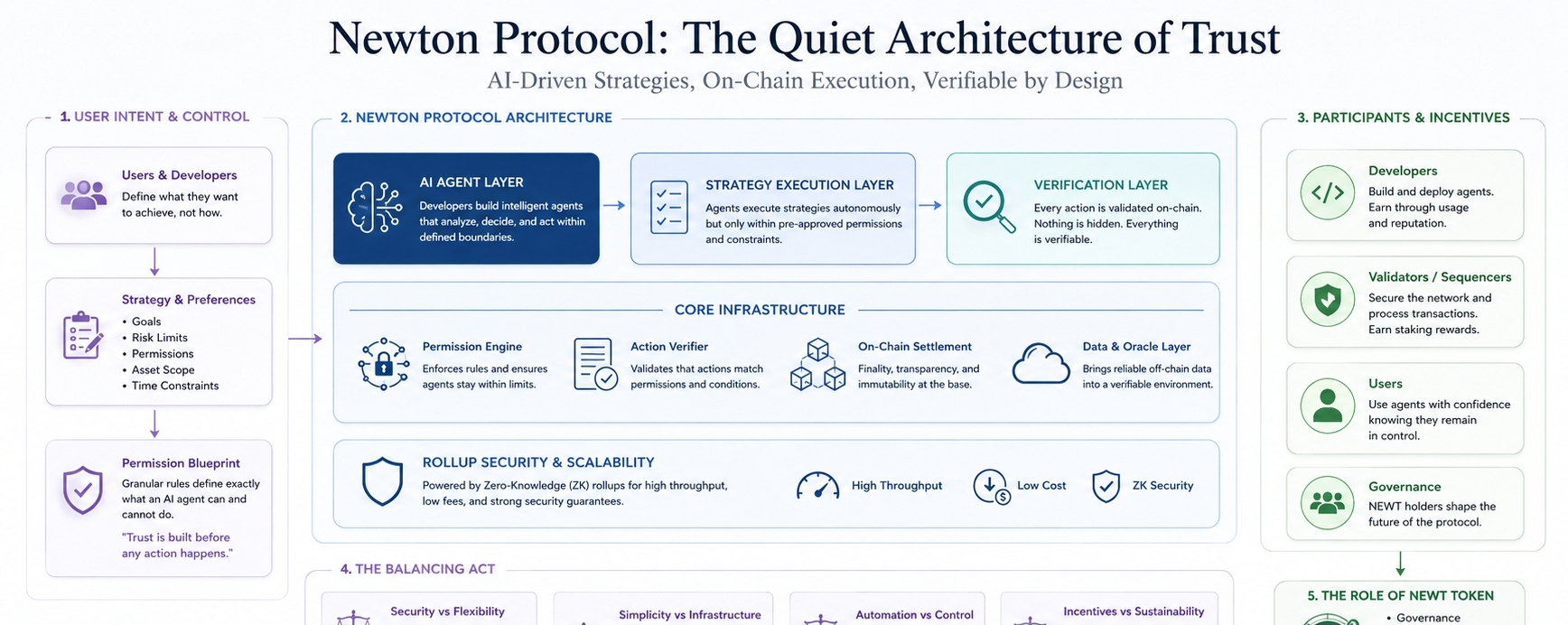
As I understand it, Newton Protocol is trying to build infrastructure where AI-driven strategies and automated actions can exist without asking users to give away complete control. Instead of assuming software should have unlimited permission, it tries to define exactly what an automated agent is allowed to do before anything actually happens. The protocol then focuses on making those actions verifiable rather than simply asking users to trust that everything went according to plan.
I actually find that approach refreshing.
Sometimes crypto projects make me feel like every new feature is about removing another layer of friction. Newton feels slightly different. The design philosophy seems to accept that some friction is necessary if people are going to trust automation with meaningful responsibilities. That doesn't make the system simpler, but maybe simplicity was never the real objective.
Still, the more I thought about it, the more I realized the protocol is constantly balancing difficult trade-offs instead of avoiding them.
The first one is security versus flexibility.
If automated agents have strict rules, users naturally gain more confidence because the software can't suddenly behave outside those limits. But those same limits also reduce adaptability. Markets change. Conditions change. Strategies sometimes need to react to situations nobody predicted. Giving software more freedom makes it more useful, but it also introduces more uncertainty. Restricting that freedom improves safety while reducing flexibility. I don't think either side wins completely.
Another balancing act exists between making the experience feel simple and building the infrastructure necessary to support that simplicity.
From a user's perspective, the ideal experience is probably straightforward. Set your preferences, define your permissions, let automation handle repetitive work, and step away. But underneath that experience sits an enormous amount of coordination. Permissions need to be enforced. Actions need to be verified. Developers need reliable tools to build agents, and the network itself has to confirm that everyone follows the same rules. None of that disappears simply because users don't see it.
I think that's something people often forget. Good infrastructure usually feels invisible, but invisible doesn't mean uncomplicated.
There's also the question of incentives.
Any protocol that relies on different participants needs everyone pulling in roughly the same direction. Developers need reasons to keep building useful agents. Network participants need incentives to secure the system. Users need confidence that the platform will remain reliable over time. From what I understand, the NEWT token mainly exists to coordinate those relationships through governance, staking, and participation inside the protocol rather than serving as the main focus itself. Even so, maintaining those incentives is never easy. Push too hard in one direction and something else starts feeling neglected.
When I picture how all of this might work in practice, I don't immediately think about traders trying to maximize returns. I think about people simply wanting fewer repetitive decisions in their daily lives. Maybe a developer builds an agent that automates routine financial tasks within clearly defined limits. Maybe a business wants software to execute certain operations without giving it unrestricted access. Maybe someone just wants to spend less time staring at charts while still knowing they remain in control.
That, at least to me, feels like a more realistic way of thinking about automation.
Of course, none of these improvements come for free.
Adding stronger verification creates more confidence, but it also adds more infrastructure. Defining stricter permissions improves safety, but it reduces flexibility. Making automation easier for users often makes the protocol itself more complicated behind the scenes. I don't see those as flaws. They're simply the cost of solving one problem without pretending every other problem disappears.
The more I read about Newton Protocol, the less I found myself asking whether it's ambitious enough. Instead, I started wondering whether it's patient enough. Building systems that people can genuinely trust usually takes longer than building systems that simply attract attention.
Maybe that's why I still don't have a definitive opinion about it.
I think the project is trying to solve a real structural problem, but the interesting part isn't whether the technology works. It's whether people gradually become comfortable letting software act on their behalf without feeling like they've surrendered control. That feels like a much bigger question than any single protocol can answer.