
i was nt to tell you about two things that happened in the same week and why the market treated only one of them as news.
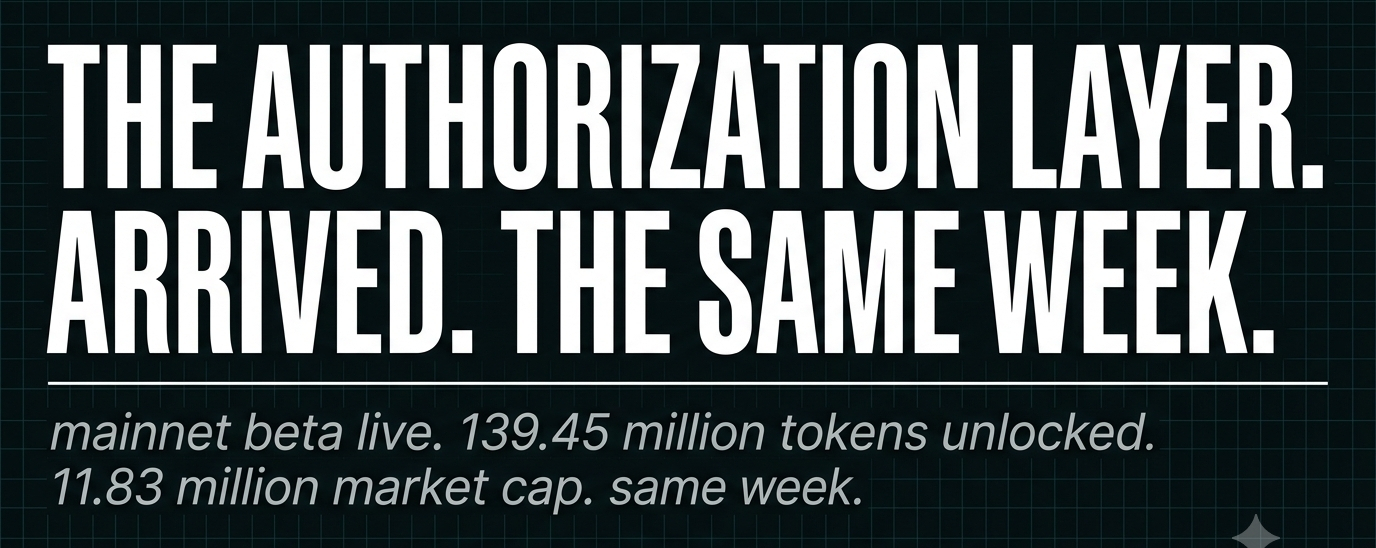
June 24 2026. 139.45 million NEWT tokens unlocked. thirteen point nine five percent of total supply entering circulation in a single event. at the price that day the unlock was worth approximately 12.04 million dollars. the market cap was 11.83 million dollars. the unlock was worth more than the entire company.
that was the news the market noticed. price dropped. volume spiked. NEWT hit levels that made the 94.10 percent drawdown from ATH feel even more permanent than it already did.
the same week Newton Protocol's mainnet beta went live.
that was the news almost nobody wrote about.
Why the Authorization Layer Is Not a Roadmap Promise Anymore
i been going through the Newton Protocol whitepaper carefully since the mainnet announcement and the mechanic at the center of it is more specifically timed than most coverage suggests.
Newton Protocol is the Authorization Layer for onchain transactions.
the analogy the whitepaper uses is precise and worth sitting with.
just as Visa authorizes payment transactions before settlement checking fraud rules, verifying identity, enforcing spend limits in real time Newton authorizes onchain transactions against programmable compliance and risk policies before they execute on any blockchain.
the mechanic works in four steps.
a user or agent initiates a transaction.
a lightweight code snippet routes the request to the Newton network. decentralized operators evaluate the transaction against policies written in Rego the same declarative language used in enterprise cloud infrastructure inside Trusted Execution Environments. the operators produce cryptographic attestations proving the checks were done correctly. the smart contract enforces those attestations at execution time.
the result is a compliance receipt. an immutable onchain record that a specific policy was evaluated for a specific transaction. not a log that monitoring was performed. proof that enforcement happened.
that distinction matters enormously in 2026 specifically. the GENIUS Act signed July 18 2025 requires stablecoin issuers to demonstrate enforceable controls at the transaction level not just at onboarding. MiCA in the EU establishes transaction monitoring requirements for crypto-asset service providers. FATF Travel Rule guidance requires virtual asset service providers to collect and transmit originator and beneficiary information for transfers above applicable thresholds. all three regulatory frameworks converged on the same requirement in the same twelve month period. enforceable verification at the transaction level with audit evidence that policies were actually applied.
Newton Protocol is the only decentralized infrastructure specifically built to produce that evidence natively. not as a compliance API. not as a monitoring dashboard. as a cryptographic proof generated before settlement.
NEWT at 0.0485 dollars today June 29 2026. market cap 11.83 million dollars. circulating supply 243.9 million against 1 billion maximum. ATH of 0.8206 from earlier in the cycle means the token is trading 94.10 percent below its peak. RSI at 33.52 — neutral territory, neither oversold enough to signal imminent bounce nor overbought enough to signal new selling pressure.
the June 24 unlock of 139.45 million tokens was the post-cliff linear release beginning. the whitepaper confirms the core team, early backers, and ecosystem funds all have vesting schedules that began releasing after the cliff period ended. July 24 brings another 17.37 million NEWT — 1.74 percent of total supply. August 24 brings another 17.37 million. September 24 the same. October 24 the same.
monthly supply entering circulation from these linear releases sits at approximately 17 to 35 million NEWT depending on which allocation categories are releasing simultaneously. against 12 million dollars of daily volume on a good day and 9.27 million dollars of average daily volume as of June 29 the absorption math is uncomfortable.
what changes the math is protocol fee revenue denominated in NEWT. every transaction that Newton's operator network evaluates generates a fee. as the stablecoin market at 298 billion dollars in circulating supply increasingly requires Newton's compliance verification layer the fee volume grows. the question is whether fee-driven NEWT demand scales faster than the monthly unlock schedule adds supply.
the BeInCrypto Institutional 100 2026 Long List recognition for Best OnChain Finance Infrastructure is the most meaningful external validation the project has received.
that recognition is based on quantitative data and expert scoring of institutional clientele and regulatory maturity. it is not a price catalyst. it is evidence that the right audience is paying attention to the right mechanic.
most authorization layer comparisons in crypto are loose analogies. the Newton whitepaper comparison to Visa is unusually precise and the preciseness is what makes it worth examining carefully.
Visa does not hold funds. Visa does not replace banks. Visa provides the authorization network between them. the fee Visa earns on every transaction is a fraction of the transaction value — not a fixed amount. as transaction volume grows Visa's fee revenue grows proportionally without requiring proportional growth in infrastructure cost.
Newton Protocol is designed around the same economic structure. NEWT fees are not fixed per transaction. they are calculated as a percentage of the computational work performed — metered by policy evaluation complexity, data provider calls, and bandwidth consumed. as the protocols using Newton's authorization layer grow — as more stablecoins embed Newton, as more RWA platforms use policy packs, as more AI agent wallets require programmatic authorization — the NEWT fee revenue grows without requiring proportional growth in operator infrastructure.
the operator network secured through EigenLayer restaking is the analogy to Visa's member bank network. operators stake restaked ETH or liquid staking tokens. incorrect or malicious responses can be challenged and result in slashing. the economic cost of attacking Newton scales with total stake in the system. the same EigenLayer economic security model that backs other AVS deployments backs Newton's policy evaluation network.
VaultKit the SDK that makes vault rules enforceable onchain announced recently is the developer-facing product that converts the authorization architecture into something builders can actually integrate without understanding the full TEE and BLS aggregation stack underneath.
mainnet beta live.
GENIUS Act creating mandatory compliance demand. institutional recognition from BeInCrypto Institutional 100. EigenLayer security model providing credible decentralization. VaultKit reducing integration friction. Polymarket, Forbes, Helium, WalletConnect, Mattel — the 200,000 plus developers using Magic Labs embedded wallet infrastructure representing a direct pipeline for Newton Protocol enterprise adoption.
bearish signals: 94.10 percent below ATH. monthly unlock schedule producing predictable supply pressure through at least October 2026. fee revenue from protocol usage not yet publicly quantified. adoption evidence from mainnet beta not yet measurable in published on-chain data. RSI at 33.52 signaling neither accumulation conviction nor panic selling.
the honest market sentiment is neutral-to-cautious with a specific catalyst dependency. the bull case requires enterprise adoption evidence to emerge fast enough that protocol fee revenue becomes visibly meaningful before the monthly supply releases erode price support further. the bear case is that 17.37 million NEWT per month arriving into 9 to 12 million dollars of daily volume produces sustained downward pressure regardless of how real the compliance infrastructure is.
What the Whitepaper Gets Right That Price Does Not Reflect
the three pillar architecture Verifiable Credentials, Programmable Policies, Cross-Chain Interoperability — is genuinely differentiated at the infrastructure level. Rego as the policy language is not an arbitrary choice. it is the same language used by enterprises for Kubernetes admission control and API gateway authorization. the policy evaluation producing BLS aggregate signatures rather than API responses means the compliance proof cannot be ignored by smart contracts the way an API response can.
the AI agent risk section of the whitepaper is the most forward-looking element. autonomous AI agents operating on crypto rails can execute transactions at machine speed without human review. Newton's programmatic policy evaluation is designed for exactly this authorization requirement. as AI agent activity on-chain grows the demand for Newton's authorization layer grows with it.
the cross-chain architecture supporting EVM-compatible chains through EigenLayer's ELIP-008 specification means Newton operators register once on Ethereum and their registration synchronizes to all supported destination chains. applications on Arbitrum, Optimism, Polygon, and Base receive the same operator set and security guarantees without requiring separate compliance infrastructure on each chain.
honestly don't know if mainnet beta arriving simultaneously with the largest supply event in NEWT's history is the worst possible timing for price or the most interesting setup where the market has to decide in real time whether the compliance infrastructure justifies absorbing the unlock pressure
what is your take Authorization Layer going live during the largest supply event changes how the market prices the next six months or does the unlock math dominate regardless of product progress??