
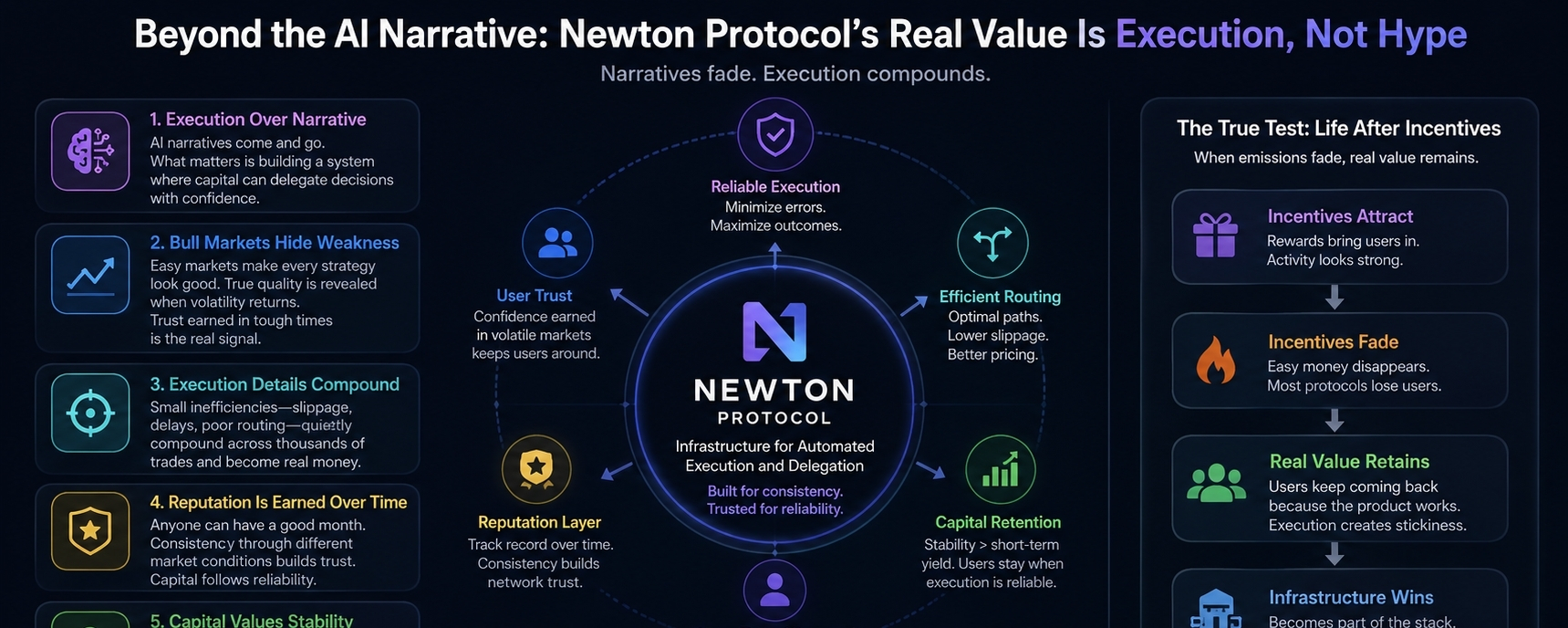
@NewtonProtocol The more I watch Newton Protocol, the less I care about the AI narrative around it. We've seen enough cycles to know that narratives come and go, but execution is what survives. What caught my attention wasn't the promise of AI-driven strategies. It was the idea of building a system where capital can delegate decisions without constantly wondering if it should step back in. That's a much harder problem to solve than getting people excited about AI.
One thing I've learned over the years is that bull markets make almost every automated strategy look smarter than it really is. Liquidity is everywhere, mistakes get hidden, and people stop questioning the process. It's only when volatility returns that you find out which systems were actually built well. If users keep trusting automation after a rough week instead of rushing to turn everything off, that's the kind of signal I pay attention to. Confidence earned during difficult markets means a lot more than activity during easy ones.
Something else I think people overlook is how small execution mistakes quietly add up. A little extra slippage here, a delayed transaction there, slightly worse routing than expected. None of those things make headlines, but over hundreds or thousands of trades they become real money. Experienced traders usually notice that long before they notice a flashy dashboard or impressive transaction count. Good execution isn't exciting, but it's exactly what keeps serious capital around.
I'm also curious about how reputation develops inside the marketplace. Anyone can have a good month when conditions line up. That's happened every cycle. The people who earn trust are the ones who stay consistent when the market changes completely. If developers start building reputations based on reliability instead of one lucky streak, that's where I think the network becomes much more interesting. Capital usually follows consistency before it follows performance.
What makes automation different from traditional yield farming is that the capital behaves differently. Yield farmers move the moment a better incentive appears. People relying on automated execution don't always want to keep changing systems because every migration introduces uncertainty. Once users become comfortable with an execution framework that consistently does what it's supposed to do, they often value stability more than squeezing out a little extra return somewhere else.
The real test comes when incentives stop doing the heavy lifting. We've all watched protocols look incredibly active while rewards were flowing, only to become ghost towns once emissions slowed down. That's why I care much more about whether users keep coming back when the easy money disappears. If they do, the product is creating real value. If they don't, the incentives were doing all the work.
At this point, I don't think Newton succeeds or fails because of AI. It succeeds if it becomes part of the infrastructure people quietly rely on every day without thinking about it. The strongest protocols I've used over the years aren't the ones everyone talks about on Crypto Twitter. They're the ones I keep using because they continue to work, especially when markets stop being easy.