
So I've been down the Newton Protocol rabbit hole for the past couple weeks, and I want to talk through what I actually found, because the more I dug, the more the core idea started making sense to me in a way most "AI + crypto" pitches never do.
Let me back up. The thing that hooked me was a problem I've personally run into. I've used automated trading tools before. You know the drill you connect the thing, and somewhere in the fine print you realize you've basically handed over the keys to your wallet. I remember staring at one of those approval screens thinking, "wait, this bot can just… do whatever now?" That gut-check moment is exactly the gap Newton is trying to close. Today's automation solutions, primarily bots and centralised services, require users to surrender private keys, creating security vulnerabilities, counterparty risk, and no way to verify if actions align with user intent.
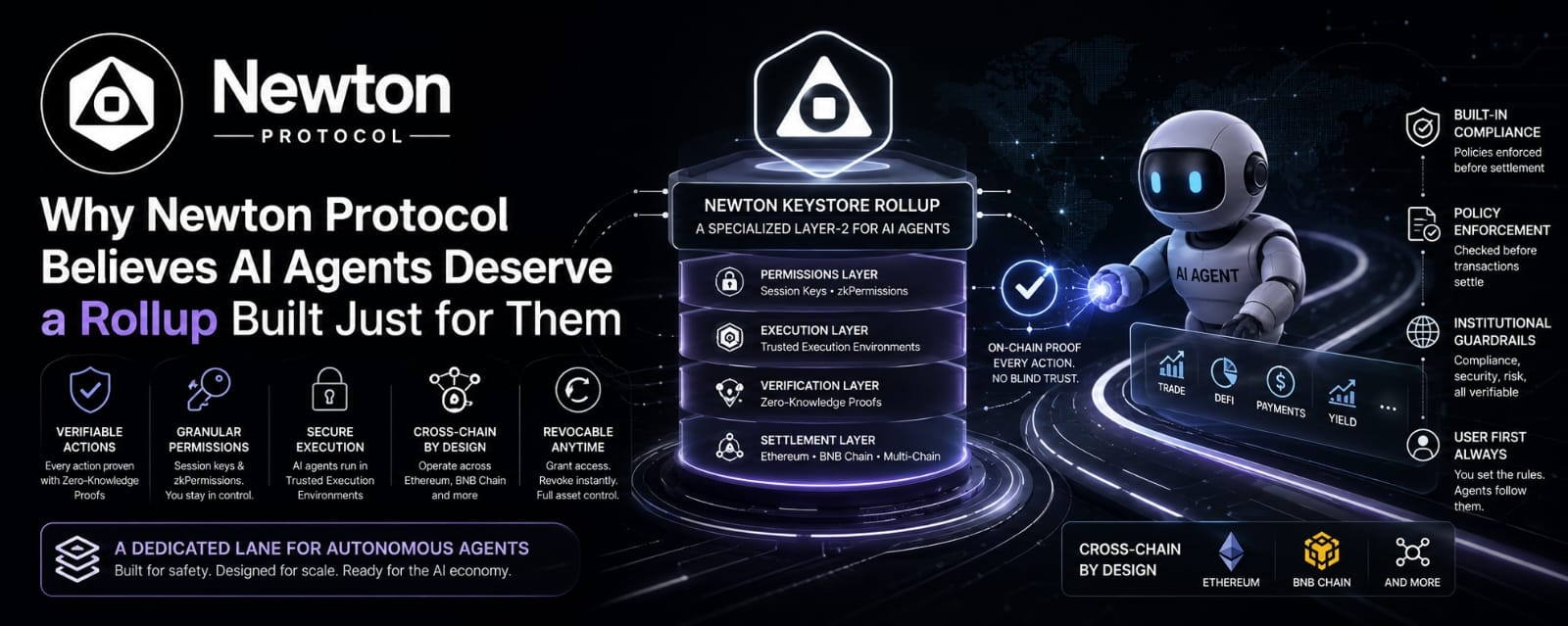
Here's the whole thesis in plain terms. If AI agents are going to move real money around on-chain, they can't run on the same blind-trust plumbing we've tolerated for years. They need their own dedicated lane. That's the "why a rollup" part. The Newton Keystore is a specialized rollup a Layer-2 scaling solution designed specifically for storing and updating user permissions, so instead of giving an agent your private key, you grant it granular, revocable permissions via technologies like session keys or zkPermissions.
Think of it like this. A general-purpose blockchain is a giant public highway everything drives on it, cars, trucks, bikes. An AI agent zipping around with your money on that highway is chaos waiting to happen. Newton's argument is that agents deserve a purpose-built track with guardrails welded in, not painted on. That metaphor clicked for me.
How does the trust actually work, though? Because "trust me, the AI behaved" is not good enough. This is where I noticed the design gets genuinely interesting. AI agents execute tasks within secure hardware enclaves Trusted Execution Environments and for every action, a Zero-Knowledge Proof is generated and posted on-chain, proving the action's correctness without revealing sensitive data. This eliminates the need for blind trust. So you're not hoping the agent stayed in its lane you get a receipt that mathematically says it did.
And you set the boundaries yourself. Every automated transaction the agent performs is cryptographically guaranteed to stay within user-approved parameters, and unlike risky trading bots that require full control of your wallet, the agents operate within strict guardrails you set. The comparison I keep coming back to is that permissions here work a bit like signing into an app with a "log in with Google" button you grant specific, scoped access, and you can yank it back. They use session keys and permissions, akin to OAuth for blockchain, so the agent can act on your behalf only in allowed ways.
The cross-chain angle is the part I'd underrate at my own peril. The Keystore Rollup, a multi-chain validity rollup, enables AI agents to operate across blockchains like Ethereum and BNB Chain, and users retain full asset control while agents handle complex tasks. That matters because my own holdings aren't all sitting in one place, and neither are yours.
Now for the skeptic in me, because you should keep yours switched on too. This is infrastructure for a market that barely exists yet. Its success is heavily dependent on the team's ability to build, secure, and deploy the full Keystore rollup, and its value will depend on developers building useful agent models and users adopting them at scale. There's also a dependency risk I noticed: the protocol's reliance on external technologies like TEEs and zk-VMs means its performance and security are partially linked to the development and stability of those systems. Translation Newton is betting on tech it doesn't fully control. Not a dealbreaker, but worth writing down.
On recent developments, one update stood out to me as more than marketing. Magic Labs, the embedded wallet provider for Polymarket and Naver, integrated Newton Protocol for onchain compliance, a move to make compliance plug-and-play and affordable for 200,000 developers and to bring institutional-grade safeguards to 50 million wallets. That's real distribution, not vaporware. It also reframed the pitch for me it's not just about degen trading bots, it's about rules getting checked before a transaction settles. Builder-defined policies use both onchain and offchain data to decide whether a transaction should be approved or blocked, a decentralized network of operators secured through Ethereum restaking and NEWT evaluates each policy inside TEEs and generates proofs, and the results can be verified by anyone through the Newton Explorer.
Now the numbers, because sentiment lives and dies here. Across the trackers I checked, NEWT has been trading roughly in the $0.05–$0.10 band recently. On one snapshot, NEWT was trading at $0.097784 with a market cap of $21.02M, ranking it #1115 among all cryptocurrencies. Another had it lower around $0.0485 with a 24-hour volume of about $12.29M, a market cap near $11.83M, and a rank of #882. The token is a long way off its highs: it reached an all-time high of $0.8206 and is now trading roughly 94% below that peak. Supply-wise, it's a fixed 1 billion token supply. If you want the freshest figure before acting, check the live NEWT market data yourself rather than trusting any single article's number mine included.
Actionable tip from my own process: I never let a market cap that small lull me into thinking "cheap = safe." A sub-$25M cap means thin liquidity and violent swings. I size those positions tiny and treat the thesis, not the price, as the reason to watch. If you're curious, NEWT trades on Binance, and I'd read the audited contract details before touching anything.
So here's where I land. Newton's bet that autonomous agents need verifiable rails, not borrowed ones feels directionally right to me. Whether it wins is a separate question from whether it's correct.
What about you? Would you actually let an AI agent manage a slice of your portfolio if you could revoke it anytime? And where's your personal line trading, payments, or nothing at all? I'd genuinely love to hear how you're thinking about it.
