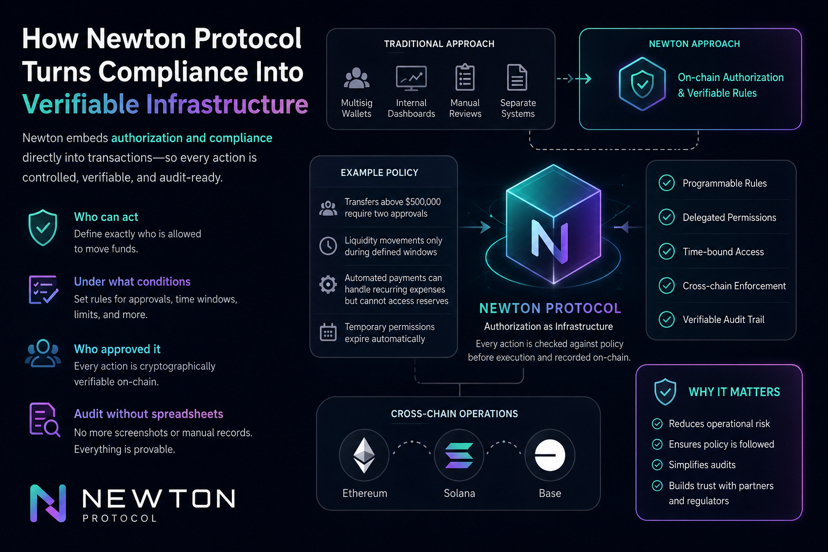
What caught my attention first was not transaction speed or scalability.It was the operational mess behind the scenes.
Crypto has already become very good at moving assets. Stablecoins settle quickly, bridges are improving, and cross-chain activity is becoming routine. But when businesses actually start using these systems day to day, another issue shows up almost immediately: authorization.
Who is allowed to move funds?
What conditions need to be met first?
Who approved the transaction?
And later, how do you prove those approvals actually happened without relying on spreadsheets, screenshots, or internal databases?@NewtonProtocol $NEWT #Newt
That part of crypto infrastructure still feels incomplete.I started looking into Newton Protocol because it approaches compliance differently from most projects I have seen. Instead of treating compliance as something added after transactions happen, it tries to build those rules directly into the transaction process itself.
That may sound like a small difference, but operationally it changes quite a bit.
Right now, a lot of crypto companies still handle approvals through a messy combination of multisig wallets, internal tools, manual checks, and separate accounting systems.The blockchain records the transfer itself, but the logic behind why the transfer was allowed often exists somewhere else entirely.
That creates weak points.Take a simple example.Imagine a company handling stablecoin payments across Ethereum, Solana, and Base. One team member prepares supplier payments, while another approves larger transfers before the funds move.Treasury managers move liquidity between chains when balances get uneven. Later, auditors need to confirm whether company policy was actually followed.@NewtonProtocol #Newt 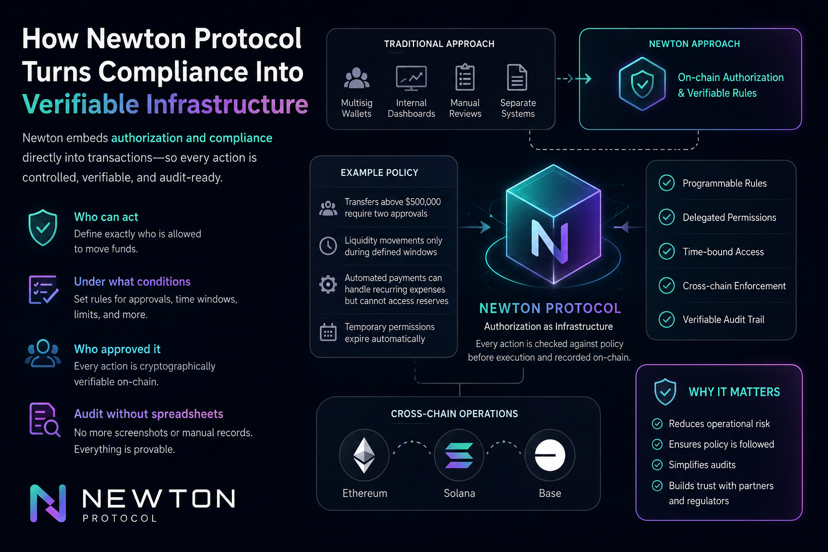
In most setups today, verifying that process still depends heavily on trusting internal records.
Newton seems to focus directly on that problem.
The interesting part is that authorization itself becomes programmable. Instead of only checking whether a wallet signed a transaction, the system can also verify whether the signer had permission to perform that specific action under predefined rules.$NOM
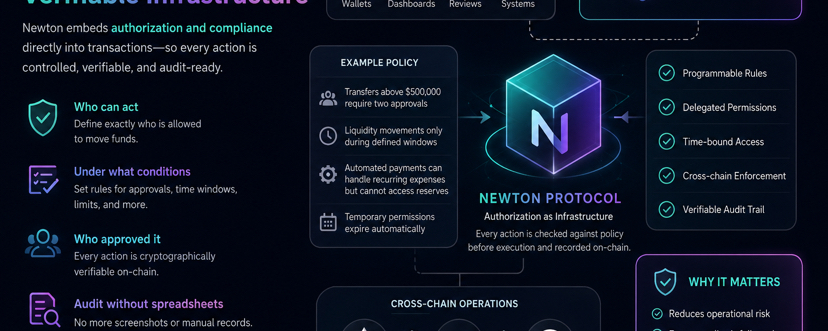
That sounds technical, but the real-world use case is pretty straightforward.A company policy could look something like this:
* Transfers above $500,000 require two approvals
* Liquidity movements can only happen during certain time windows
* Automated payment systems can handle recurring expenses but cannot access reserve funds
* Temporary permissions expire automatically after a fixed period
Those rules become part of the infrastructure itself rather than something enforced manually behind the scenes.I think this becomes more important as crypto systems become more automated.
A lot of infrastructure is moving toward automation now. Treasury management, recurring payments, liquidity balancing, yield strategies — many of these processes are gradually becoming less manual.
But automation without clear permission structures creates obvious risks.A compromised account, faulty script, or bad configuration can become a much larger problem when systems are allowed to operate continuously across multiple chains.
Traditional finance already deals with this through layered approval systems and detailed audit trails. Crypto still feels early in that area.
That is why Newton’s focus stands out to me. It treats authorization as core infrastructure instead of leaving every application to build its own version separately.
Another part I found interesting is the way delegated permissions are handled. Instead of treating wallet ownership as unlimited authority, permissions can be limited, temporary, and tied to very specific responsibilities.
That actually reflects how organizations work in practice.In real companies, authority is rarely permanent or unrestricted. Spending limits exist. Temporary access gets assigned. Teams rotate responsibilities. Emergency restrictions can override normal permissions.
Most crypto wallet systems still do not handle that complexity very well.And honestly, I think this is where the broader infrastructure conversation may be heading.
For years, crypto focused mainly on execution speed because that was the obvious bottleneck. Faster chains, lower fees, better scalability. But as the technology matures, operational trust may start becoming just as important as execution itself.
Large organizations probably do not only want faster settlement.They also want predictable control systems.They want clear authorization frameworks.
They want compliance processes that work across multiple chains without rebuilding internal procedures every time infrastructure changes.
That does not guarantee Newton succeeds, of course.
A lot will depend on adoption, integration quality, developer experience, and whether businesses are comfortable relying on programmable authorization systems in production environments.
That part is still uncertain.But conceptually, I think Newton is addressing a deeper infrastructure problem than many people initially realize. Not simply moving transactions faster, but proving that those transactions followed valid authorization rules from the beginning.
And if crypto keeps moving toward larger-scale financial infrastructure, that layer may eventually become just as important as settlement itself.
The real question is whether verifiable authorization eventually becomes a standard requirement across blockchain systems rather than just an optional feature.@NewtonProtocol $NEWT #Newt