
The crypto market has a habit of making everything sound bigger than it really is. Every few weeks there's a new narrative, another token, another protocol claiming it will reshape the industry. After watching several market cycles, I've learned that the loudest projects aren't always the ones worth paying attention to. Sometimes the more interesting ideas are buried underneath technical documentation that most people never bother to read. That was my first impression of Newton Protocol.
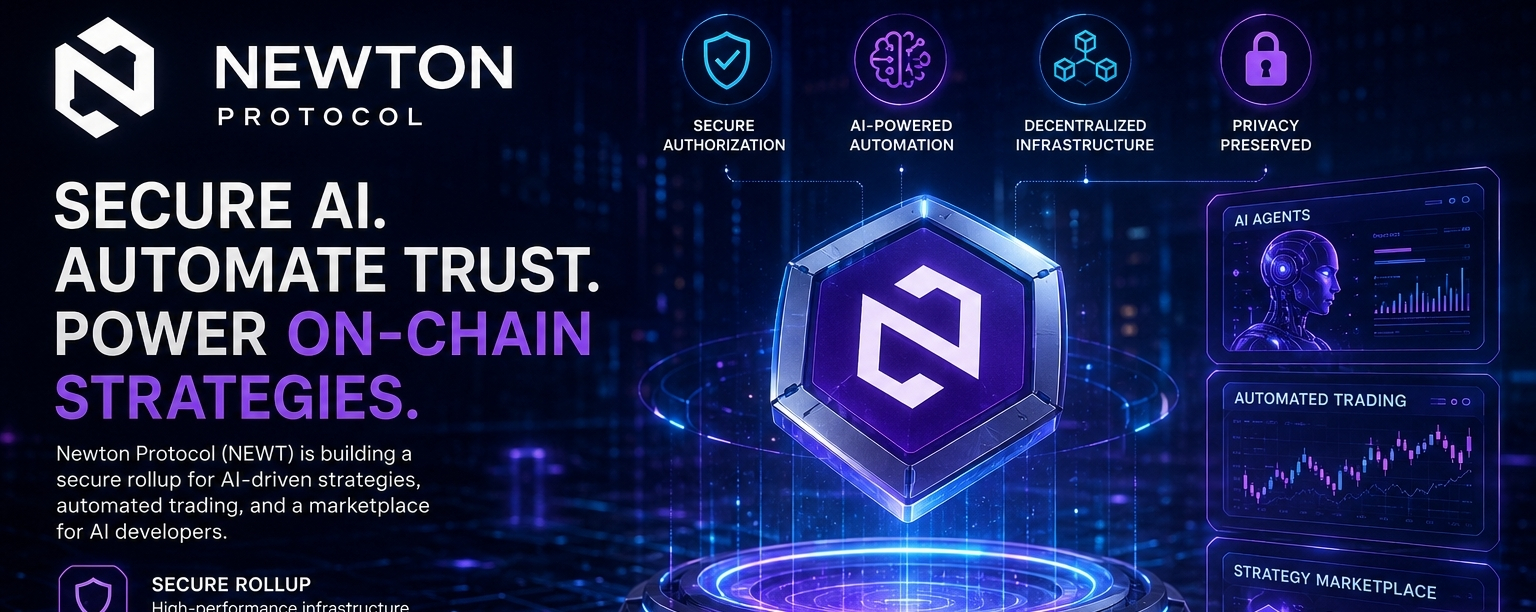
At first, it seemed easy to place it in the growing list of AI-related crypto projects. The market has become obsessed with anything connected to artificial intelligence, so it's natural to be skeptical. But after spending time understanding what Newton Protocol is actually trying to build, it became clear that the project isn't really chasing the AI narrative. The real focus is something much less glamorous but potentially much more important: creating a secure authorization layer that allows automated systems and AI agents to interact with blockchain networks while following predefined rules instead of acting without limits.
Blockchains are incredibly good at executing transactions, but they don't naturally understand context. A smart contract doesn't know whether a wallet has reached its spending limit, whether an AI trading bot is behaving outside its assigned strategy, or whether a transaction should be blocked because of compliance requirements. It simply executes whatever conditions are written into the code. Newton Protocol is designed to bridge that gap by allowing policies to be checked before a transaction is finalized instead of trying to solve problems after assets have already moved.
What makes this approach interesting is that it doesn't rely on a single centralized authority making those decisions. Policies can be created by developers or organizations, evaluated by decentralized operators, and then verified on-chain before execution. That creates an additional layer of security without completely changing how existing decentralized applications work. It feels more like adding intelligence to blockchain infrastructure than replacing the infrastructure itself.
The rise of AI makes this conversation even more relevant. More developers are experimenting with autonomous agents that can trade, rebalance portfolios, manage treasuries, or perform routine blockchain tasks without constant human input. The possibilities are exciting, but they also introduce entirely new risks. Automation is powerful until something unexpected happens. One faulty instruction, one manipulated data source, or one compromised wallet can create losses within seconds. Having a system that defines exactly what an AI agent is allowed to do before it interacts with assets seems like a logical direction rather than an unnecessary layer of complexity.
Another aspect that stood out while exploring Newton Protocol is its architecture. Instead of embedding every possible rule directly into smart contracts, the protocol separates policy creation from execution. Developers can write flexible authorization policies while decentralized operators evaluate them using both on-chain and off-chain information. Once enough operators agree on the result, the blockchain receives cryptographic proof that the required conditions have been satisfied before allowing the transaction to proceed. It's a design that attempts to preserve decentralization while introducing a practical way to manage risk.
Privacy also appears to have been considered from the beginning. Sensitive information isn't intended to be permanently exposed on-chain, while cryptographic verification allows policies to be enforced without revealing unnecessary personal data. In an industry that constantly debates transparency and privacy, finding a balance between the two has always been difficult. Newton Protocol seems to acknowledge that users need verification without sacrificing confidentiality.
The NEWT token serves several purposes within the ecosystem beyond simple market speculation. It supports network security through staking, enables governance participation, pays protocol-related fees, and contributes to the economic model that keeps decentralized operators incentivized to perform policy verification honestly. Whether those utilities eventually translate into long-term value depends entirely on adoption, but at least the token has a clear function inside the protocol instead of existing solely because every project is expected to launch one.
Like many new projects, Newton Protocol attracted attention through major exchange listings and growing discussions across the crypto community. That initial excitement is almost expected these days. Markets react quickly to narratives, listings, and token launches, but those moments rarely reveal whether a protocol has genuine staying power. The more meaningful test always comes later, when developers continue building after the spotlight has shifted elsewhere and users decide whether the infrastructure solves real problems or simply sounded attractive during launch week.
The more I looked into Newton Protocol, the more it felt like one of those projects that isn't trying to dominate headlines. Instead, it seems focused on becoming part of the invisible infrastructure that other applications quietly depend on every day. History has shown that those foundational layers often become far more valuable than the products generating the most social media attention.
There is still a long road ahead. Every ambitious protocol looks convincing on paper, but real success only comes when developers integrate it, users trust it, and the network proves itself under real-world conditions. Newton Protocol still has to earn that confidence over time. Even so, it stands out because it addresses a problem that becomes more obvious as crypto grows increasingly automated. If autonomous finance is going to become a meaningful part of the blockchain ecosystem, then systems capable of enforcing clear, verifiable rules before transactions happen may eventually become just as important as the transactions themselves. That's the part I'll be watching most closely as the ecosystem continues to evolve.