
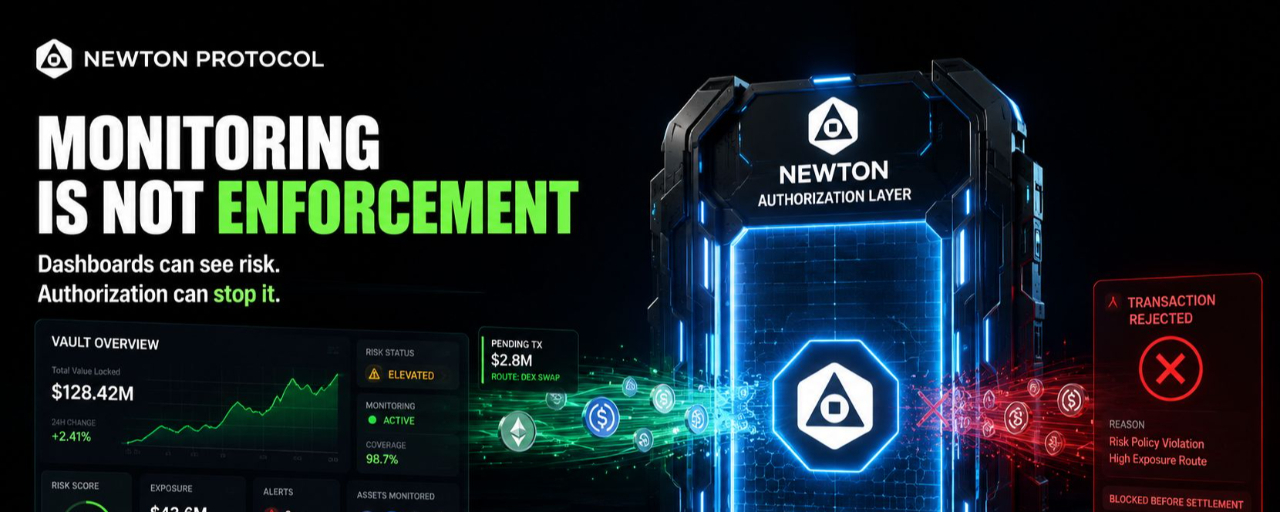
I used to mistake visibility for safety.
Whenever I opened a DeFi vault, I followed the same routine: check TVL, APY, oracle status, collateral ratio, market exposure, and the risk dashboard. If everything was green, I felt comfortable.
That feeling usually came from the dashboard, not from understanding what would actually happen if someone tried to break the rules.
While researching @NewtonProtocol Mainnet Beta, I started thinking about a simple scenario.
Imagine a $100 million vault with a published rule that no single market can receive more than 20% of its capital. A new pool suddenly offers an unusually high APY, so the manager tries to move $30 million into it.
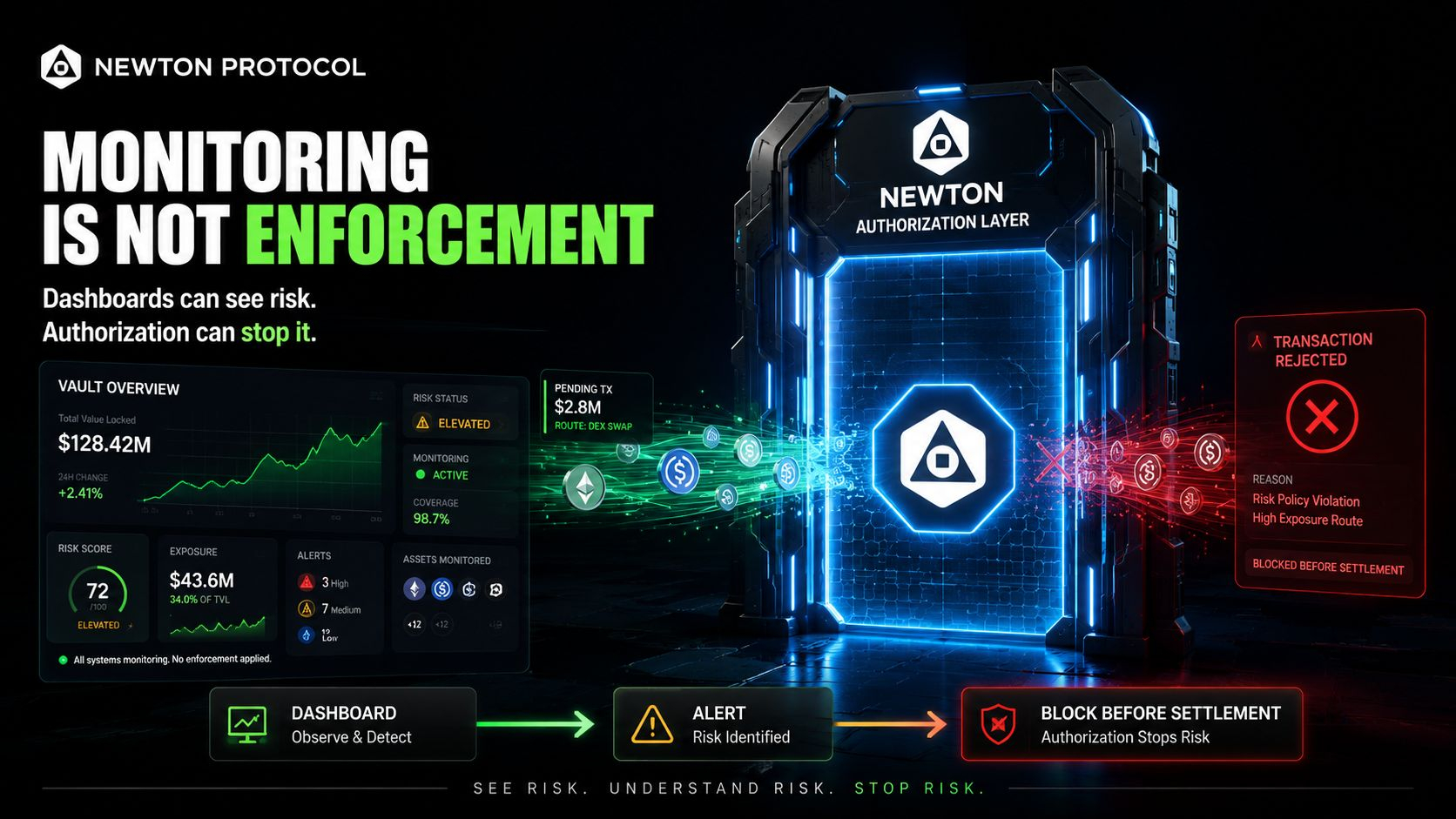
A monitoring platform may detect the concentration risk. The dashboard turns red. An alert is sent. The transaction is added to a report.
But if settlement has already happened, none of those actions protected the capital.
They only documented the violation.
That is the difference between monitoring and enforcement.
A dashboard answers:
What is happening?
An alert answers:
What just went wrong?
Enforcement answers:
Should this transaction be allowed to happen at all?
Newton is designed around that third question. Before a transaction settles, the intent can be evaluated against active policies covering allocation limits, leverage, sanctions, identity, oracle health, counterparty exposure, or other application-defined conditions. Newton’s operator network then returns a signed pass-or-fail attestation, which the smart contract can require before execution.
In the $100 million vault example, the 30% allocation would not merely generate an alert. If the active policy capped exposure at 20%, the transaction could be rejected before the money moved.
The whitepaper makes this distinction directly: existing analytics and monitoring systems are generally advisory and post-hoc, while Newton is built for verifiable enforcement at the transaction level.
The easiest analogy for me is a security camera and a lock.
A camera gives you visibility. It records who opened the door and when.
A lock changes the outcome. It prevents the door from opening without authorization.
DeFi has built increasingly sophisticated cameras: dashboards, alerts, wallet labels, risk scores, and real-time analytics. All of them are valuable. But they are not the same as a lock.
That does not mean authorization automatically removes risk. A badly written policy could block a legitimate transaction. Stale data could produce the wrong decision. Mainnet Beta still needs to prove that policy evaluation remains fast and reliable when real capital depends on it.
But the underlying idea is important.
Security should not begin after settlement.
Because once funds have moved, a perfect dashboard may only provide a very detailed explanation of why they should not have moved.
Monitoring helps us understand risk.
Enforcement changes what risk is allowed to become.