
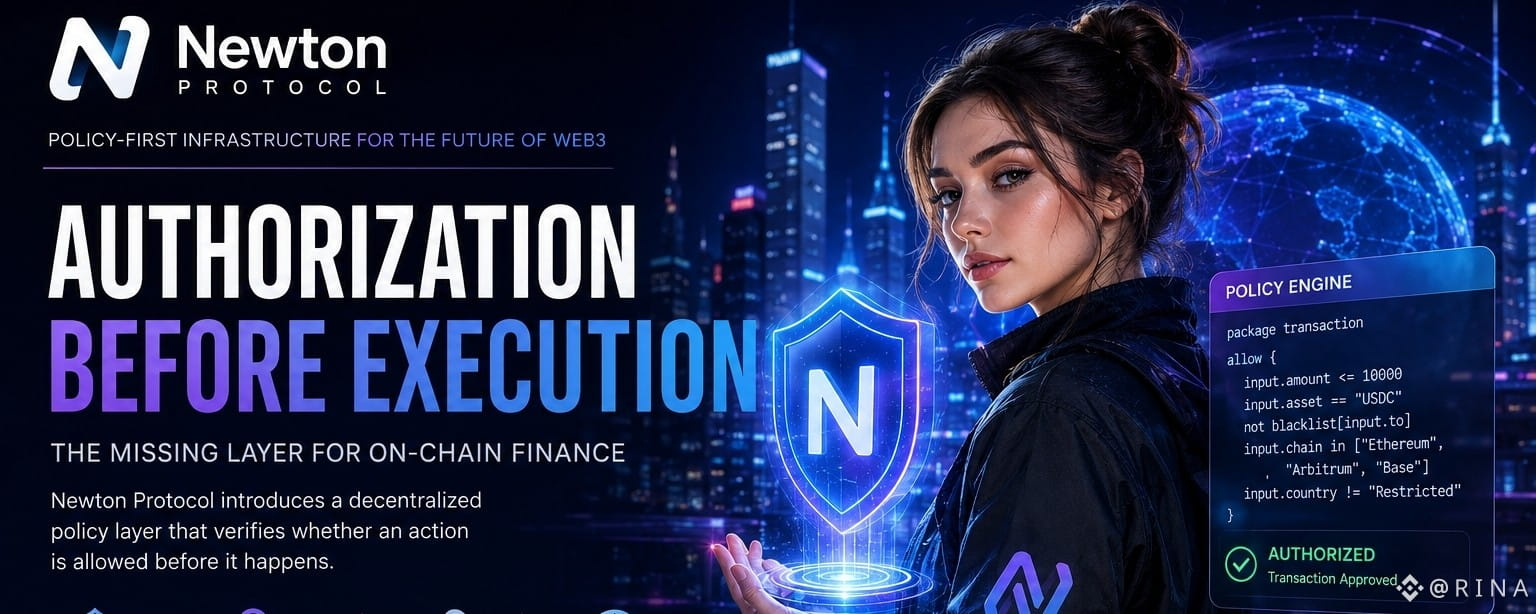
Every once in a while, a project appears that isn't trying to build a faster blockchain or another DeFi application—it is trying to solve a structural problem. After spending time studying Newton Protocol, I think its biggest strength isn't a feature or a token. It's the direction of its architecture.
The crypto industry has spent years optimizing execution. Transactions settle faster, bridges move assets across chains, smart contracts automate complex logic, and AI agents are beginning to interact with blockchains. But one question still feels surprisingly underexplored:
Who verifies whether an action should happen before it executes?
That distinction may sound subtle, but I think it could become increasingly important as blockchain infrastructure matures.
Newton Protocol approaches this problem by introducing a decentralized policy layer. Instead of assuming that every valid transaction should execute, it asks whether the transaction satisfies predefined policies before execution. That feels less like another smart contract framework and more like bringing authorization logic into decentralized infrastructure.
From a builder's perspective, this is where the project becomes technically interesting.
Traditional smart contracts execute deterministic instructions. Newton extends that model by allowing programmable policies to define how, when, and under which conditions actions are permitted. Using policy frameworks such as Rego/OPA gives developers significantly more expressive control than simple permission checks. Rather than writing isolated contract logic, teams can describe organizational rules, compliance requirements, treasury controls, or AI permissions in a structured way.
That architecture reminds me more of enterprise security systems than conventional DeFi protocols.
I also appreciate that the design isn't limited to one blockchain. If the future consists of stablecoins, RWAs, AI agents, and applications operating across multiple ecosystems, policy enforcement cannot remain chain-specific forever. A cross-chain authorization layer makes more long-term sense than rebuilding the same permission logic on every network independently.
The integration of off-chain information is another practical decision. Markets, regulations, risk metrics, and institutional requirements rarely exist entirely on-chain. Allowing policies to reference external data acknowledges how financial systems actually operate instead of pretending blockchain exists in isolation.
However, this is also where I think the project's biggest challenge begins.
The more powerful a policy engine becomes, the more complexity it introduces.
Developers generally prefer infrastructure that is simple, predictable, and easy to integrate. Authorization frameworks inevitably create additional operational overhead. Teams must design policies, maintain them, audit them, test edge cases, and ensure they don't unintentionally block legitimate transactions.
In other words, Newton isn't just asking developers to integrate another protocol.
It's asking them to adopt a completely different security philosophy.
That transition is much harder than solving a technical problem.
There's also the issue of incentives.
A policy layer creates value primarily by preventing mistakes rather than generating immediate revenue. Historically, infrastructure focused on prevention often receives slower adoption because its benefits become obvious only after failures occur. Convincing developers to invest time in invisible protection rather than visible features may prove to be one of Newton's toughest ecosystem challenges.
Another question is standardization.
Authorization only becomes truly powerful when many protocols agree to use similar policy frameworks. If every application defines its own incompatible policies, fragmentation could reduce many of the network effects Newton hopes to create.
This is why I believe execution—not architecture—will determine the protocol's future.
The vision is technically compelling. Leveraging decentralized security, programmable policies, cross-chain compatibility, and external data creates an infrastructure layer that feels relevant to institutional finance, AI agents, stablecoin issuers, DAOs, and RWA platforms alike.
But strong infrastructure rarely wins because it is technically elegant.
It wins because developers actually build on it.
If Newton can lower integration friction, attract builders, and demonstrate that policy-first design improves both security and usability without slowing innovation, it could become an important primitive for the next generation of on-chain finance.
If not, it risks becoming another technically impressive framework that developers respect—but rarely deploy.
As blockchain infrastructure evolves beyond simple execution, do you believe authorization and policy verification should become a native layer of every protocol, or will developers continue prioritizing speed and composability over programmable governance?