I don't think my perspective on AI changed overnight.
If anything, it happened gradually.
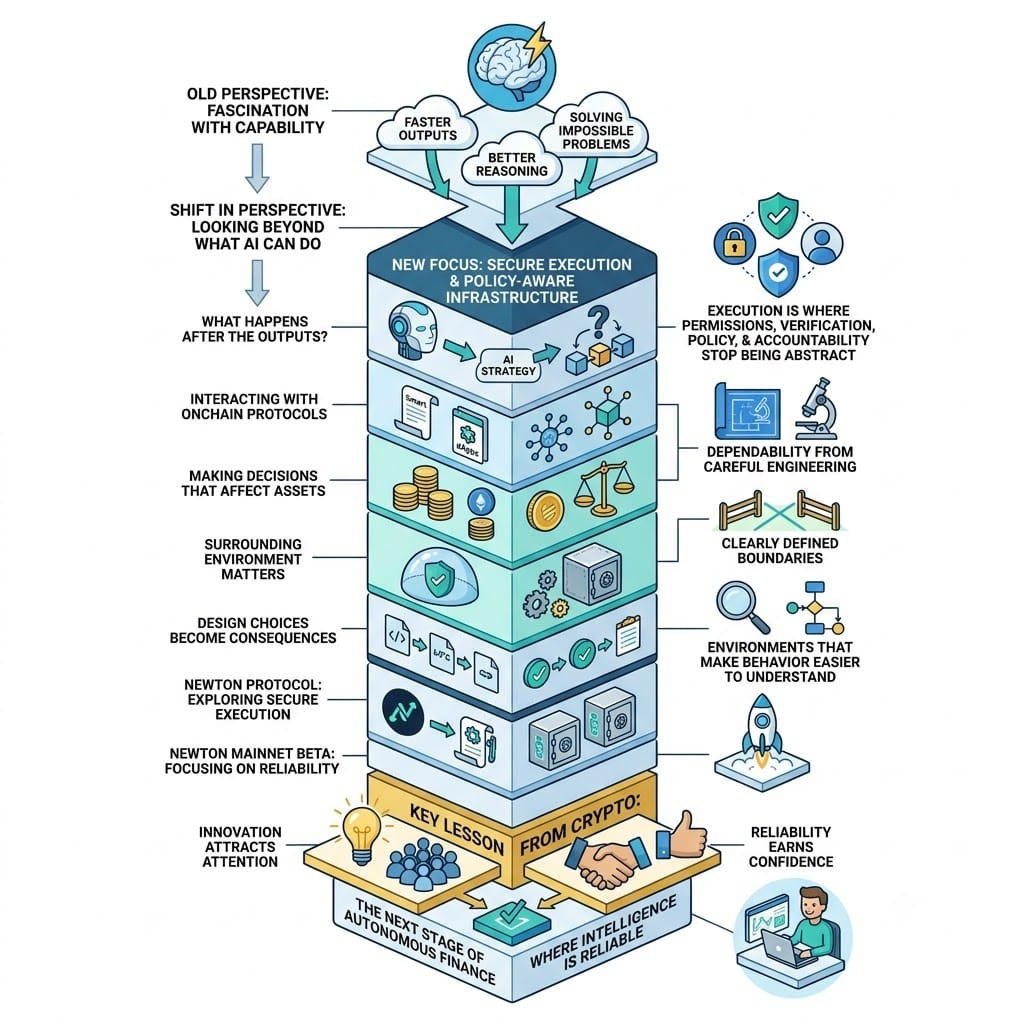
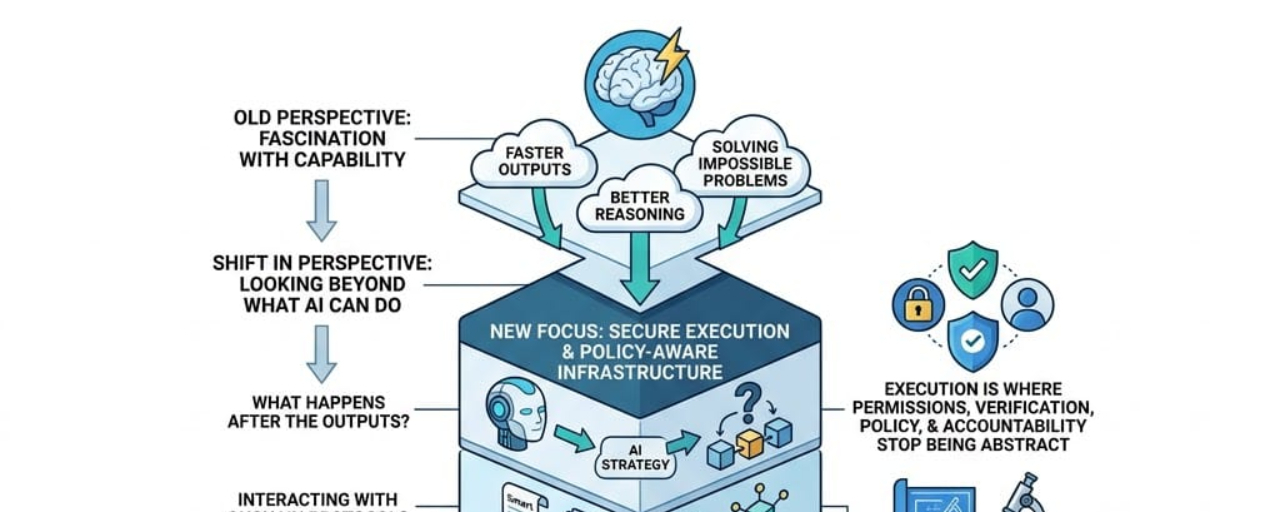
For a long time, I was fascinated by capability. Every new model seemed to solve problems that had looked impossible only months earlier. Better reasoning, better predictions, faster outputs—those improvements naturally became the center of every conversation.
Lately, though, I've found myself paying attention to something else.
Not what AI can produce.
What happens after those outputs begin interacting with systems that manage real value.
That feels like a completely different challenge.
Software can generate an impressive strategy in seconds. It can explain its reasoning with confidence. But once that same strategy begins executing automatically, interacting with onchain protocols, or making decisions that affect assets, intelligence becomes only one part of the equation.
The surrounding environment suddenly matters just as much.
I've spent enough time following blockchain infrastrcture to realize that systems aren't remembered only because they introduced new ideas. They're remembered because they behaved consistently when expectations collided with reality.
That's why I've become more interested in execution than prediction.
Execution is where design choices become consequences.
It's where permissions, verification, policy, and accountability stop being abstract concepts and start determining how software behaves when conditions are no longer ideal.
That shift in perspective is what led me to spend more time reading about @NewtonProtocol.
I wasn't looking for another project claiming AI would transform finance. There are already plenty of those conversations.
What interested me was a different question.
If autonomous systems eventually become part of everyday blockchain activity, what kind of infrastructure should exist before people feel comfortable relying on them?
I don't think the answer is simply "better AI."
Smarter models don't automatically create more dependable systems.
Dependability usually comes from careful enginering, clearly defined boundaries, and environments that make behavior easier to understand rather than harder to explain.
Newton Mainnet Beta appears to be exploring that direction by focusing on secure execution and policy-aware infrastructure for AI-driven strategies.
Whether that vision succeeds is something only adoption can answer.
Infrastructure always faces the same challenge.
It's easy to appreciate when everything works.
Its real value only becomes visible when something unexpected happens and the system still behaves the way people hoped it would.
That's probably the lesson crypto has taught me more than anything else.
Innovation attracts attention.
Reliability earns confidence.
As AI continues becoming more capable I suspct those two qualities will become increasingly difficult to separate.
Maybe the next stage of autonomous finance won't be defined by whichever system appears the smartest.
Maybe it'll be defined by whichever environment makes intelligence reliable enough that people no longer have to wonder what happens after the decision has already been made.
For me, that's the more interesting question—and it's the one that keeps bringing me back to projects like Newton.