
Most conversations in crypto revolve around faster blockchains, cheaper transactions, or the latest AI narrative.
But while everyone debates execution speed, I’ve been thinking about something that happens before execution.
Who decides whether an action should happen in the first place?
It sounds like a simple question, yet it may become one of the defining challenges of the next generation of decentralized applications.
That’s exactly why Newton Protocol caught my attention.
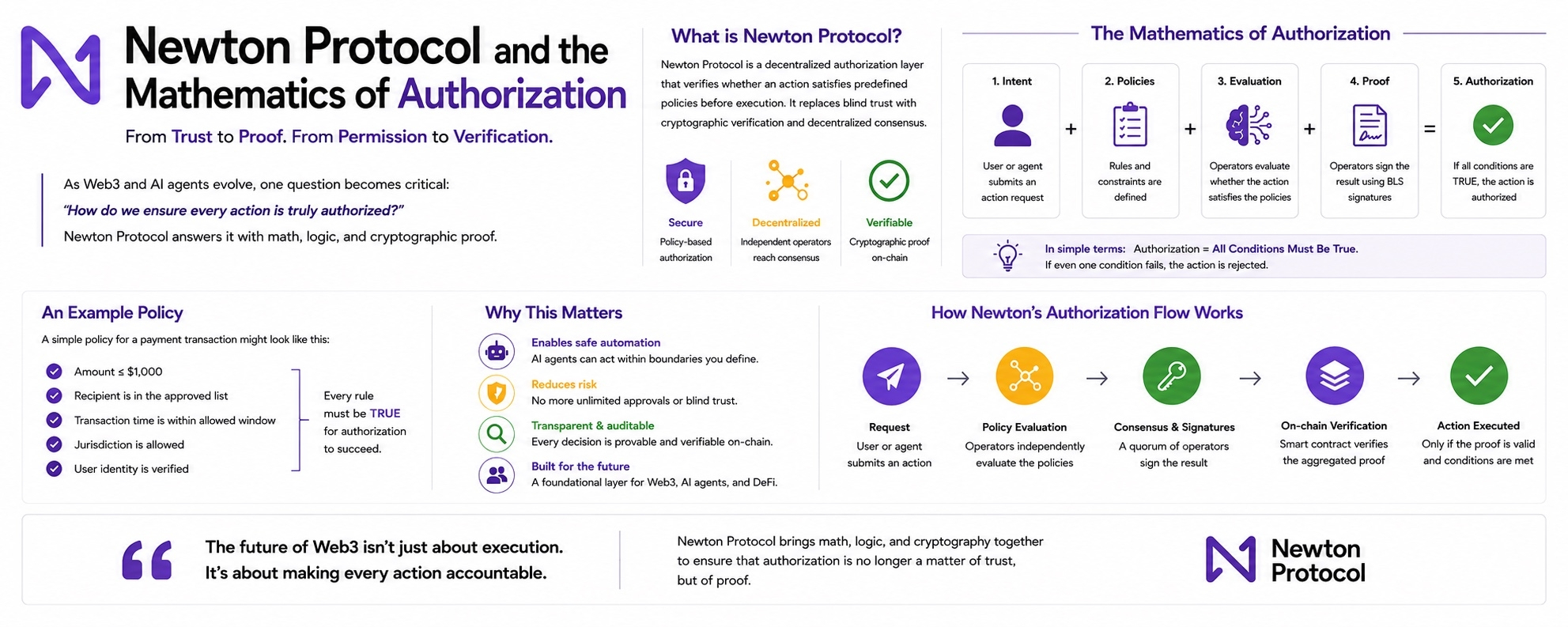
Rather than treating authorization as a background process, Newton approaches it as a mathematical system—one where permissions aren’t based on assumptions or blind trust, but on cryptographic verification and clearly defined rules.
We Already Verify Transactions. But Do We Verify Intent?
Every blockchain is excellent at proving that a transaction was signed correctly.
What it doesn’t always prove is whether that transaction actually matches the user’s intended rules.
Think about it.
If you accidentally authorize the wrong application, or an automated agent behaves unexpectedly, the blockchain faithfully executes the signed instruction. The network isn’t judging your intent—it simply validates the signature.
Newton introduces a different perspective.
Instead of asking only “Was this transaction signed?”, it also asks:
“Does this action satisfy every condition the user originally defined?”
That subtle difference completely changes how authorization can work.
Authorization Is Really a Mathematical Problem:
The word authorization often sounds administrative, as if it’s just another permission setting.
In reality, it’s a logic problem.
Imagine creating a simple policy:
Never spend more than a specific amount.
Only interact with approved addresses.
Execute transactions only within a defined time window.
Require additional verification for sensitive actions.
Each of these conditions has only two possible outcomes.
True.
Or false.
Newton evaluates those conditions before execution.
If every required condition evaluates to true, authorization succeeds.
If even one evaluates to false, the action doesn’t move forward.
No subjective interpretation.
No guessing.
Just deterministic evaluation based on predefined policies.
That’s where the mathematics begins—not with complicated formulas, but with logical consistency.
Trust Doesn’t Scale. Verification Does.
One lesson I’ve learned from following Web3 is that every time an ecosystem grows, trust becomes harder to manage.
More wallets.
More protocols.
More cross-chain interactions.
More autonomous software.
Eventually, trusting every application or AI agent individually becomes unrealistic.
Verification scales far better than trust.
Newton embraces this philosophy by allowing independent operators to evaluate authorization requests and produce cryptographic proofs that demonstrate whether a policy has been satisfied.
The important point isn’t that someone says an action is allowed.
It’s that the system can prove why it is allowed.
That’s a meaningful distinction.
AI Makes Authorization Even More Important:
AI agents are quickly moving from simple chat assistants to software capable of executing blockchain transactions.
Imagine asking an agent to rebalance your portfolio, manage liquidity positions, or claim rewards automatically.
Convenient?
Absolutely.
But convenience without boundaries can become risk.
Instead of giving an AI unrestricted wallet access, Newton enables users to define explicit operating limits.
The agent isn’t trusted simply because it’s intelligent.
It’s trusted because every action must remain inside mathematically defined boundaries.
That’s a much stronger security model than relying on good behavior alone.
Security Isn’t Just About Preventing Attacks:
Most discussions about blockchain security focus on protecting private keys.
That’s obviously important.
But there’s another layer that receives far less attention:
What happens after legitimate access has already been granted?
Authorization answers that question.
It determines not only who can act, but how, when, where, and under what conditions those actions remain valid.
As decentralized applications become increasingly automated, this layer could become just as important as consensus itself.
Why This Matters Beyond Newton Protocol?
Whether Newton becomes the dominant authorization layer isn’t the only interesting question.
The bigger idea is that programmable authorization may become foundational infrastructure for Web3.
We’re entering an era where wallets won’t just interact with people.
They’ll interact with autonomous agents, decentralized services, and applications making decisions at machine speed.
In that environment, signatures alone may no longer be enough.
Mathematically verifiable authorization provides an additional layer of confidence between user intent and transaction execution.
That’s a shift worth paying attention to.
Final Thoughts:
When people describe blockchain, they often say, “Don’t trust. Verify.”
Ironically, authorization has remained one of the few areas where users still rely heavily on trust.
Newton Protocol attempts to close that gap.
Instead of assuming software will always behave correctly, it asks software to prove that every action complies with rules established in advance.
That changes authorization from a permission system into a verification system.
To me, that’s the most interesting part of Newton Protocol.
Not because it’s flashy.
Not because it’s the latest narrative.
But because it addresses a problem that will only become more important as AI agents, automation, and decentralized applications continue to evolve.
Sometimes the biggest innovations aren’t about making blockchains faster.
They’re about making every decision made on those blockchains more accountable. $NEWT
@NewtonProtocol #Newt $NFP #NFP #NewToken #NFP/USDT $TAIKO