
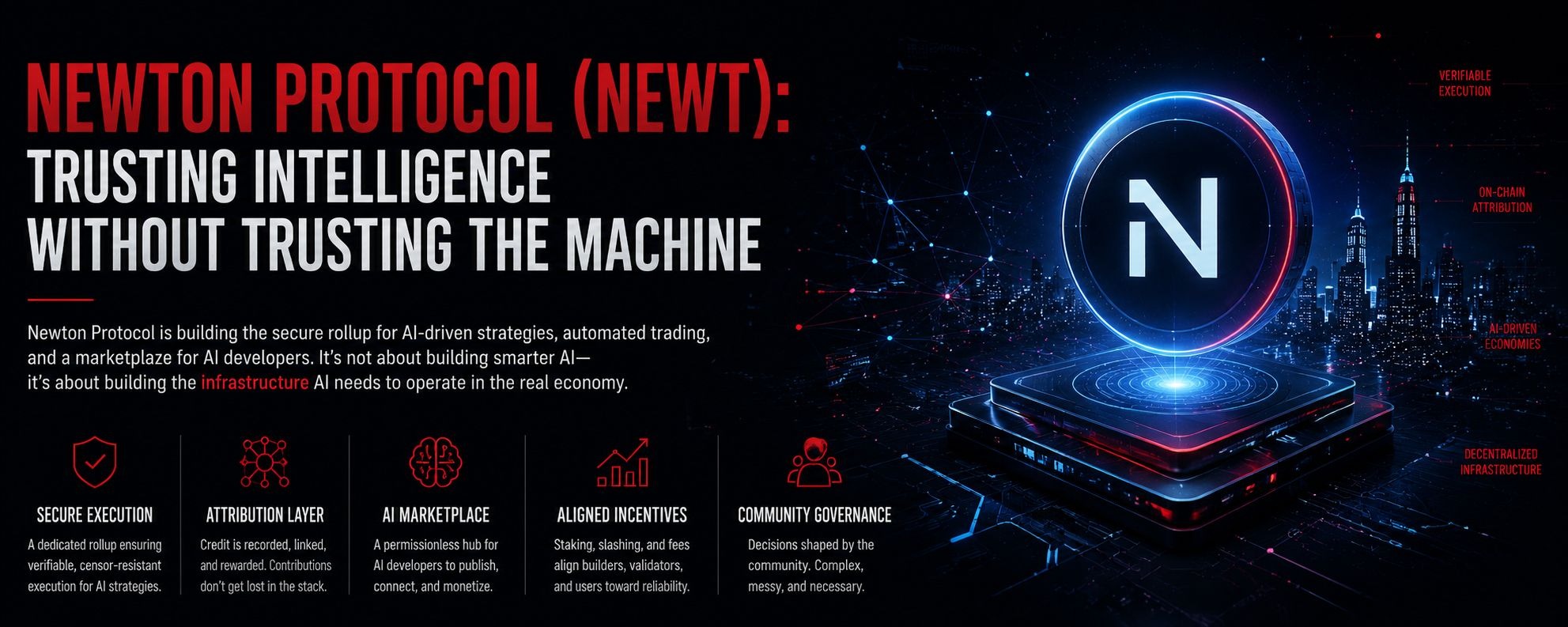
Newton Protocol (NEWT): Trusting Intelligence Without Trusting the Machine
I'll be honest. When I first came across Newton Protocol, I assumed it was another project trying to ride the momentum surrounding artificial intelligence. Crypto has become remarkably good at borrowing the language of whatever technology dominates the conversation, and AI has become the latest destination for that habit. It has reached a point where almost every new protocol promises autonomous agents, decentralized intelligence, or machine-driven economies without spending much time explaining why any of those things actually require a blockchain in the first place. My initial impression of Newton was shaped by that same skepticism.
The more I looked into it, however, the more I realized that the project isn't really trying to compete in the race to build smarter AI. Instead, it is asking a quieter question that most conversations about artificial intelligence tend to overlook. If software eventually begins making meaningful financial decisions on behalf of people—executing trades, managing capital, interacting with decentralized applications, and adapting continuously to changing markets—how do we build enough trust around those decisions without placing complete trust in the organization operating the software? That question feels much more fundamental than simply making AI faster or more capable.
Artificial intelligence has become extraordinarily good at producing answers, yet it remains surprisingly difficult to understand why those answers exist. Modern models often resemble black boxes. They recognize patterns at a scale impossible for humans, but the reasoning process itself is rarely transparent. That uncertainty becomes uncomfortable when the consequences extend beyond generating text and begin influencing financial systems where mistakes carry real costs. The issue is no longer whether machines can make decisions. Increasingly, they can. The issue is whether people can verify that those decisions happened within agreed boundaries.
This is where Newton Protocol starts to become interesting. Rather than treating blockchain as a marketing accessory attached to AI, it treats blockchain as a layer of institutional trust. The secure rollup at the center of the protocol is less about increasing transaction throughput and more about creating an environment where autonomous strategies can execute under transparent rules. Every interaction, every permission, and every state change becomes part of a verifiable record. That may sound technical on the surface, but beneath it lies a surprisingly human concern. Throughout history, societies have developed institutions because trust does not scale naturally. Courts, contracts, accounting standards, and financial regulations all exist because people eventually discovered that relying on individual promises was insufficient. Newton seems to ask whether autonomous intelligence now requires its own version of those institutions.
That idea shifts the conversation away from intelligence itself and toward coordination. The industry often assumes that the biggest challenge is creating increasingly capable models, but computation has become cheaper every year. Coordination remains stubbornly expensive. Building software is difficult, but aligning incentives among thousands of independent participants is significantly harder. Every decentralized network eventually discovers that technology solves only part of the problem. The rest depends on economics, governance, and social cooperation. Newton appears to recognize that autonomous AI cannot become a meaningful participant in digital economies unless those underlying coordination problems are addressed first.
One aspect that deserves more attention is attribution. Artificial intelligence is frequently presented as though it emerges from a single company or research laboratory, yet almost every meaningful advance depends upon countless invisible contributors. Researchers publish papers. Engineers optimize systems. Communities create datasets. Developers improve infrastructure. Users generate feedback that gradually shapes future models. Value emerges collectively while ownership often becomes centralized. That imbalance has quietly become one of the defining characteristics of the AI industry.
Newton hints at a different possibility. Instead of treating intelligence as something entirely owned by whoever deploys it, the protocol attempts to create infrastructure where contribution itself becomes economically visible. Attribution is no longer simply a matter of recognition. It becomes part of how value moves through the ecosystem. That distinction may seem subtle, yet it reflects a deeper philosophical shift. Ownership becomes less about possessing software and more about participating in an evolving network where improvements accumulate through many independent actors rather than one dominant institution.
Of course, elegant ideas rarely survive contact with reality unchanged. Like every decentralized protocol, Newton ultimately depends on incentives rather than idealism. Validators need rewards. Developers expect compensation. Participants respond to economic signals that are often more complicated than protocol designers anticipate. History has shown repeatedly that token economies can drift away from their intended purpose. Speculation frequently arrives before utility. Governance can become concentrated despite decentralized aspirations. Financial influence often grows faster than technical contribution. Newton is not immune to those pressures simply because it focuses on AI infrastructure. If anything, combining artificial intelligence with financial systems may amplify those tensions rather than reduce them.
Governance introduces another layer of uncertainty. Decentralization is frequently described as though it were a finished destination, but in practice it behaves more like an ongoing conversation that never truly reaches a final answer. Every governance model forces uncomfortable compromises. Greater participation usually slows decision-making. Faster coordination often concentrates authority. Technical expertise is never distributed equally, even within highly engaged communities. Newton will eventually face these same realities as the protocol evolves. The difficult question is not whether governance becomes complicated. It is whether the community can continue adapting without quietly recreating the centralized structures decentralized technology originally hoped to avoid.
Perhaps what I appreciate most about Newton Protocol is that it implicitly acknowledges something many projects prefer not to discuss. Intelligence alone is not enough. The internet did not transform society simply because computers became faster. It transformed society because new institutions emerged around communication, commerce, and information sharing. Artificial intelligence may follow a similar path. The future will depend not only on increasingly capable models but also on the invisible infrastructure governing how those models interact with people, capital, and one another. That infrastructure may prove less exciting than breakthrough algorithms, yet it could become far more important over time.
I still don't think Newton Protocol has all the answers, and perhaps expecting any protocol to solve such foundational questions would be unrealistic. Building systems where autonomous software manages value without introducing new concentrations of power is an extraordinarily difficult challenge. There will almost certainly be design flaws, governance disputes, incentive failures, and unexpected behaviors that only emerge through real-world use. That uncertainty is not necessarily a weakness. It is simply the cost of exploring problems that have never existed before.
In many ways, Newton matters less because of what it claims to achieve today and more because of the direction it encourages us to think. As artificial intelligence becomes increasingly woven into economic life, questions surrounding ownership, accountability, attribution, and trust will become harder to ignore. We are gradually moving toward a world where algorithms participate in markets alongside humans, and that transition demands more than better software. It demands new ways of coordinating trust itself.
Whether Newton ultimately succewds or fades into the long history of ambitious crypto experiments is impossible to know. What feels more certain is that the questions it raises will remain long after individual protocols come and go. The future of decentralized AI is unlikely to be defined solely by who builds the most powerful model or the fastest blockchain. It will be shaped by something far less visible: how societies decide who owns intelligence, who is responsible for its actions, and whether trust can emerge from transparent systems instead of centralized authority. Newton Protocol does not offer a final answer to those questions, but it reminds us that asking them carefully may be just as important as trying to solve them.
