
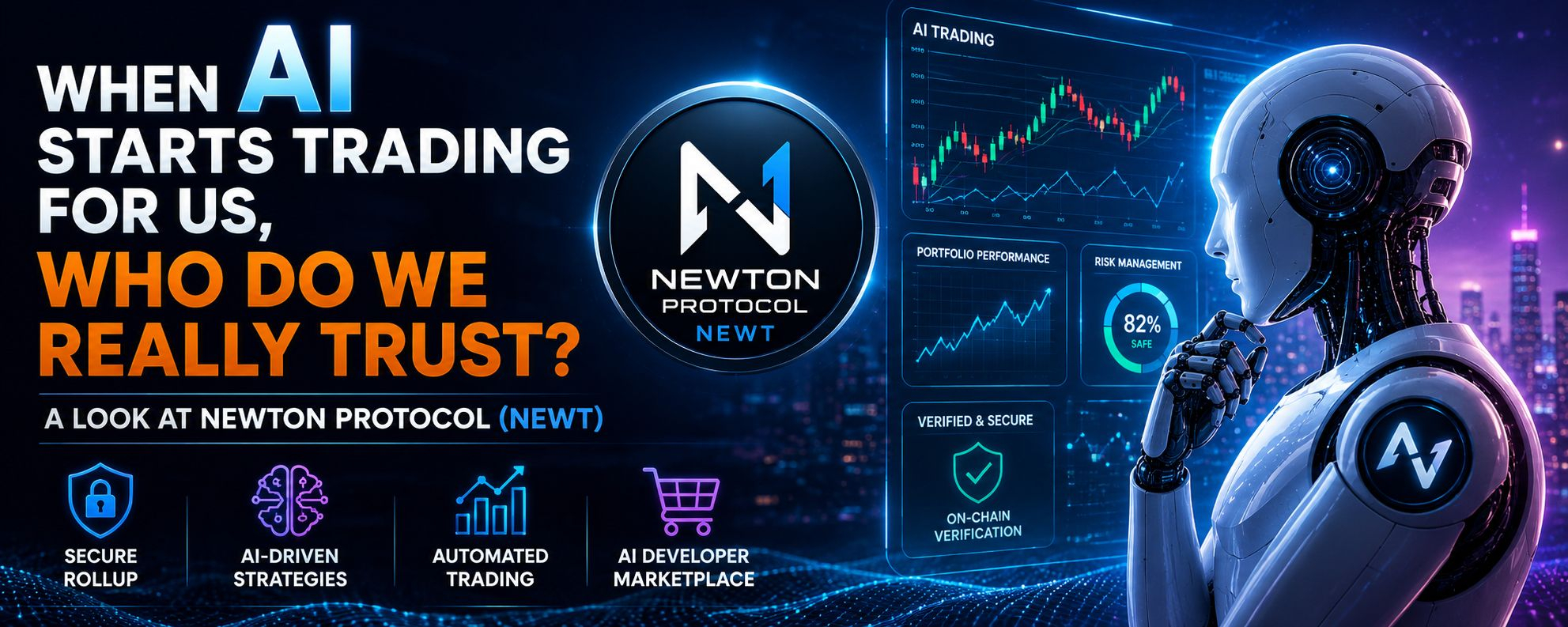
I have been following the intersection of artificial intelligence and blockchain for quite some time, and one thing has become increasingly clear to me: we are moving toward a future where machines will not just assist us in making decisions they will make decisions themselves.
That idea sounds exciting until I think about what it actually means.
Imagine giving an AI system permission to manage your investments, move funds between protocols, search for profitable opportunities, and execute transactions while you sleep. The technology already exists in various forms, and every month it becomes more sophisticated. But whenever I consider this future, I find myself asking a simple question: if an AI is handling my money, who is making sure it behaves exactly as intended?
This is the question that caught my attention when I first came across Newton Protocol (NEWT).
At first glance, it might seem like another blockchain project trying to capitalize on the growing excitement around artificial intelligence. The crypto industry has seen countless projects add "AI" to their branding in hopes of attracting attention. However, the more I researched Newton Protocol, the more I realized that it is trying to address a problem that many people are overlooking.
The challenge is not creating smarter AI.
The challenge is creating trustworthy AI.
Most conversations around AI powered trading focus on performance. People want to know whether an algorithm can outperform human traders, identify opportunities faster, or generate higher returns. While those questions are important, I believe they miss a more fundamental issue.
Trust.
Traditional trading bots often require users to hand over significant control. In some cases, users must trust a centralized platform. In others, they rely on software that operates behind the scenes with little transparency. As automation becomes more advanced, that trust requirement only grows larger.
Newton Protocol approaches the problem differently. Instead of asking users to blindly trust an AI system, it attempts to create a framework where every action can be verified and controlled through predefined rules.
What I find fascinating is the philosophy behind this approach.
The protocol seems to start with a realistic assumption: AI is powerful, but it is not perfect.
That may sound obvious, yet many technology discussions today are driven by the belief that artificial intelligence will eventually solve nearly every problem. I am not convinced things are that simple. AI systems can process enormous amounts of information, recognize patterns, and perform tasks at remarkable speed. But they can also make mistakes, misunderstand context, and react unpredictably when faced with situations they were never trained to handle.
Financial markets are particularly unforgiving environments.
Markets are influenced by economics, politics, human emotions, regulations, global events, and countless variables that constantly change. Even experienced traders with decades of expertise struggle to predict outcomes consistently. Why should we assume an AI system will always get it right?
This is where Newton Protocol becomes interesting to me.
Rather than giving AI unlimited authority, the protocol focuses on defining boundaries. Users can establish permissions and conditions that determine what an autonomous agent can and cannot do. The goal is not to eliminate human oversight entirely but to create a system where automation operates within clearly defined limits.
In many ways, I see this as one of the most practical approaches to integrating AI into decentralized finance.
Another aspect that stands out is Newton's vision of creating a marketplace for AI developers.
When I think about the potential impact of this idea, I am reminded of how smartphone app stores transformed software distribution. Before app stores, creating software was one challenge and distributing it was another. Once platforms emerged that connected developers directly with users, innovation accelerated dramatically.
Newton appears to be pursuing a similar concept for AI-powered blockchain automation.
Developers can build specialized agents designed for specific tasks, whether that involves portfolio management, yield optimization, automated trading, treasury operations, or other financial activities. Users can then access these services through a decentralized ecosystem rather than relying on a small number of dominant platforms.
If successful, this model could democratize access to sophisticated financial tools.
For years, advanced algorithmic strategies have largely been available to hedge funds, large institutions, and professional trading firms with significant resources. A decentralized marketplace could potentially allow talented developers from anywhere in the world to contribute innovative solutions while enabling everyday users to benefit from them.
Of course, this vision also raises difficult questions.
What happens if an AI agent makes a poor decision?
Who bears responsibility when an automated strategy fails?
How do users evaluate the quality of competing AI systems?
These are not purely technical questions. They are economic, ethical, and social questions as well.
One of the reasons I find Newton Protocol worth watching is that it acknowledges these complexities rather than pretending they do not exist. The project incorporates mechanisms intended to encourage accountability among participants through incentives and verification processes.
Still, I think it is important to remain realistic.
No technology can completely eliminate risk.
The blockchain industry has a long history of ambitious projects promising to revolutionize finance, only to discover that adoption is far more difficult than innovation. Building impressive technology is one challenge. Convincing people to trust and use that technology is another.
Ultimately, Newton Protocol's future will depend not only on its architecture but also on its ability to attract developers, users, operators, and institutions who believe in its vision.
As I step back and look at the bigger picture, I think Newton represents something larger than a single cryptocurrency project.
It reflects a broader shift taking place across society.
For decades, technology has been helping humans make decisions. Now we are entering an era where technology is increasingly making decisions on behalf of humans.
That transition changes everything.
The conversation is no longer just about faster computers or smarter algorithms. It is about governance, accountability, and trust. It is about determining the rules that intelligent systems must follow when they interact with assets, markets, and people.
In my view, the most important question facing the future of AI and finance is not whether machines can make decisions. They already can.
The real question is whether we can create systems that ensure those decisions remain transparent, secure, and aligned with human intentions.
Newton Protocol is one attempt to answer that question.
Whether it ultimately succeeds remains uncertain. The blockchain industry evolves quickly, competition is intense, and technological trends can shift overnight. But the problem Newton is trying to solve is real, and I suspect it will become even more important in the years ahead.
As artificial intelligence gains greater autonomy, trust may become the most valuable infrastructure of all.
And perhaps that is the biggest lesson I took away while researching Newton Protocol. The future of finance may not belong entirely to humans or entirely to machines. Instead, it may belong to systems that allow both to work together where intelligence is automated, but accountability remains firmly in place.
@NewtonProtocol #Newt $NEWT #NEWT
