
I have been around the crypto market long enough to recognize a familiar pattern. Every cycle seems to produce one idea that suddenly becomes impossible to ignore. At one point it was decentralized finance. Then it was NFTs. After that came Layer-2 scaling, modular blockchains, and now almost every conversation somehow finds its way back to artificial intelligence.
The names change, the narratives evolve, but one thing rarely does. The industry has an incredible ability to make every new direction sound like the missing piece that blockchain has always needed.
That is probably why I have become more interested in the questions behind the technology than the technology itself.
When I first started exploring blockchain years ago, transparency felt revolutionary. Anyone could inspect transactions. Anyone could verify balances. No central institution was required to convince people that the ledger was accurate because everyone could see it for themselves. Compared to traditional finance, where information often disappeared behind closed systems, public blockchains felt refreshingly honest.
Over time, though, that same feature began to look less like an advantage and more like a compromise.
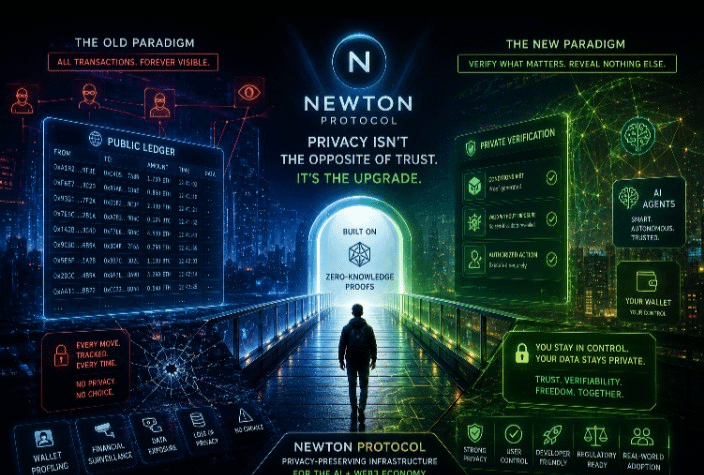
The longer I stayed in crypto, the more I realized that transparency has a cost. Every wallet gradually becomes a public diary. Every transaction contributes another page to a financial history that never disappears. Even if wallet addresses are technically pseudonymous, blockchain analytics have become increasingly effective at connecting activity across multiple applications.
I started wondering whether we had accepted something that very few people would tolerate anywhere else.
Outside crypto, nobody expects their bank account to be searchable by strangers. Companies do not publish every payment they make. Investors do not normally reveal every portfolio adjustment in real time. Privacy has always been treated as a practical necessity rather than something suspicious.
Yet blockchain largely flipped that assumption.
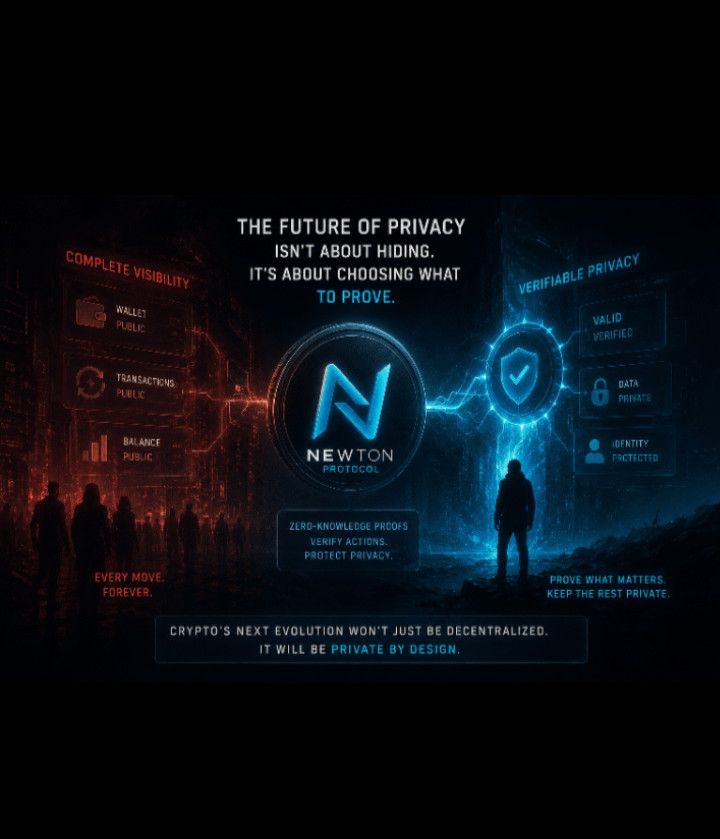
Some people argue that this is exactly how decentralized systems should work. Complete transparency creates trust, prevents manipulation, and allows anyone to verify the network independently. I understand that argument because I believed it myself for a long time.
Now I am less certain.
As blockchain tries to move beyond speculation and into mainstream applications, I increasingly wonder whether permanent public visibility is actually sustainable. Trust matters, but so does confidentiality. The real world depends on both.
That is one reason Newton Protocol caught my attention.
Not because I think it has already solved the problem, but because it appears to be asking a more interesting question than many AI crypto projects currently are.
Instead of treating artificial intelligence as another feature to attach to blockchain, Newton Protocol focuses on something that feels more fundamental. If AI agents are eventually going to interact with wallets, execute transactions, or manage digital assets, how do users remain in control without exposing every detail of those interactions?
Its answer revolves around zero-knowledge proofs and programmable authorization.
I find that concept more compelling than the growing number of projects simply promising "AI-powered blockchain" without explaining what that actually means.
The basic idea is surprisingly reasonable. Rather than revealing every piece of information, a system can prove that specific conditions have been satisfied without exposing everything underneath. Verification remains possible, while unnecessary disclosure is avoided.
On paper, that sounds like a healthier balance.
The keyword, however, is "on paper."
Crypto has taught me to separate elegant architecture from practical success.
I have watched protocols introduce remarkable cryptographic breakthroughs that hardly anyone ended up using. I have seen technically brilliant projects struggle because they asked developers to learn entirely new frameworks or required users to tolerate just enough friction that adoption quietly stalled.
The market has never rewarded good ideas simply because they were good.
It rewards software that people continue using after the excitement disappears.
That is why I find myself asking different questions whenever I read about projects like Newton Protocol.
Will developers actually build around this model if implementation becomes more complicated than existing alternatives?
Will users notice meaningful improvements, or will privacy simply become another technical feature that sounds valuable but rarely influences behavior?
Can zero-knowledge systems remain efficient enough to support large-scale applications without introducing delays, higher costs, or unnecessary complexity?
These questions matter much more than impressive technical diagrams.
I also think the industry occasionally overestimates how much ordinary users think about privacy.
Crypto enthusiasts often describe privacy as one of blockchain's greatest missing pieces. At the same time, millions of people voluntarily connect public wallets to social media accounts, share transaction screenshots online, and interact with entirely transparent applications every day.
That contradiction is difficult to ignore.
Perhaps users genuinely care about privacy but have never been given accessible tools.
Or perhaps convenience consistently wins until privacy becomes a personal problem.
Technology history offers examples supporting both possibilities.
That uncertainty is exactly why I am cautious about making confident predictions.
Newton Protocol is entering a market where privacy has been discussed for years but adopted unevenly. It is also arriving at a time when artificial intelligence is beginning to automate more online decisions, making verifiable authorization more relevant than it may have seemed only a few years ago.
Those trends could eventually reinforce one another.
They could also develop independently, leaving protocols built around that intersection searching for stronger product-market fit than early supporters expected.
I honestly do not know which outcome is more likely.
What I do know is that blockchain has reached a point where simply building faster networks is no longer enough. The next generation of infrastructure will probably be judged less by transaction speed and more by whether it can support everyday economic activity without forcing users to sacrifice either security or privacy.
Newton Protocol deserves attention because it is attempting to address that tension instead of pretending it does not exist.
Still, I have been in crypto long enough to know that thoughtful ideas are only the beginning. Real adoption has a way of exposing weaknesses that architecture diagrams never reveal. Complexity, developer incentives, regulatory expectations, and ordinary user behavior often decide the fate of protocols long before their technical ambitions are fully realized.
That is why I am choosing to watch Newton Protocol with curiosity rather than conviction.
Its approach to privacy feels more nuanced than many blockchain projects I have followed, and its use of zero-knowledge proofs offers an interesting alternative to the industry's long-standing assumption that everything must always be visible. But the real question has never been whether a protocol can build an elegant system.
The real question is whether people will continue choosing that system years from now, after the headlines fade, the excitement cools, and only genuine utility remains.