
To be honest, I used to think settlement was the main thing crypto needed to fix.
Before.
Now I think the real gap comes earlier.
Crypto is good at moving value. It is also good at proving what happened. A wallet signs. A transaction reaches a contract. The chain settles it. Then everyone can inspect the record.
From my analysis, that flow is useful, but it misses one question.
Should this transaction be allowed?
A signature can prove ownership, bit it cannot always prove permission.
A vault may have a risk limit. A stablecoin app may need transfer rules. An AI agent may have a spending cap. A fund may have an internal mandate.
If the check comes after settlement, it is already late.
And this is the point where Newton Mainnet Beta caught my attention.
I am not reading it as another general DeFi update.
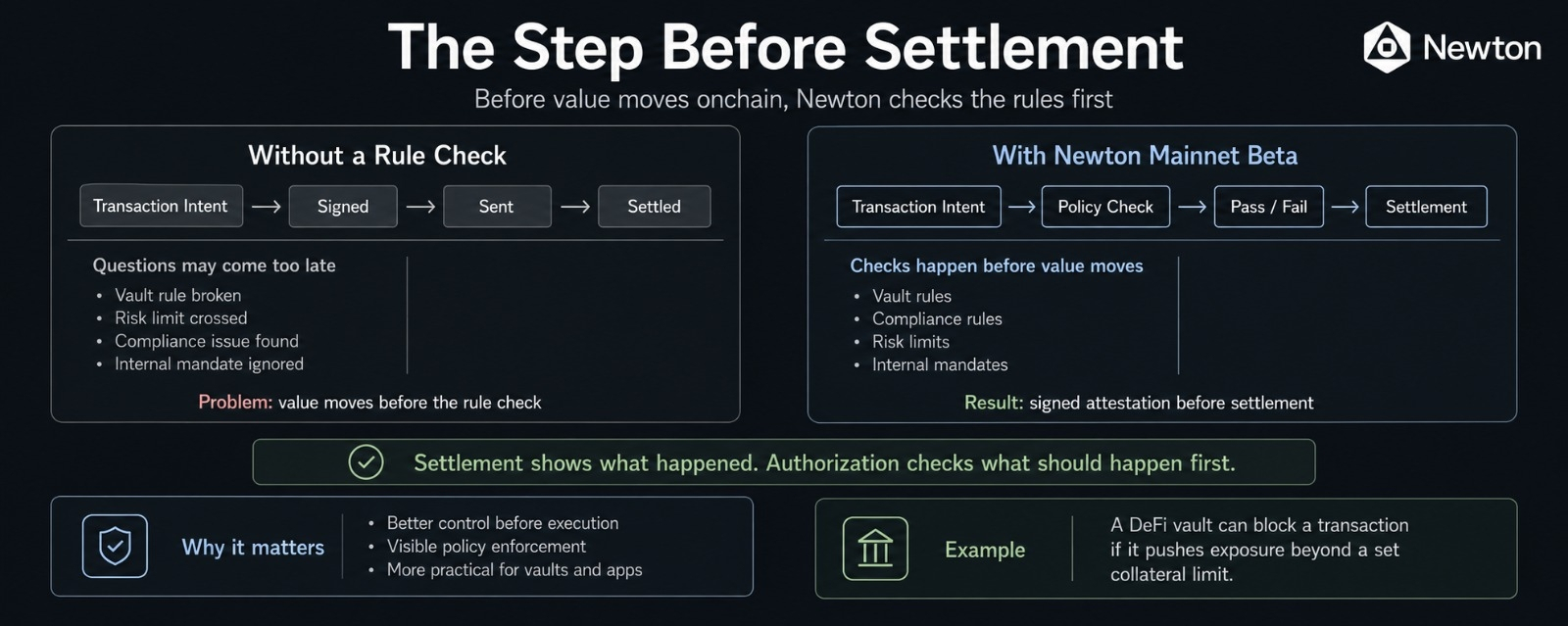
I am reading it as a check placed between intent and settlement.
@NewtonProtocol ’s Mainnet Beta post says VaultKit makes vault rules enforceable onchain. It also says Newton checks rules before a transaction settles, then returns a signed pass or fail attestation onchain.
Newton’s own blog says Newton Protocol is live on Base and Ethereum, enforcing rules onchain.
The mechanism matters more than the slogan to me.
A transaction starts as an intent. Newton evaluates that intent against a policy. The policy can include spend limits, sanctions screening, fraud checks, compliance rules, or risk data.
Newton docs describe this as onchain transaction authorization, not just reporting after the fact.
RedStone’s June 25, 2026 blog gives a useful example. RedStone provides price and market data. Credora provides risk ratings. Newton can use those inputs inside vault policy checks. Their stated first use case is transaction-time policy gating in vaults, where a position may be blocked or liquidated if data crosses a set threshold.
A real problem appears when a DeFi vault manages user funds across different assets.
The vault may have a rule that says no single collateral type can cross a set exposure limit. That rule protects users from too much concentration risk. But if the rule sits in a dashboard, a spreadsheet, or a curator’s manual process, the transaction may still settle before anyone reacts.
That is the weak point.
With a pre-settlement policy check, the vault can test the action before value moves. If the new position breaks the exposure rule, the transaction should fail. If it stays inside the rule, it can pass with a signed attestation.
This is not only cleaner.
Safer.
It turns a human rule into an onchain rule.
This is the practical idea I like. Newton is not only asking whether a transaction can execute. It asks whether the transaction should execute under active rules.
That small difference matters for vaults, stablecoin apps, funds, and automated agents.
I still see one main risk.
Adoption.
A strong authorization layer only matters if real vaults, apps, and builders use it. This is where readers should stay practical.
I would not judge Newton by campaign posts, or $NEWT by noise.
Signals.
I would watch Newton Explorer records.
I would look for live vault usage, policy IDs, signed attestations, failed checks, and real integrations.
A policy layer becomes useful when it changes outcomes, not when it sounds smart.
Newton’s own blog says curated DeFi vault TVL has grown more than 350% in the past year. I treat that as project-provided context, not independent proof.
Still, it explains why vault controls are part of the conversation.
I think readers should ask simple questions.
Are policies visible? Are records verifiable? Are vaults using them? Are bad actions blocked?
These are better signals than loud posts. At least from my observation...
Look, my view is simple but practical. Settlement solved one part of crypto. Authorization may be the missing part before serious use grows.
Newton Mainnet Beta is interesting to me because it focuses on that small moment before money moves.
Before the click. Before the trade. Before the loss.
Would you trust onchain finance more if every important transaction had a rule check before settlement?