I'm not entirely comfortable with how quickly the conversation has shifted.
A few years ago, the question was whether AI could produce useful ideas. Now the assumption seems to be that, of course it can, so the next step is letting it act. I understand why people are excited by that progression. I just don't know if we've earned the confidence that often comes with it.
Watching AI and crypto evolve separately was oddly simpler.
One was mostly about improving judgment. The other was mostly about reducing the amount of trust required between strangers. They were solving different problems, even if they occasionally borrowed each other's language.
Now they're beginning to overlap, and the overlap is where things get uncomfortable.
The interesting question doesn't seem to be whether an agent can generate a strategy anymore. It seems to be whether that agent should be trusted to execute it repeatedly, under changing conditions, with real value at stake.
Execution has a way of exposing everything that looked convincing in a demo.
Markets don't care whether an idea came from a person or a model. They care whether the system behaves predictably when conditions stop being predictable. That's why I keep thinking the invisible layers deserve more attention than the intelligence itself.
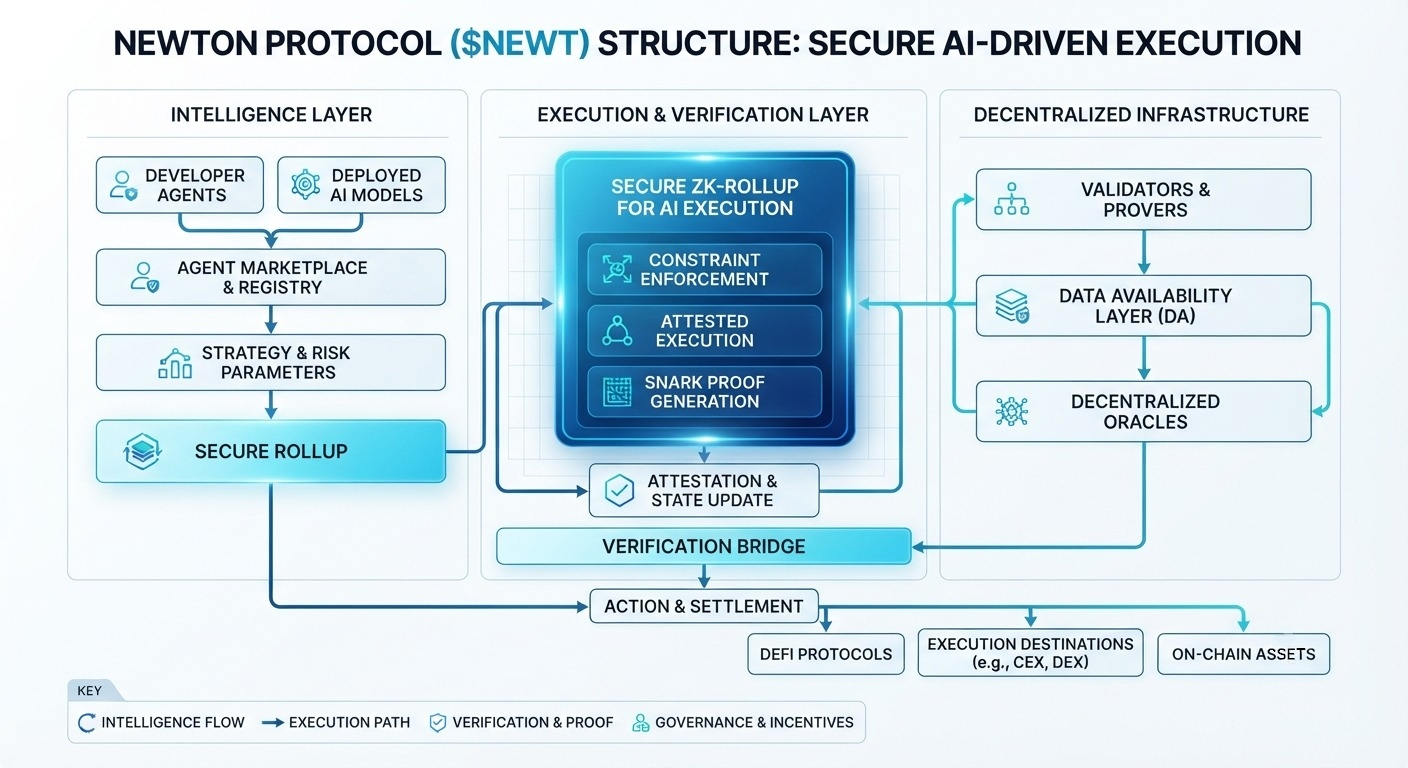
I stumbled across Newton Protocol while thinking about exactly that. Not because I was looking for another AI project, but because it appears to focus on the space between a decision and an action. A secure rollup for AI-driven execution feels like an acknowledgment that autonomy creates a different category of risk than simple automation. The marketplace angle is interesting too. If developers can deploy, share, and monetize intelligent agents, eventually people will rely on code they didn't write and strategies they didn't design.
That changes the trust equation.
Performance alone probably won't be enough. Neither will branding. At some point, people will want to know how actions are constrained, how they're verified, and what happens when something goes wrong without assuming perfect behavior from either humans or machines.
Maybe that's where this is heading. Maybe it isn't.
I've been around long enough to know that infrastructure usually proves its value only after optimism fades. If autonomous finance becomes a real thing, I suspect the lasting questions won't be about which agents thought the smartest, but about which systems people were still willing to trust when those thoughts started moving money.