I once watched a security guard at an office building stop someone who had the right ID card but was carrying the wrong delivery. The badge opened the door, but it didn't answer the more important question: Should this person be doing this, right now, under these conditions? That moment stayed with me because access and authorization are often mistaken for the same thing.
We see a similar distinction in everyday life. A driver's license allows someone to drive, but it doesn't automatically permit them to enter a restricted construction site, operate heavy machinery, or access a private facility. Every environment applies its own rules, even when identity has already been established. The real challenge isn't proving who someone is it's deciding what they're allowed to do based on context.
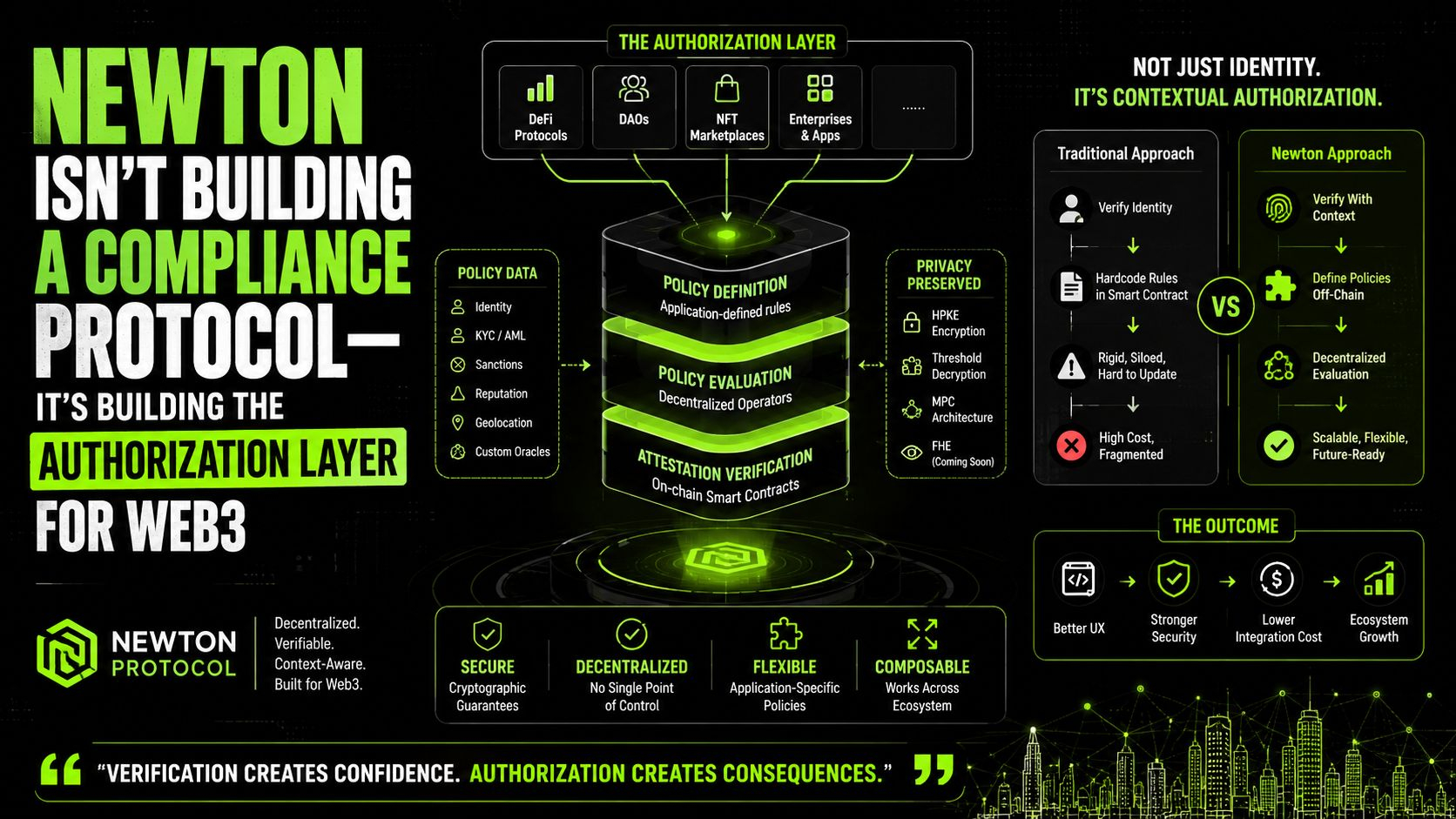
That is why I think Newton Protocol is often described too narrowly. Many people see references to KYC, compliance, or policy enforcement and assume it's building another compliance framework. But after reading its architecture, a different picture emerges. Newton isn't primarily trying to make compliance more efficient. It's attempting to separate authorization from application logic and turn it into shared infrastructure.
The more interesting question isn't whether a protocol can verify an identity. It's this: Who decides what gets authorized, and how can everyone trust that decision without rebuilding the same logic over and over again?
Newton's design reflects that shift. Applications define their own policies, decentralized operators evaluate those policies using external data when needed, and smart contracts verify cryptographic attestations instead of embedding every authorization rule directly into code. That changes where complexity lives. Rather than every protocol reinventing permission systems, authorization becomes a reusable network service.
Imagine a growing city where every building hires its own security team, writes its own rulebook, and verifies every visitor independently. The city functions, but coordination becomes expensive and inconsistent. Now imagine shared infrastructure that verifies permissions while allowing each building to define its own rules. The buildings don't lose autonomy they stop duplicating the same work.
Of course, this introduces new tradeoffs. Decentralizing policy execution doesn't decentralize policy creation. Builders still decide the rules their applications follow, and operator incentives, data quality, and governance remain critical to maintaining trust. A decentralized verifier cannot compensate for poorly designed policies. Systems rarely become centralized because someone intends them to; they often do so because coordination quietly concentrates where decisions are made.
One idea kept resurfacing as I studied Newton's architecture:
Verification creates confidence. Authorization creates consequences.
The distinction matters because the next generation of decentralized applications may depend less on proving facts and more on coordinating decisions across many independent actors.
If protocols like Newton succeed, their legacy won't be that they made compliance easier. It will be that they transformed authorization from isolated application code into shared public infrastructure. Like roads beneath a city, the strongest infrastructure is rarely the most visible. Its value is measured by how many different journeys it quietly makes possible.