The first thing I felt wasn't excitement. It was hesitation.Not because there was anything obviously wrong with Newton Protocol. I've simply reached the point where every new infrastructure project reminds me of several older ones that sounded equally convincing at the beginning. Some disappeared quietly. A few survived. Most ended up becoming something different from what anyone originally imagined.
That history is difficult to ignore.
So instead of asking whether Newton Protocol makes sense I found myself asking whether I'm even asking the right questions anymore.
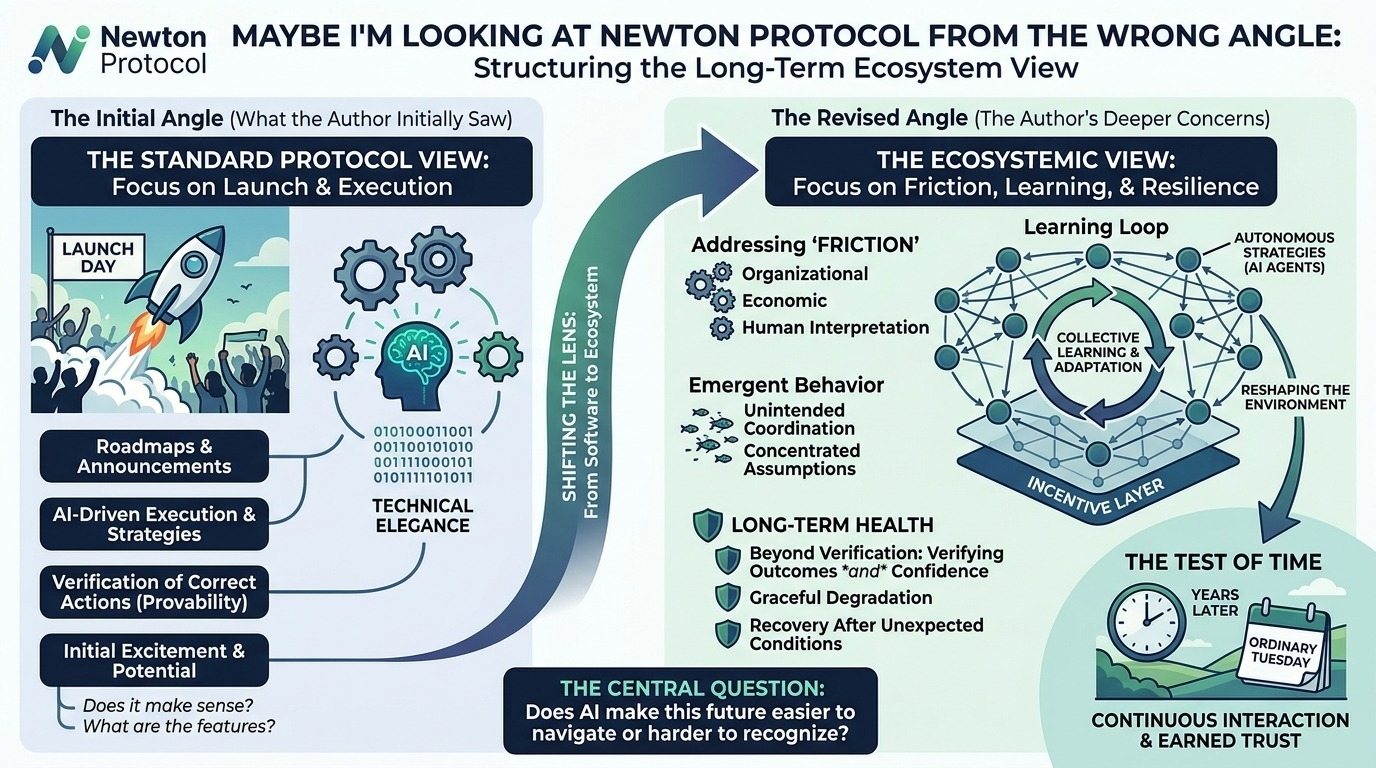
The obvious conversation revolves around AI making decisions, executing strategies interacting with decentralized systems. Fine. That's interesting. But after sitting with it for a while I realized I wasn't actually thinking about intelligence.
I was thinking about friction.
Real systems accumulate it in strange ways.
Not technical friction, necessarily. Organizational friction. Economic friction. Human friction. The sort that appears after thousands of participants begin interpreting the same incentives through completely different lenses.
That's usually where elegant designs become messy.
Crypto has always been unusually good at creating environments that nobody fully controls. That's part of its appeal. It's also part of its problem. Once enough independent actors begin interacting with a protocol the protocol slowly stops behaving like an isolated piece of software and starts behaving more like an ecosystem.
Ecosystems don't follow roadmaps.
They adapt.
Sometimes in healthy ways.
Sometimes not.
That's why I can't quite think about AI-driven execution without wondering what happens after everyone else starts doing the same thing. One autonomous strategy is interesting. Thousands responding to each other in real time feels like an entirely different category of problem.
Not because they'll all fail.
Because they'll all learn.
And learning systems have an odd tendency to reshape the environments that taught them in the first place.
That loop keeps pulling my attention back.
People often talk about verification as though it's enough. If every action is provable, if execution is correct, then surely the infrastructure is dependable.Maybe.But dependable for whom?Dependable under what conditions?
Correct execution doesn't tell us whether the incentives remain healthy six months later. It doesn't explain what happens when optimization begins concentrating around the same assumptions. It doesn't guarantee that autonomous participants won't collectively create behavior that nobody intended, even if every individual action follows the rules perfectly.
I've watched enough markets to know that unintended coordination isn't some exotic edge case.It's almost routine.
That probably explains why the quieter parts of infrastructure seem more important to me now than the visible ones. Recovery after unexpected conditions. The ability to verify not only outcomes but confidence in those outcomes. Systems that degrade gracefully instead of pretending degradation isn't possible.
None of those ideas are particularly exciting.
They're also the first things I look for.
Maybe that's what years in crypto slowly do to you. You stop searching for the cleverest design and start wondering how ordinary Tuesday afternoon looks after the protocol has been running for years. No headlines. No announcements. Just continuous interaction with participants who have discovered uses nobody predicted.Newton Protocol keeps bringing me back to that image.Not launch day.Not peak attention.
Just the long stretch afterward when infrastructure quietly earns or loses the right to be trusted.
I'm still not certain whether AI makes that future easier to navigate or simply more difficult to recognize while it's unfolding.Lately those feel like very different questions.