

I used to believe that once something was recorded on-chain, it could be trusted by default. It felt logical. Transparent ledger, immutable records, verifiable transactions. That should be enough.
But the more I spent time actually observing how transactions behave in real scenarios, the more I realized something important is missing.
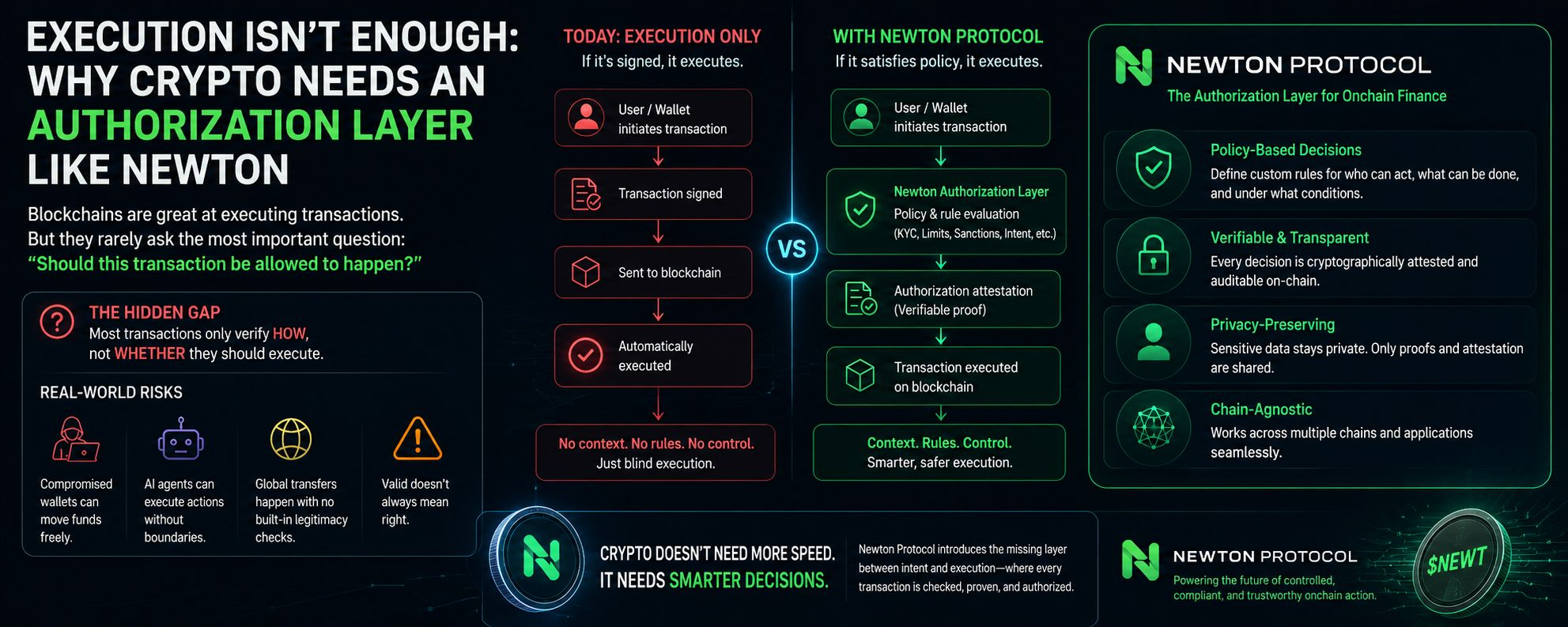
Blockchains are extremely good at executing instructions. If a transaction is valid and properly signed, it will go through exactly as written. There’s no hesitation, no interpretation, no judgment. The system does what it’s told to do.
At first, that sounds like a strength. But over time, it starts to feel like a limitation.
Because nowhere in that process is there a question being asked about whether the transaction should happen in the first place.
There is no built-in awareness of context. No evaluation of intent. No restriction based on behavior. The system confirms that something can be executed, but not whether it makes sense to execute it.
This gap becomes much clearer when you step outside theory and look at actual usage.
If a wallet is compromised, the attacker doesn’t need to bypass complex checks. As long as they can sign, they can act freely. The system will accept those transactions as completely valid.
If an AI agent is given the ability to interact with protocols, it can execute complex actions without any real boundaries unless those limits are manually engineered somewhere else.
If funds are sent across borders, they arrive instantly, but there’s no native way to prove that the transaction followed any rules or met any conditions beyond basic validity.
Everything works exactly as designed, but something still feels incomplete.
What’s missing isn’t speed or efficiency. It’s the ability to introduce logic before execution happens.
That’s where the idea behind Newton Protocol started to make more sense to me.
Instead of focusing on how transactions are executed, it focuses on whether they should be allowed to execute at all.
It introduces a layer where rules can be defined, evaluated, and enforced before a transaction is finalized. These rules aren’t informal or external. They are part of the system and can be verified.
So instead of a model where a signed transaction automatically goes through, the flow becomes more deliberate. A transaction must satisfy certain conditions before it is accepted.
That small shift changes how you think about everything.
It creates a way to control behavior without relying on centralized oversight. It allows systems, users, and even AI agents to operate within defined boundaries that are transparent and enforceable.
It also introduces something that crypto has largely avoided so far, which is structured decision-making at the protocol level.
The more I think about it, the more this feels like a natural next step.
We already have systems that guarantee execution. We already have systems that provide liquidity and coordination. But we don’t really have systems that evaluate decisions in a consistent and verifiable way.
Newton Protocol is essentially trying to fill that gap.
Not by slowing things down or restricting access in a traditional sense, but by making the logic behind actions programmable and provable.
And that changes the conversation.
Instead of asking whether a transaction is valid, we start asking whether it is appropriate, allowed, and aligned with defined rules.
That’s a very different model from what most people associate with crypto today.
And personally, it made me rethink something I used to take for granted.
Maybe trust in crypto isn’t just about removing intermediaries.
Maybe it’s about building systems that can justify actions, not just execute them.