 Look, I've been covering technology long enough to know how these stories usually begin. Someone identifies a genuine problem. They build another protocol, another network, another token, and another set of promises around it. Investors hear words like "infrastructure" and "AI," developers hear "permissionless," and suddenly everyone starts talking as if the future has already arrived.
I've seen this movie before.
Sometimes the technology changes the industry. Most of the time, the industry quietly ignores it.
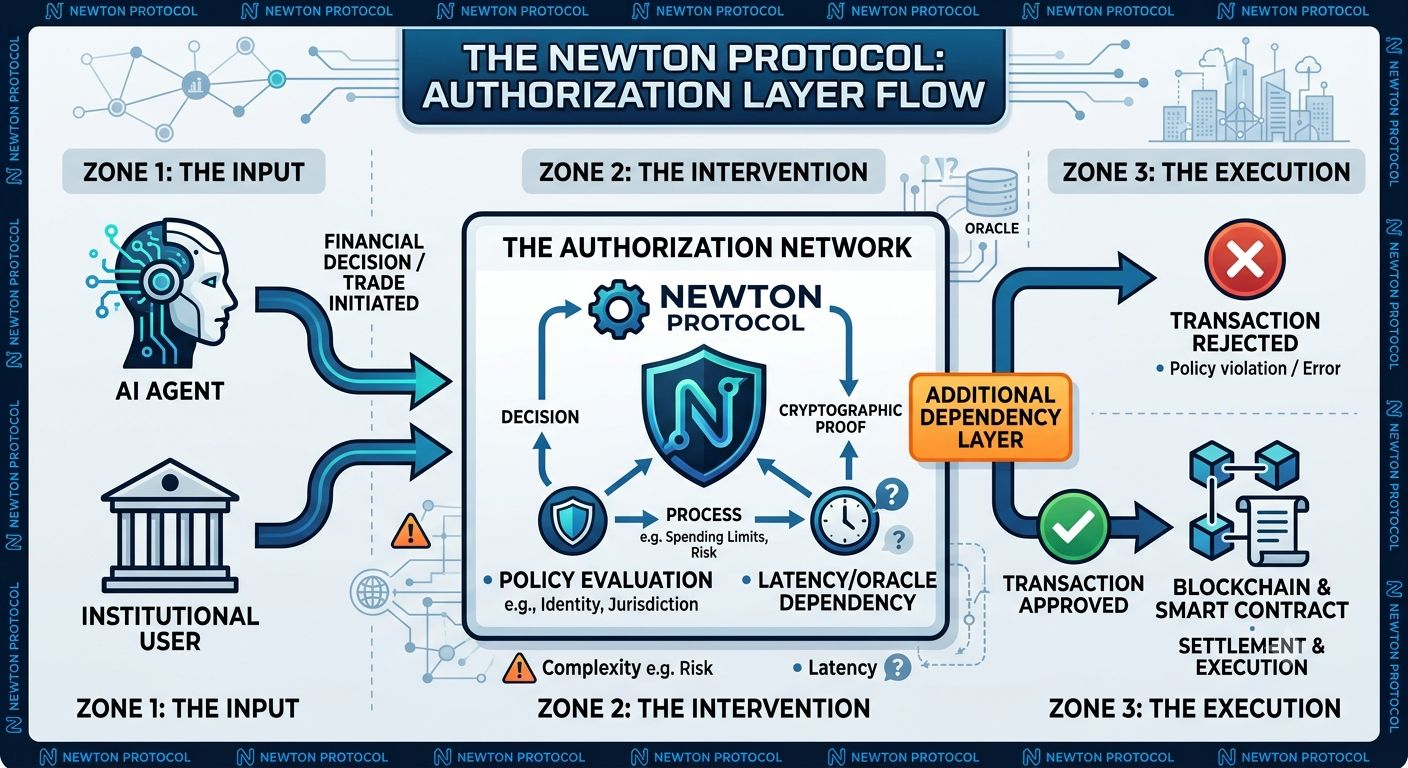
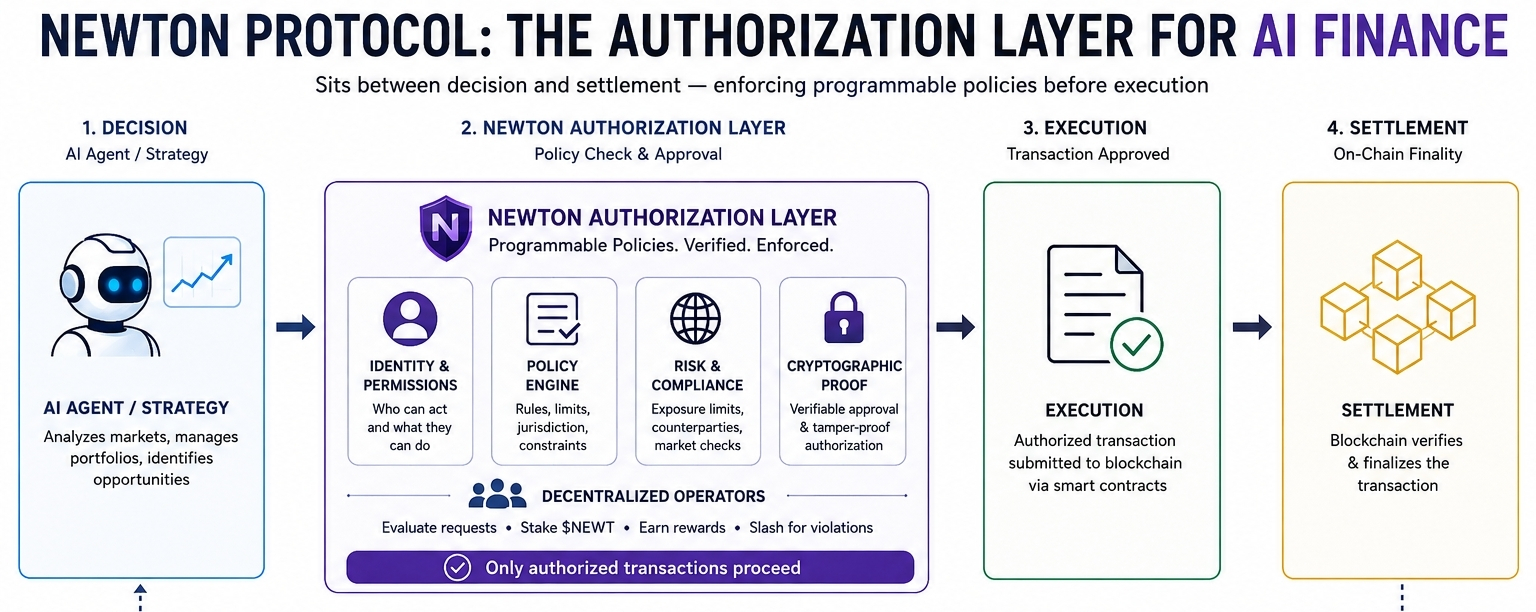
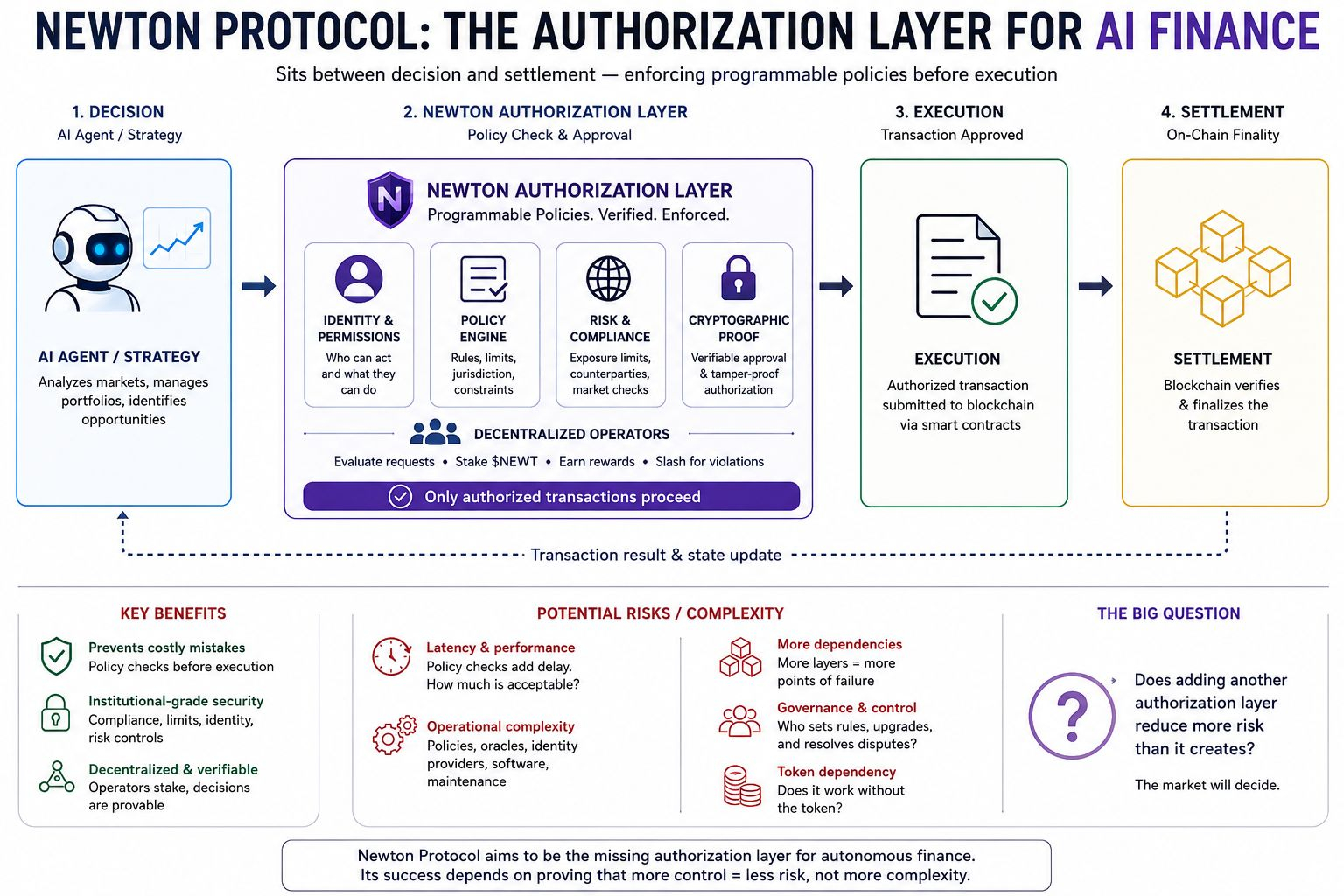
Newton Protocol arrives with a fairly straightforward argument. As artificial intelligence becomes capable of making financial decisions, existing blockchain infrastructure isn't enough. Smart contracts can execute transactions, wallets can sign them, and blockchains can settle them, but none of those systems really ask whether the transaction should happen in the first place. Newton wants to become the authorization layer that sits between the decision and the settlement. Every transaction, especially those initiated by AI agents, passes through programmable policies before reaching the blockchain.
It sounds tidy.
On paper, at least.
The real question is whether this fixes an actual missing piece or simply inserts another checkpoint into an ecosystem that already struggles under its own complexity.
Let's be honest. The problem Newton points to isn't imaginary. Autonomous software is improving at an astonishing pace. AI systems are already analyzing markets, managing portfolios, executing trades, and interacting with decentralized finance protocols with very little human supervision. Once software begins moving money instead of merely recommending decisions, mistakes become expensive almost instantly.
Traditional finance solved this decades ago.
Banks don't allow billions of dollars to move because someone clicked a button. Layers of approvals exist. Compliance teams exist. Spending limits exist. Risk departments exist. Identity checks exist. None of these systems make finance exciting, but they prevent disasters that rarely become headlines because they never happen.
Blockchain took a different path.
Once a transaction is properly signed, the network doesn't really care whether it's a brilliant investment decision or a catastrophic mistake. It only verifies that the transaction follows protocol rules.
Newton says that's the missing layer.
Maybe.
But here's where I become skeptical.
Every time crypto discovers a limitation, the default solution is adding another protocol instead of simplifying the existing system.
Need faster transactions?
Build another Layer 2.
Need interoperability?
Add another bridge.
Need privacy?
Build another rollup.
Need AI safety?
Insert another authorization network.
Notice the pattern?
The stack keeps growing while everyone pretends complexity is disappearing.
Every additional layer introduces another dependency. Another validator set. Another governance system. Another token. Another software update. Another point where something can fail.
Technology rarely becomes more reliable by adding moving parts.
Newton describes itself as an authorization network, but authorization isn't free. Every transaction now depends on policy evaluation before execution. Those policies may include identity verification, jurisdictional rules, portfolio constraints, approved counterparties, market conditions, treasury limits, or custom organizational logic.
That sounds responsible.
Until something breaks.
Imagine a volatile market where prices move within seconds. An automated strategy identifies an opportunity. Before execution, the authorization layer evaluates multiple external data sources, verifies policy compliance, produces cryptographic proof, and only then allows settlement.
How much delay is acceptable?
Milliseconds?
Seconds?
Nobody complains about latency until it starts costing money.
The marketing material naturally emphasizes security.
Marketing always does.
What it spends less time discussing is operational complexity.
Policy engines require maintenance.
Compliance rules change.
Identity providers change.
Oracle feeds fail.
Software gets updated.
Governance disputes happen.
The more sophisticated your authorization system becomes, the larger the attack surface grows—not necessarily for hackers, but for ordinary operational failures.
People often assume decentralization magically solves these problems.
It doesn't.
It redistributes them.
Newton relies on operators evaluating authorization requests before transactions proceed. Operators stake tokens. Governance determines protocol upgrades. Economic incentives encourage honest participation.
That's the theory.
The practical question is who actually controls the important decisions.
Who defines the default policies?
Who decides which upgrades matter?
Who resolves disagreements when regulators introduce conflicting requirements?
Who bears responsibility if an authorization error blocks a legitimate transaction worth millions?
Marketing departments love the phrase "decentralized governance."
Lawyers usually ask a different question.
Who do we call when something goes wrong?
Then there's the token.
Crypto projects almost always have one.
The explanation usually follows a familiar script. The token secures the network, aligns incentives, enables governance, rewards participation, and creates economic accountability.
All reasonable ideas.
Yet after covering this industry for two decades, I've learned to ask a simpler question.
Would this protocol still exist if the token disappeared tomorrow?
If the answer is yes, then perhaps the token isn't the product.
If the answer is no, investors should probably understand exactly what they're buying.
Because speculation has an unfortunate habit of arriving long before utility.
Newton argues that autonomous finance needs programmable authorization.
I don't disagree.
The broader question is whether decentralized authorization itself becomes essential infrastructure or simply another optional service competing with existing enterprise security systems, cloud identity platforms, compliance software, and traditional financial controls that already solve similar problems without introducing another blockchain layer.
That's a much harder market than most crypto projects acknowledge.
There's another uncomfortable reality.
Developers generally dislike unnecessary complexity.
Institutions dislike operational uncertainty even more.
Both groups demand reliability long before they care about elegant architecture.
If Newton succeeds, it won't be because the whitepaper sounds convincing or because the token performs well during a bull market. It'll succeed because banks, asset managers, trading firms, and developers quietly decide that routing every important transaction through another authorization layer genuinely reduces more risk than it creates.
That's a very high bar.
I've watched enough ambitious infrastructure projects come and go to know that the hardest part isn't building sophisticated technology. The hardest part is convincing people that one more layer between them and their money is actually making life simpler instead of merely making the diagram more complicated.
And that's the part no amount of marketing can answer.