
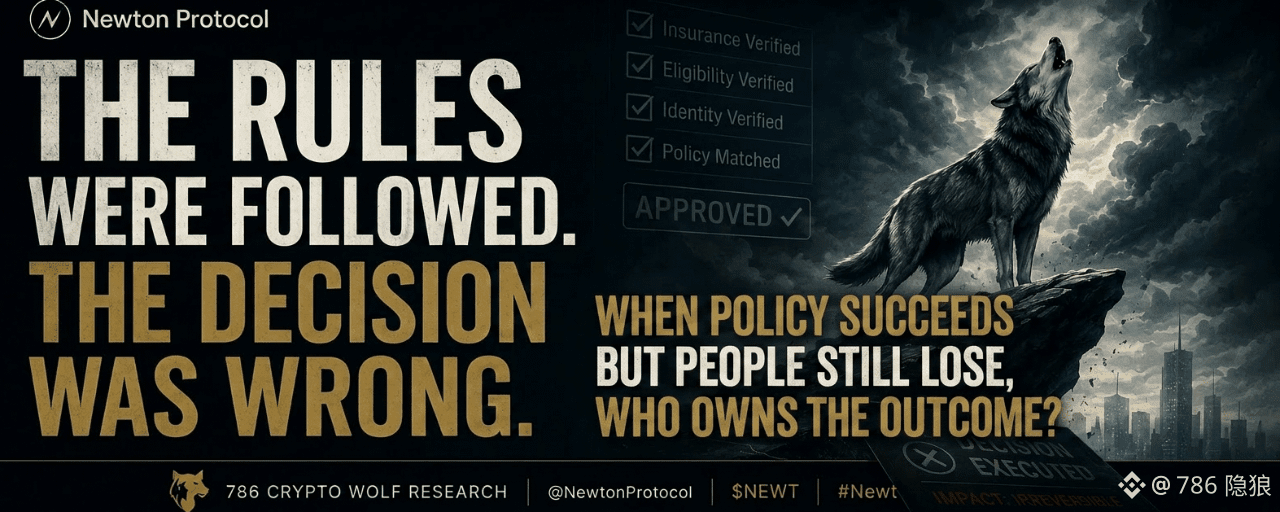

The AI followed every rule correctly.
Authorization succeeded.
The compliance checks passed.
The transaction executed exactly as designed.
Months later, everyone agreed the decision should never have happened.
That possibility keeps capturing my attention as I think about systems like @NewtonProtocol.
For years, the conversation around AI focused on one question:
Can machines follow the rules?
But a more difficult question may be approaching:
What happens when they do?
Traditional failures are easy to explain.
A bug caused the issue.
A bad actor exploited the system.
Someone bypassed the controls.
Someone broke the rules.
Those situations have clear causes and clear accountability.
This scenario is different.
Nobody bypassed authorization.
Nobody ignored compliance.
Nobody violated policy.
The logs are clean.
The signatures are valid.
The audit trail exists.
And somebody still suffers.
That may become one of the hardest accountability problems in the age of autonomous systems.
As AI moves into finance, healthcare, identity, and institutions, policy authors may quietly become some of the most important decision-makers in the entire stack.
Authorization can prove a decision was allowed.
It cannot prove the decision was wise.
A system can be perfectly compliant and still be perfectly wrong.
If nobody broke the rules, who should carry the consequences when the outcome fails?