
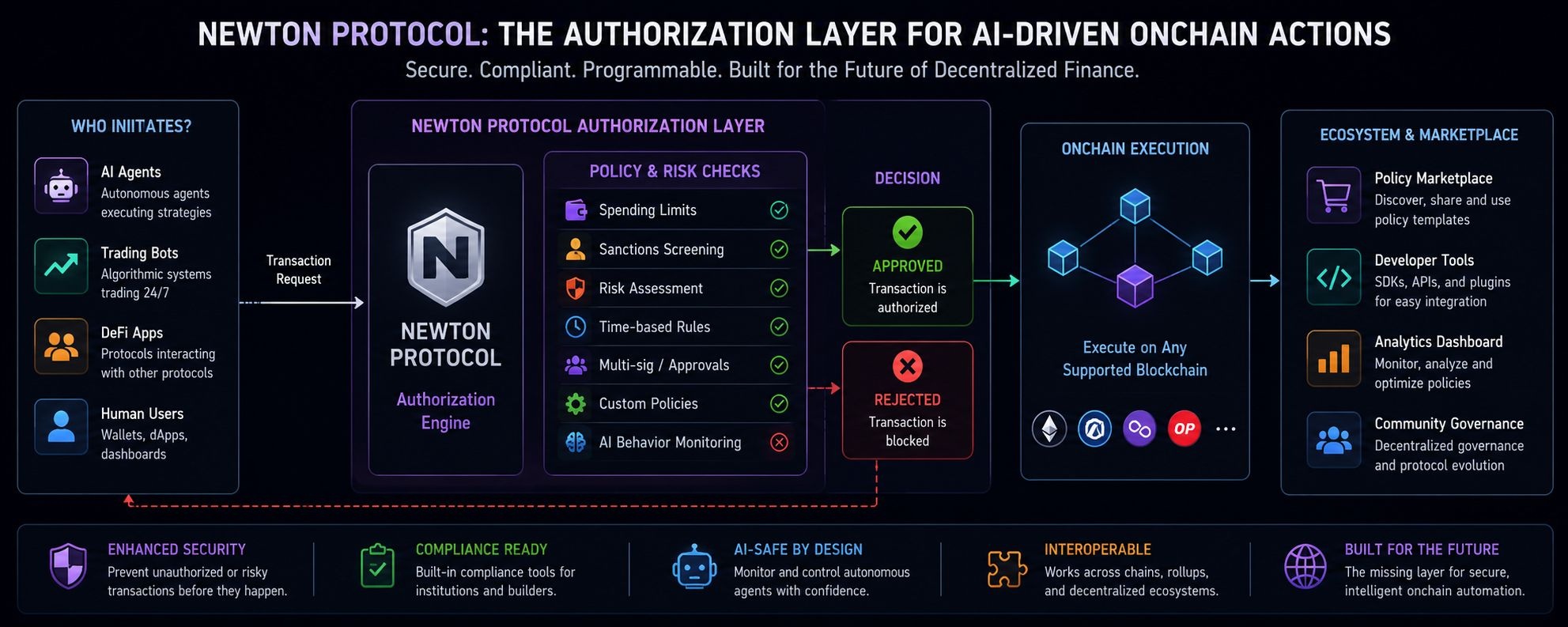
I've spent enough time around crypto to notice a pattern. Every cycle seems to have its favorite buzzwords. First it was smart contracts, then DeFi, NFTs, Layer 2s, modular blockchains, AI...the list keeps growing. Most projects promise to make crypto faster, cheaper, or more scalable. Those things matter, of course, but after reading about Newton Protocol, I found myself thinking about a completely different question.
What if speed isn't the biggest problem anymore?
What if the bigger issue is deciding whether a transaction should happen at all?
That sounds obvious when you say it out loud, but blockchain has never really been built around that idea. Once a valid transaction is signed, the network simply processes it. It doesn't stop to ask if the transaction makes sense, whether it breaks a spending policy, whether an AI agent is behaving strangely, or whether someone accidentally gave a bot permission to do something they never intended.
That's the gap Newton Protocol is trying to fill.
The more I looked into it, the more I realized this isn't another project trying to replace Ethereum or compete with every Layer 1 blockchain. It feels more like an additional layer that sits between users and blockchain transactions, making sure certain rules are checked before anything actually happens.
The timing is interesting too.
Crypto is changing. A few years ago almost every transaction came directly from a person clicking a button in their wallet. Today that's becoming less true. Automated trading bots move billions of dollars. Portfolio managers rebalance assets automatically. AI is slowly becoming part of financial decision-making, and developers are experimenting with autonomous agents that can execute transactions without someone approving every single action.
That's exciting...but it's also a little uncomfortable.
The moment software starts making financial decisions on its own, trust becomes much more complicated.
An AI doesn't need malicious intentions to create problems. It only needs incorrect data, unexpected market conditions, or poorly written instructions. Blockchain doesn't really care why something happened. If the transaction is valid, it goes through. Once it's confirmed, reversing it is usually impossible.
Newton Protocol seems to be built around the idea that maybe there should be another checkpoint before that point of no return.
Instead of only asking whether a wallet signed a transaction, the protocol allows developers and organizations to create programmable policies. Maybe a wallet can't spend above a certain amount. Maybe funds can't be sent to specific addresses. Maybe certain transactions require additional approvals. Maybe an AI trading system can only operate inside predefined risk limits.
None of those ideas sound particularly flashy.
Ironically, that's one of the reasons I find the project interesting.
Crypto often gets distracted by technology that looks impressive in presentations but solves problems very few people actually have. Newton feels different because authorization is something almost every serious financial system eventually needs.
Traditional finance is filled with approval processes, internal controls, compliance checks, spending limits, and risk management systems. Crypto removed much of that in pursuit of decentralization, which was understandable in the beginning. But as more money enters the ecosystem, those controls start looking less like unnecessary bureaucracy and more like basic infrastructure.
That doesn't mean Newton has everything figured out.
Far from it.
Building technology is one thing. Convincing developers to use it is something else entirely.
Crypto has produced countless technically brilliant projects that never attracted meaningful adoption. Good code doesn't automatically create a successful ecosystem. Developers have to integrate it. Institutions have to trust it. Users have to understand it. Those are much harder problems than writing software.
There's also the question of complexity.
Every additional security layer introduces another system that needs configuration, maintenance, and monitoring. If authorization policies become too complicated, developers might avoid them altogether. If they're too simple, they won't provide much protection. Finding that balance isn't easy.
Another thing I noticed is how Newton sits right at the intersection of several trends that are growing at the same time.
Artificial intelligence is becoming more capable.
Stablecoins are becoming part of everyday financial conversations.
Tokenized real-world assets continue attracting institutional interest.
On-chain treasury management is becoming increasingly sophisticated.
All of these developments have one thing in common. They require better ways to control how digital assets move.
Maybe that's where Newton fits.
Instead of becoming another blockchain competing for users, it could become infrastructure that other blockchain applications quietly rely on in the background. Sometimes the most valuable technology isn't the one people talk about every day. It's the technology people barely notice because it simply works.
Of course, that's also where the biggest uncertainty lies.
Infrastructure projects rarely become overnight successes. Their growth depends on developers, integrations, partnerships, and long-term adoption. They don't usually create dramatic headlines, even when they're solving meaningful problems.
That's why I'm still somewhere in the middle.
I don't think Newton Protocol is just another AI buzzword wrapped inside a crypto token. The problem it's trying to solve feels real, especially as software becomes more autonomous and financial systems become more automated.
At the same time, believing in the problem doesn't automatically mean the project will become the standard solution. Crypto has a long history of recognizing important challenges while failing to build lasting ecosystems around them.
For me, that's what makes Newton worth watching.
Not because it promises impossible returns or claims to reinvent blockchain, but because it's asking a question the industry probably should have been asking years ago.
As AI becomes more involved in moving money, making decisions, and interacting with decentralized applications, simply proving that a transaction was signed may no longer be enough.
The harder question is whether that transaction should happen in the first place.
Newton Protocol is trying to answer that question.
Whether it eventually succeeds is impossible to know right now.
But I do think it's looking in a direction that much of the crypto industry has ignored for far too long, and sometimes that's where the most meaningful innovation begins.