
For the past few years, most conversations around blockchain infrastructure have revolved around faster networks, cheaper transactions, and increasingly sophisticated smart contracts. Quietly, however, another question has been growing in importance. If software agents are going to manage wallets, execute trades, distribute treasury funds, rebalance portfolios, and coordinate decentralized organizations, who decides what those agents are actually allowed to do?
That question is where Newton Protocol enters the discussion. It has not attracted attention because it promises another faster blockchain or another artificial intelligence assistant. Instead, it is attempting to solve a far less glamorous problem: creating a decentralized authorization layer that determines whether automated actions should happen at all.
The timing is interesting. AI agents are becoming more capable, decentralized finance continues to automate financial operations, and DAOs increasingly rely on scripts and external bots to keep systems running. As automation expands, so does the cost of mistakes. A bot executing the wrong transaction, an agent acting beyond its intended permissions, or a compromised automation service can create losses within seconds. The market is slowly realizing that automation without verifiable control is simply another form of operational risk.
One of blockchain's oldest assumptions is that valid signatures equal valid intentions. If a wallet signs a transaction, the network executes it. That model has worked surprisingly well for direct human interaction, but it becomes much less comfortable once software begins acting continuously on behalf of users.
Consider a treasury management system that automatically moves stablecoins between protocols depending on yields. Imagine a recurring investment strategy that purchases assets every week, or a DAO distributing incentives according to changing governance rules. Today, many of these operations depend on centralized servers, privately managed automation bots, cloud infrastructure, or trusted administrators monitoring conditions outside the blockchain.
Those systems often function well until they do not.
Infrastructure outages happen. Credentials leak. Servers fail. Software bugs appear. Sometimes the automation simply follows outdated logic while the surrounding market has completely changed. None of these failures are unique to crypto. Financial institutions, cloud providers, and enterprise software have wrestled with automation risk for decades.
Newton Protocol argues that the problem is not automation itself but the absence of a decentralized permission system capable of explaining why an automated action was authorized before it occurs.
That distinction matters because execution is only half of automation. Authorization is the other half.
Most casual observers will probably describe Newton as another AI project because it frequently discusses autonomous agents. That interpretation misses the more interesting architectural idea.
The protocol is less concerned with making agents smarter than with making them accountable.
In traditional blockchain systems, execution usually receives the most attention. Developers optimize transactions, improve throughput, and reduce fees. Newton shifts attention toward policy enforcement. Instead of asking whether an agent can perform an action, it asks whether predefined conditions permit that action in the first place.
This sounds like a subtle difference, but it changes the design philosophy considerably.
Rather than trusting a bot operator, Newton attempts to establish programmable guardrails around every delegated permission. A user may authorize an agent to trade, but only under certain market conditions. A DAO might authorize treasury management, but only within defined spending limits. An automation could rebalance assets, but only after cryptographic verification confirms the required conditions.
The protocol effectively introduces an authorization layer that sits between intention and execution.
That is not necessarily revolutionary, but it is arguably more practical than many grand blockchain narratives because real financial systems already rely heavily on layered authorization models.
How the System Actually Works
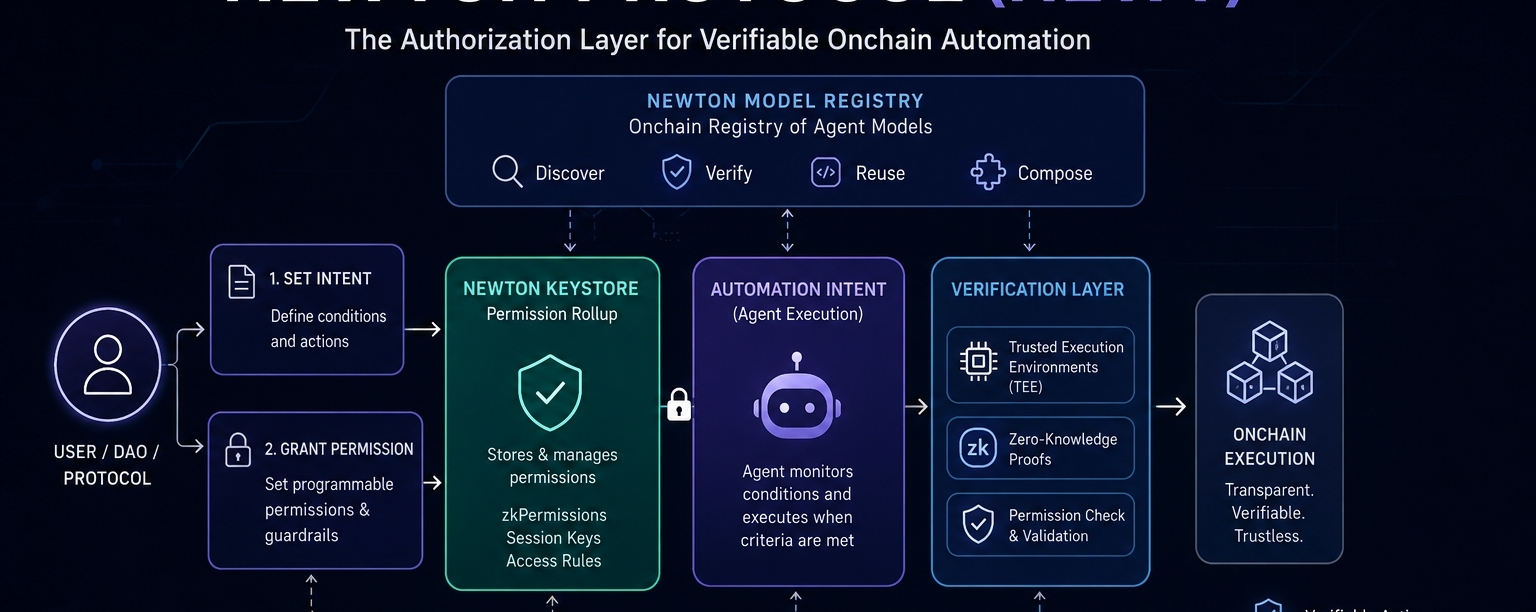
Newton's architecture revolves around three primary components that separate responsibility instead of concentrating everything inside a single automation engine.
The Newton Model Registry functions as a public directory where automation models are published and referenced. Rather than every developer inventing isolated automation logic, standardized trigger-action models can become reusable building blocks. If an automation strategy proves reliable, others can inspect, reuse, or extend it instead of rebuilding identical logic repeatedly.
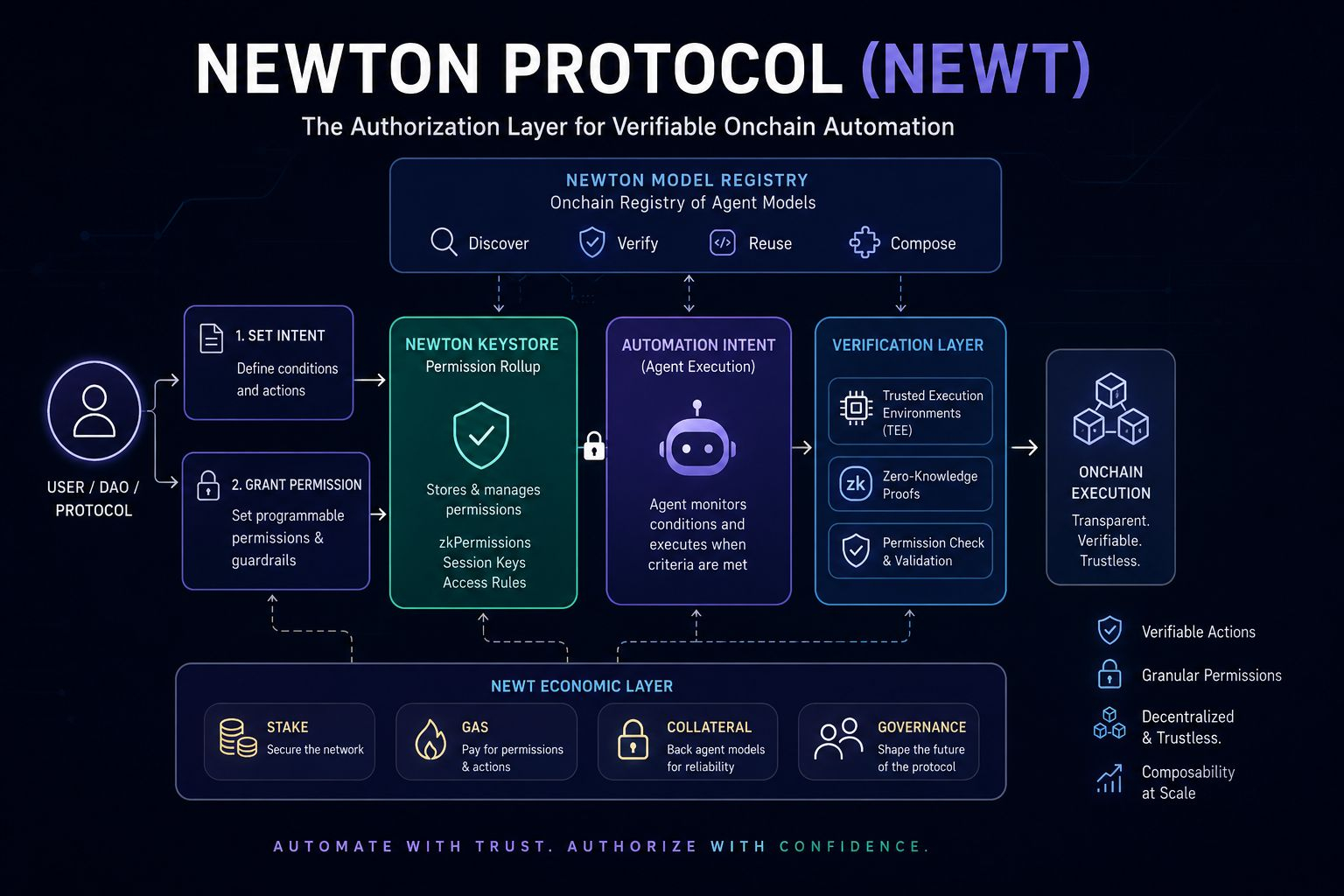
The Newton Keystore introduces another important layer. Rather than embedding permissions directly into every application, the protocol stores programmable authorization rules inside a specialized rollup. These permissions define exactly which agents may act, under which circumstances, and with what limitations. Session keys and zero-knowledge permissions allow delegation without exposing permanent wallet control.
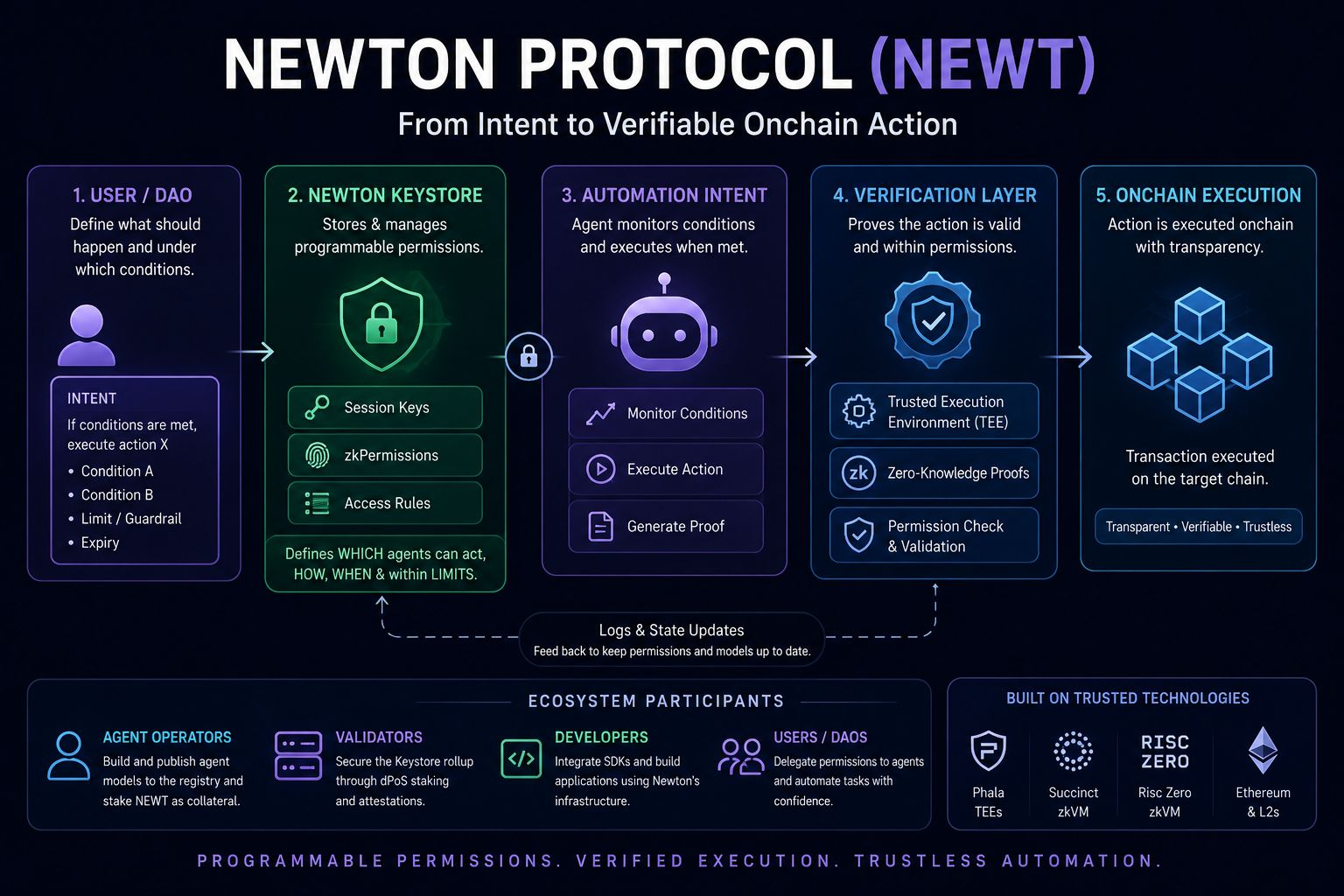
Automation Intents represent the user's actual instructions. These describe the desired outcome rather than every execution step. An intent might specify that assets should move only if market volatility reaches a threshold, or that governance funds should be released only after predefined voting conditions have been satisfied.
Verification sits alongside execution rather than behind it.
Trusted Execution Environments provide confidential computing environments where automation logic executes with hardware-backed integrity guarantees. Zero-knowledge proofs contribute cryptographic evidence that required conditions were satisfied without exposing unnecessary information. Permission libraries verify whether an agent's requested action remains within its delegated authority.
Together these components attempt to transform automation from a trust-based service into a verifiable infrastructure layer.
Whether this architecture ultimately achieves that goal depends less on technical elegance than on operational reliability.
Like many infrastructure protocols, NEWT performs several distinct economic functions instead of relying on a single use case.
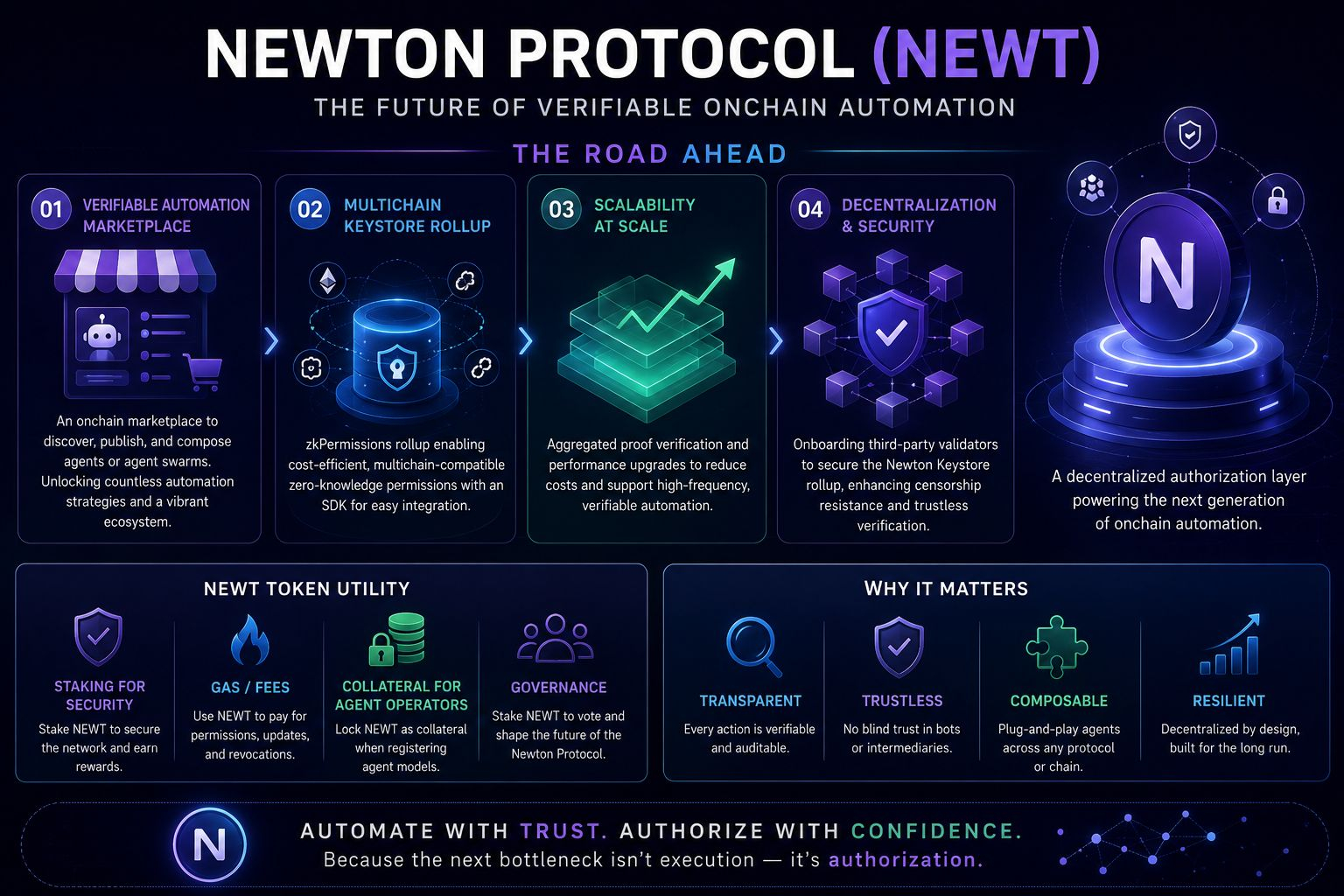
Security comes first. Validators stake NEWT to participate in protecting the Newton Keystore rollup through delegated proof-of-stake. If the authorization layer becomes critical infrastructure, validator incentives become directly tied to maintaining availability and integrity.
The token also serves as the protocol's native gas asset. Every permission update, delegation, modification, or revocation requires NEWT. This creates operational demand tied directly to automation activity rather than speculative trading alone.
Collateral introduces another interesting mechanism. Agent operators lock NEWT when registering automation models. In theory, collateral aligns incentives because operators have economic exposure attached to the services they provide. If an ecosystem of reusable automation agents eventually develops, collateral could become a meaningful quality signal.
Governance represents the final layer. Token holders who stake NEWT participate in protocol decisions as decentralization progresses.
The token therefore resembles infrastructure fuel combined with security collateral and governance rights rather than a simple payment instrument.
Still, token utility only becomes economically meaningful if automation volume grows substantially. Infrastructure tokens frequently possess logical utility models on paper while lacking sufficient network activity to generate sustainable demand.
Where the Model Gets Interesting
The most distinctive aspect of Newton is not any individual technology it incorporates.
Trusted Execution Environments already exist. Zero-knowledge proofs continue improving across the industry. Rollups are well established. Agent frameworks are becoming increasingly common.
The interesting design choice lies in combining those components around authorization rather than computation.
Most blockchain infrastructure optimizes execution.
Most AI infrastructure optimizes intelligence.
Newton attempts to optimize permission itself.
That may sound like a small conceptual shift, yet it aligns remarkably well with how large enterprises already think about automation. Banks, cloud providers, and regulated institutions rarely ask whether automation is technically possible. They ask who approved it, under what policy, and whether the decision can be audited afterward.
If decentralized finance eventually evolves toward institutional-scale operations, those questions become increasingly unavoidable.
Newton is effectively betting that programmable authorization will become foundational infrastructure rather than optional middleware.
The technical architecture is ambitious, but several practical challenges remain difficult.
First is latency. Every additional verification layer introduces computational overhead. Hardware attestation, zero-knowledge proof generation, permission validation, and cross-chain coordination all consume resources. Maintaining both security and responsiveness will require careful engineering.
Second is ecosystem adoption.
Authorization infrastructure becomes valuable only when wallets, decentralized applications, DAOs, and developers actually integrate it. Building elegant infrastructure is considerably easier than convincing an entire ecosystem to standardize around it.
Third is decentralization itself.
Newton currently relies on several external technologies, including confidential computing providers and established zero-knowledge frameworks. Although these choices accelerate development, they also create dependencies that the protocol must gradually diversify if it hopes to achieve the neutrality it ultimately promises.
Finally, there is the question of user experience.
Permission systems often become more secure precisely because they introduce additional complexity. Finding the balance between granular control and everyday usability may prove just as important as solving the underlying cryptography.
Newton Protocol arrives at a moment when blockchain infrastructure is beginning to shift from pure transaction processing toward coordinated automation. That makes its focus unusually relevant.
The project recognizes something many automation platforms tend to overlook. Intelligence without constraints eventually becomes operational risk. As software agents assume greater responsibility for financial decisions, authorization may become just as important as execution speed.
Its architecture reflects thoughtful engineering. Separating permissions, execution, verification, and automation models creates a cleaner security model than concentrating everything inside a single trusted service. The economic design also assigns NEWT multiple operational roles that extend beyond simple speculation.
None of that guarantees success.
History offers countless examples of technically sophisticated infrastructure that never achieved meaningful adoption because integration proved difficult, competing standards emerged, or developers simply preferred simpler alternatives.
Ultimately, Newton should not be judged by the elegance of its white paper or the sophistication of its cryptographic components. It should be judged by whether protocols actually trust it with treasury operations, whether wallets adopt programmable permissions as a default feature, whether developers build reusable agent ecosystems around its registry, and whether decentralized automation genuinely becomes safer because Newton exists.
If those pieces come together, Newton could become an invisible but important layer beneath the next generation of onchain finance. If they do not, it risks becoming another technically impressive protocol searching for a problem large enough to justify the complexity it introduces.
As with much of crypto infrastructure, the real verdict will not come from token prices or launch-day enthusiasm. It will come years later, when users either rely on the system without thinking about it or quietly move on to something that solved the same problem with fewer moving parts.