
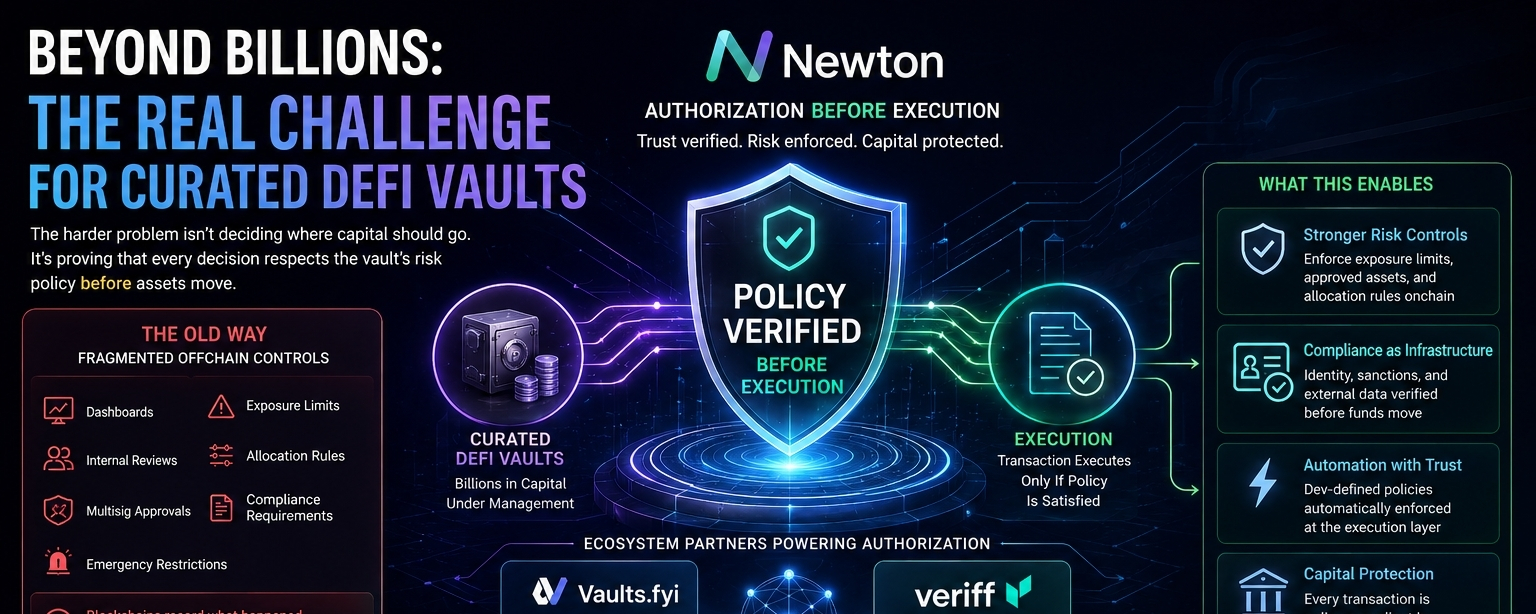

I used to think the biggest challenge for curated DeFi vaults was finding the best yield. As more institutional capital entered crypto, I assumed the winners would simply be the vaults with the smartest strategies.
The more I looked, the more I felt that wasn't the real bottleneck.
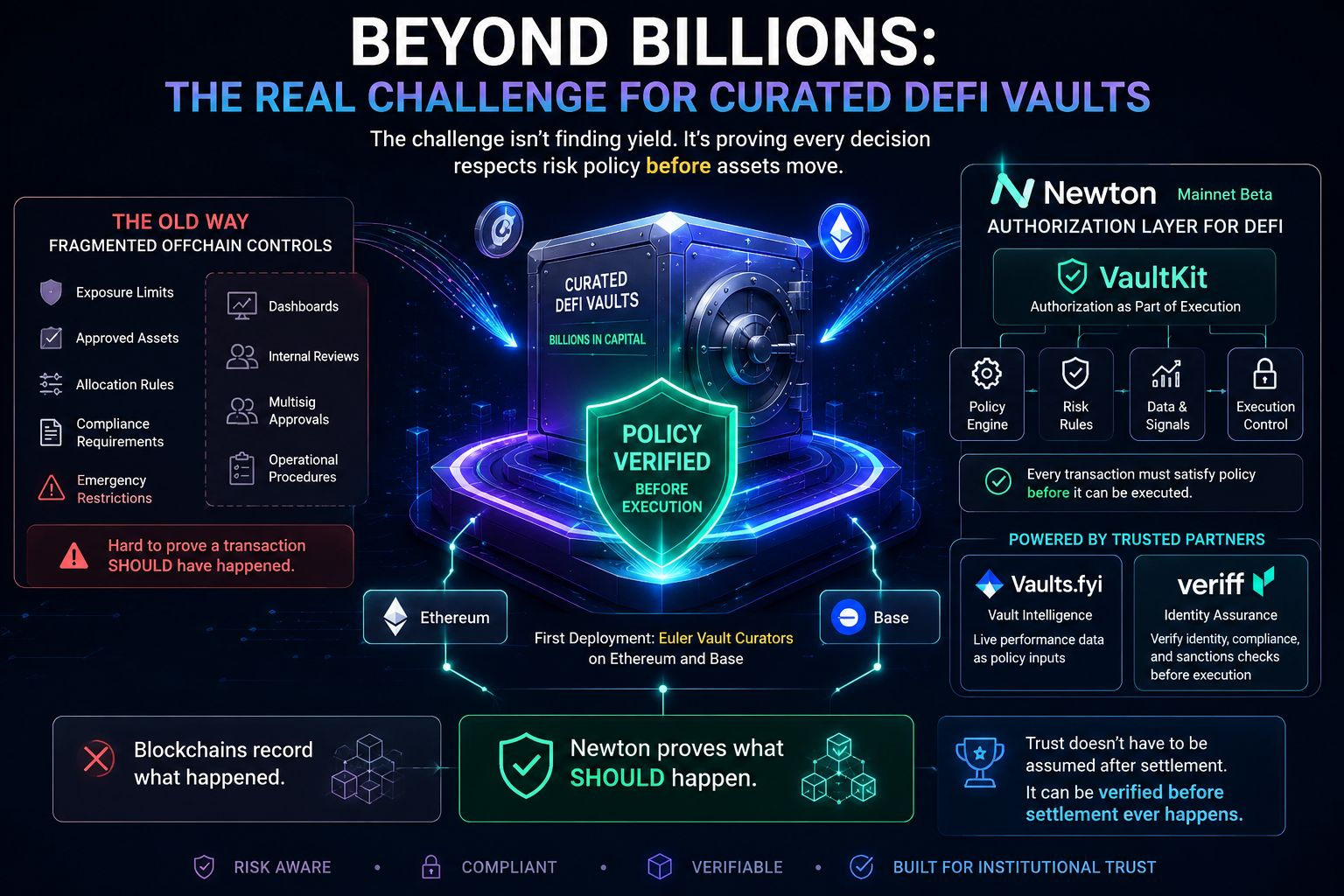
The harder problem isn't deciding where capital should go. It's proving that every decision respects the vault's risk policy before assets move.
Today, curated vaults collectively manage billions of dollars, and that number continues to grow. Yet many of the controls protecting that capital still rely on fragmented offchain processes. Exposure limits, approved assets, allocation rules, compliance requirements, and emergency restrictions are often enforced through dashboards, internal reviews, multisig approvals, or operational procedures rather than onchain infrastructure.
That creates an interesting contradiction.
Blockchains are excellent at recording what happened.
They're far less effective at proving a transaction should have happened in the first place.
That's why Newton caught my attention.
Instead of treating risk policies as documentation that humans promise to follow, Newton turns them into programmable rules that can be verified before execution. The transaction doesn't simply settle and get audited later. It first has to satisfy the policy itself.
What makes this idea more interesting is that it isn't just theoretical.
With the launch of VaultKit alongside Newton Mainnet Beta, the first deployment targets Euler vault curators on Ethereum and Base. Rather than asking vault managers to manually enforce every operational policy, VaultKit gives them a framework where authorization becomes part of execution itself.
The surrounding ecosystem makes the picture even clearer.
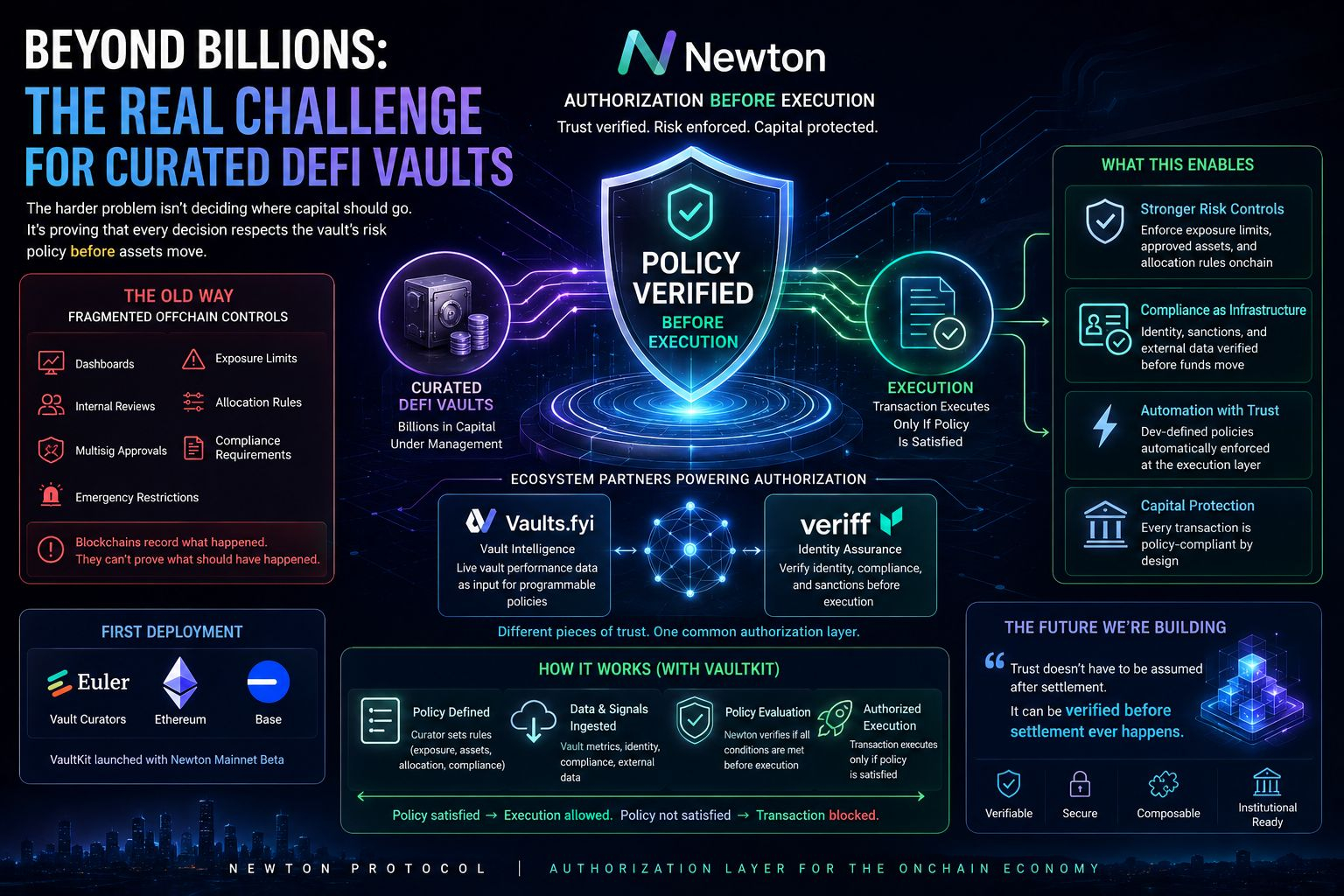
Newton's integration with Vaults.fyi allows live vault performance data to become an input for programmable policies. Instead of checking APY dashboards manually, developers can define conditions that must be satisfied before automated allocations occur. That transforms performance metrics from passive information into enforceable rules.
The same philosophy extends beyond yield.
Identity verification through Veriff can become a pre-transaction requirement rather than a separate onboarding checklist. Compliance signals, sanctions screening, and external data sources can all feed into authorization policies before funds move. Compliance shifts from paperwork to infrastructure.
What I find most compelling isn't any individual integration.
It's that each partner contributes a different piece of trust.
Vaults.fyi supplies vault intelligence.
Veriff supplies identity assurance.
Together, they suggest Newton isn't trying to replace existing services. It's creating a common authorization layer where those services become cryptographically enforceable before execution instead of being verified afterward.
Whether this becomes standard infrastructure will ultimately depend on adoption. Vault managers won't integrate another layer unless it improves security without adding unnecessary complexity.
That's the signal I'll be watching.
If more curated vaults begin embedding authorization directly into their execution flow, Newton's biggest contribution may not be another DeFi primitive.
It may be proving that trust doesn't have to be assumed after settlement.
It can be verified before settlement ever happens.

$NFP
