🤔WE'VE BEEN ASKING THE WRONG QUESTION AFTER EVERY CRYPTO HACK.
Bybit.
Cetus.
Nobitex.
Different names.
Different exploits.
One common lesson.
After every major hack, the crypto industry asks the same question:
> Who signed the transaction?
Ironically...
That may be the wrong question.
---
🔍 Authentication was never the real problem.
Modern blockchains are exceptionally good at verifying signatures.
If the correct private key signs a transaction...
The network verifies it.
Consensus is reached.
The smart contract executes.
Everything works exactly as designed.
The blockchain didn't fail.
It simply obeyed.
That's exactly what blockchains are built to do.
They execute valid instructions.
They don't understand intent.
They don't question risk.
They don't enforce policy.
---
⚠️ And that's where billions can disappear.
A signature only answers one question:
> Who initiated this transaction?
It never answers the question that actually protects capital:
> Should this transaction be allowed?
Those are two fundamentally different problems.
Authentication proves identity.
Authorization enforces permission.
Crypto has spent more than a decade perfecting the first.
The second is only beginning.
---
🏦 Traditional finance solved this years ago.
When you tap your Visa card...
Money doesn't move simply because your card is genuine.
Before the payment is approved, hundreds of invisible policy checks happen.
Is the merchant trusted?
Does the amount exceed risk limits?
Does it violate compliance rules?
Does this behavior look suspicious?
Only after those checks pass...
The payment is authorized.
Execution moves money.
Authorization decides whether money should move at all.
---
🌐 Onchain finance is reaching the same turning point.
Today's DeFi vaults already secure billions of dollars.
Tomorrow's onchain economy will expand to:
• Tokenized RWAs
• Stablecoins
• Institutional treasury management
• Autonomous AI agents
As more value moves onchain...
Signatures alone are no longer enough.
Capital needs programmable rules.
Not just programmable money.
---
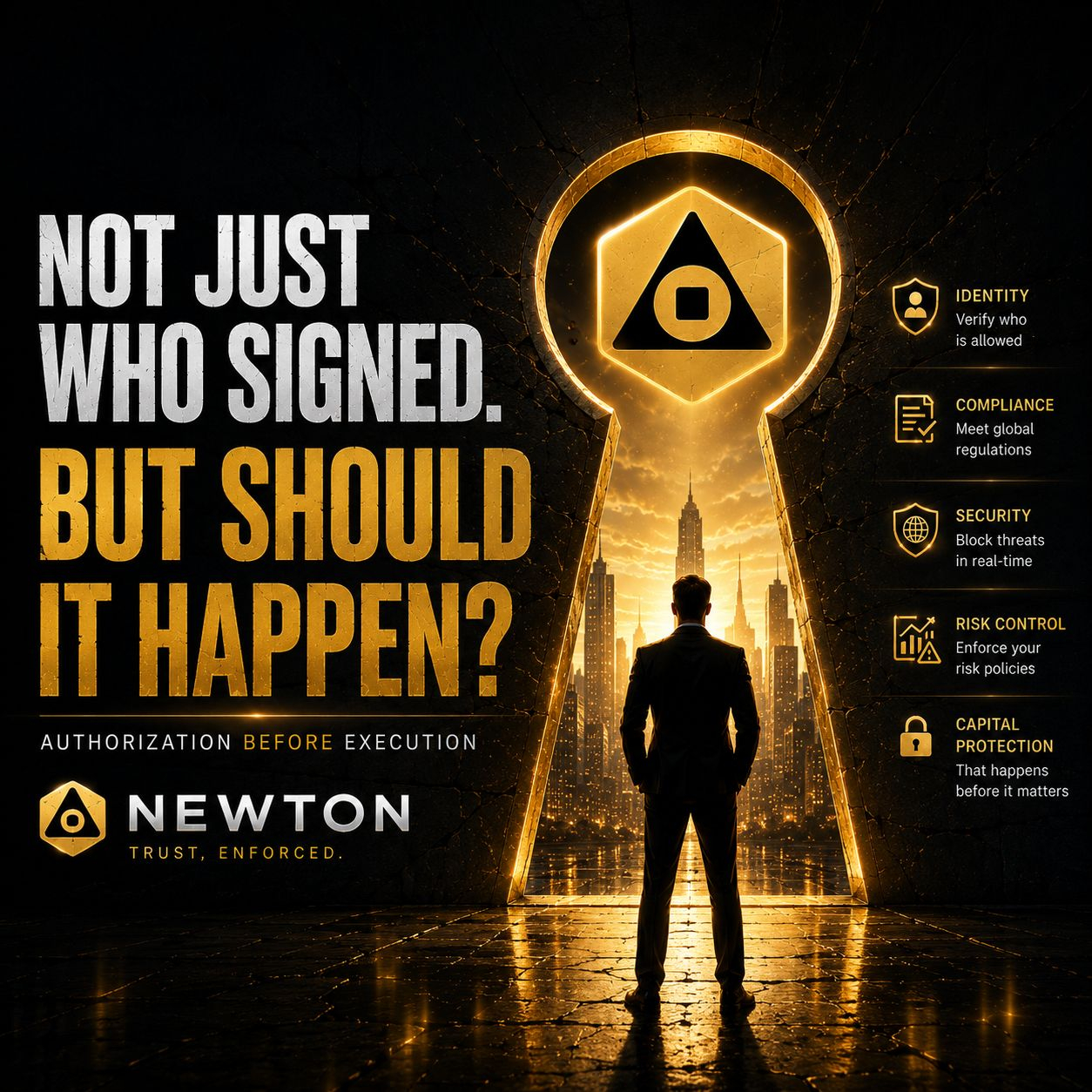
🛡️ This is the problem Newton Protocol is solving.
Rather than reacting after assets have already moved...
Newton introduces an Authorization Layer that evaluates transactions before settlement.
Every transaction can be checked against programmable policies covering:
✅ Identity & eligibility
✅ Compliance & sanctions
✅ Real-time security intelligence
✅ Risk controls including leverage, oracle health and counterparty exposure
Instead of generating another alert...
Newton returns an onchain Pass / Fail Authorization Attestation.
Not just evidence of who signed.
But proof of whether the transaction satisfied policy before execution.
---
💡 That distinction changes everything.
Monitoring tells you what already happened.
Authorization decides what is allowed to happen.
One records history.
The other shapes outcomes.
That's why Newton compares itself to Visa's authorization network for onchain finance.
Not another wallet.
Not another monitoring dashboard.
Not another security tool.
A programmable decision layer that sits between a signature and execution.
---
🚀 Crypto spent fifteen years making finance permissionless.
The next fifteen years may be about making permissions programmable.
Maybe the most important question in onchain finance is no longer:
> Who signed?
Maybe it's:
> Should this transaction happen at all?
That might be the missing layer institutional DeFi has been waiting for.