
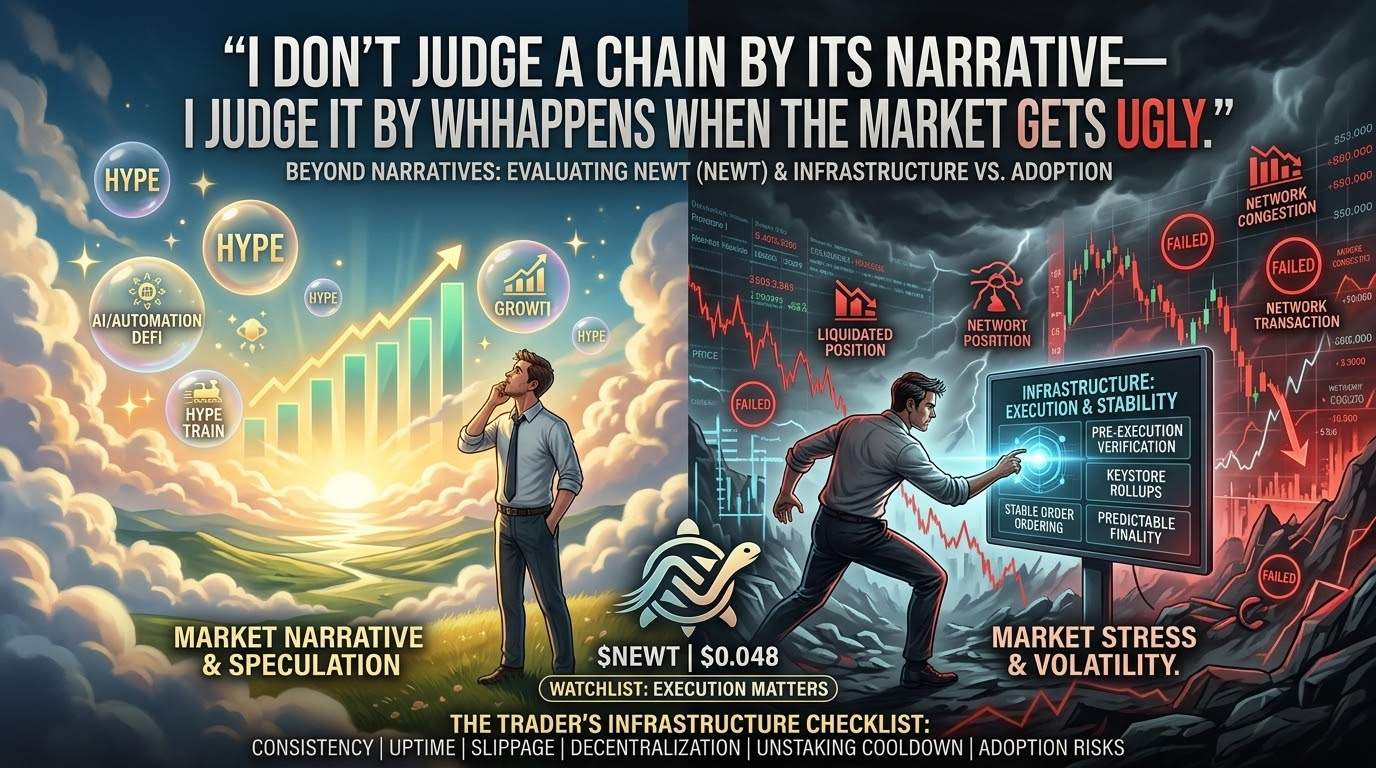
I've had trades fail for reasons that had nothing to do with my analysis. The setup was right, risk was defined, and my execution plan was clear. Then the network slowed, confirmations lagged, and by the time the transaction settled, the opportunity was gone. Those moments are frustrating because they expose a reality many traders eventually learn: infrastructure matters just as much as strategy. I don't spend much time chasing narratives anymore. I pay attention to execution quality because that's what determines whether a good decision actually becomes a profitable trade.
That's why NEWT caught my attention. Not because of social media excitement or optimistic headlines, but because it's trying to address parts of blockchain infrastructure that directly affect how automated financial systems and traders interact with the network.
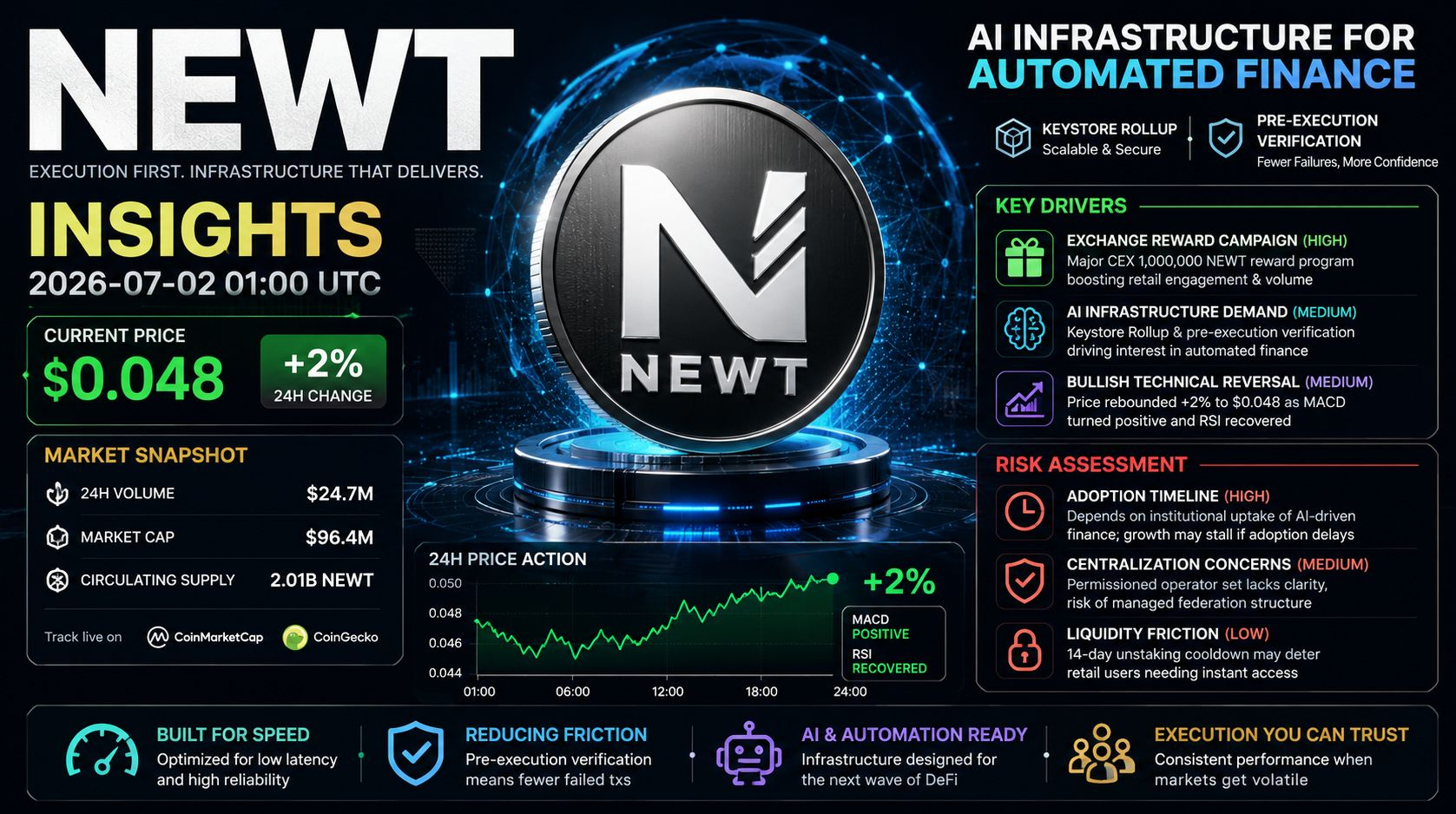
Today, NEWT is trading around $0.048, gaining roughly 2% over the last 24 hours. The move has coincided with a major centralized exchange reward campaign offering one million NEWT tokens, which has noticeably increased retail participation and trading activity. Live metrics such as 24-hour trading volume, market capitalization, circulating supply, and liquidity distribution can be monitored through platforms like CoinMarketCap, CoinGecko, and exchange market pages. I always look at those numbers as context rather than confirmation. Increased volume tells me participation is rising, but it doesn't automatically tell me whether that participation is sustainable.
From what I've studied, NEWT isn't trying to build another general-purpose blockchain that competes on branding. Its focus is more specific. The project revolves around infrastructure designed for automated finance, using technologies such as Keystore Rollups and pre-execution verification. Those terms sound technical until they're translated into something traders actually care about.
To me, pre-execution verification simply means reducing uncertainty before a transaction reaches the network. Instead of discovering problems after submitting a transaction, the system attempts to identify potential execution issues earlier in the process. That's relevant because trading isn't only about speed. It's also about confidence that an order behaves the way you expect under pressure.
The current AI infrastructure narrative surrounding NEWT is another reason the market has been paying attention. As more automated financial applications emerge, the demand for infrastructure capable of supporting machine-driven execution could increase. Whether that demand develops into long-term usage remains an open question, but it's at least a practical narrative rather than one based purely on speculation.
Performance statistics deserve careful interpretation. Every blockchain highlights metrics such as transactions per second, confirmation speed, or finality. Those figures are useful, but they don't describe the experience traders have during periods of heavy volatility. I've seen networks advertise impressive throughput numbers while becoming noticeably less reliable when everyone tries to transact simultaneously.
As a trader, I care much more about consistency than headline benchmarks.
If a network maintains predictable confirmation times during liquidation events, that's valuable. If it keeps transaction ordering stable while order books become chaotic, that's useful. Fast averages don't matter nearly as much as stable performance during stressful conditions because markets rarely reward average conditions.
Technically, NEWT has shown signs of improving momentum. The token recovered approximately 2%, the MACD has crossed into positive territory, and the RSI has rebounded quickly after reaching oversold conditions. Those indicators suggest buyers have regained some control over short-term momentum. I acknowledge those signals, but I don't build convictions around them. Momentum indicators are observations, not guarantees.
Every infrastructure project also comes with tradeoffs, and NEWT isn't exempt.
One of my biggest questions concerns decentralization. The project's permissioned operator model currently leaves some uncertainty around how decentralized the network truly is. If operational responsibilities remain concentrated within a relatively small group, resilience becomes harder to evaluate. During normal market conditions, centralized coordination may not create obvious problems. During unexpected failures or governance disputes, however, those design decisions become much more important.
Adoption timing is another meaningful risk. Much of NEWT's value proposition depends on broader institutional adoption of AI-powered financial systems. If that adoption takes longer than expected, infrastructure development could outpace actual user demand. That's not necessarily a flaw, but it's something I continue watching closely.
Liquidity flexibility also matters.
The reported 14-day unstaking cooldown introduces an opportunity cost that active traders immediately notice. Long-term investors may accept that tradeoff without hesitation, but traders often rotate capital quickly as market conditions evolve. Locked liquidity reduces flexibility, and flexibility has real value during volatile periods.
What I think many projects underestimate is why users leave DeFi in the first place.
It's rarely because transaction fees increase slightly.
People leave because the experience becomes tiring.
Repeated wallet signatures.
Unexpected gas costs.
Transactions that fail without clear explanations.
Confirmation delays that create uncertainty.
Tiny pieces of friction accumulate until users decide convenience is worth paying for elsewhere.
If NEWT's architecture successfully reduces some of that friction through better verification and transaction handling, that may ultimately matter more than another benchmark claiming higher throughput. Good infrastructure often succeeds because users stop noticing it.
Imagine a typical volatile trading session.
Bitcoin suddenly loses four percent in less than fifteen minutes.
Funding rates flip negative.
Open interest starts collapsing.
Liquidation engines activate across multiple perpetual exchanges.
At the same time, traders rush to hedge exposure while market makers widen spreads.
Those are exactly the moments when infrastructure gets tested.
If transactions begin failing, confirmations slow, or cancellation requests become unreliable, execution quality deteriorates immediately. Traders don't need perfection during those periods. They simply need predictability.
That, in my view, is where projects like NEWT either prove their value or fail to distinguish themselves.
Looking ahead, I have a simple checklist rather than a narrative.
I want to monitor liquidity quality instead of focusing only on trading volume.
I want to observe slippage during periods of elevated volatility rather than quiet market sessions.
I want to know whether order cancellations remain reliable when network demand increases.
I pay attention to uptime history because resilience is built through repeated successful operation, not isolated benchmarks.
Validator participation and operator transparency also deserve ongoing observation, particularly if decentralization remains part of the long-term roadmap.
Finally, I want to see whether the user experience actually becomes habitual. The strongest infrastructure improvements eventually become invisible because users simply stop thinking about them.
My own framework never changes regardless of the project.
I verify metrics independently instead of relying on summaries.
I read documentation before forming opinions.
I interact with protocols using small amounts before committing meaningful capital.
I paper-trade new workflows whenever possible.
Most importantly, I compare my actual trading experience before and after using the infrastructure.
If my execution becomes more consistent, that's meaningful.
If nothing changes, the technology probably isn't solving a problem I actually have.
After looking at NEWT, I don't see something that should be evaluated through excitement alone. I see infrastructure that deserves careful observation. The exchange campaign and improving technical momentum explain why attention has increased, but long-term credibility will depend on whether the network consistently performs when traders need it most.
My opinion is simple: order books eventually ignore narratives. They reward execution. If NEWT can repeatedly reduce friction, maintain reliability under stress, and prove its architecture through real market conditions instead of marketing claims, it earns a place on my watchlist. Until then, I'll continue doing what I always do—observe, test, measure, and let execution speak louder than the story.
