
A few days ago I was watching a trade that never really became a trade.
Price moved exactly where I expected. Liquidity was there. The setup looked clean. But I hesitated because I was away from my desk and wasn't comfortable giving an automated bot unrestricted control over my wallet. By the time I came back, the opportunity had disappeared.
At first I blamed myself.
Then I realized I have repeated that same behavior more times than I can count.
People often describe this as an automation problem. I don't think it is.
I think it's an authorization problem.
That distinction only became obvious after spending time reading through Newton Protocol's architecture. Newton doesn't try to replace execution. Execution already works remarkably well in crypto. Transactions settle, bridges move assets, smart contracts follow deterministic rules.
The uncomfortable part happens before any of that.
Someone or something has to decide whether a transaction should be allowed to happen in the first place.
Most discussions around Web3 infrastructure still revolve around throughput, cheaper gas, better bridges, or faster finality. Those things matter. But they're all improvements to what happens after intent has already been expressed.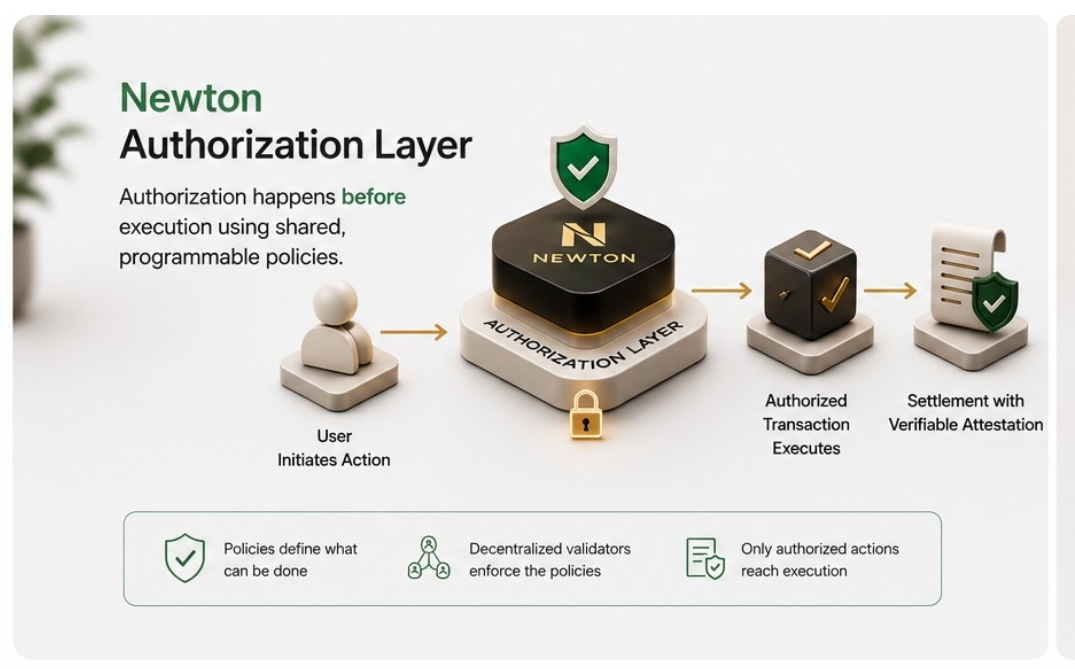
Authorization sits one step earlier.
And strangely, almost nobody treats that layer as shared infrastructure.
Today every protocol tends to build its own permission system. Wallets implement one version. DeFi protocols build another. Custodians create internal policies. DAOs vote on governance rules separately. AI agents introduce yet another permission model.
The common assumption is that permissions belong inside each application.
The more I looked at Newton, the less convinced I became that this has to stay true.
Newton positions itself as an authorization layer between user intent and on-chain execution. Instead of asking whether a transaction succeeded, the network evaluates whether predefined policies allow that transaction before settlement ever occurs. Operators independently evaluate policies, aggregate attestations, and provide verifiable authorization rather than relying on blind trust.
That sounds like a technical detail.
I don't think it is.
Visa didn't become important because cards move money faster than bank accounts.
Its value largely came from creating a common authorization network that thousands of institutions could rely on without each rebuilding the same infrastructure from scratch.
Crypto has become extremely good at settlement.
It's still surprisingly fragmented when it comes to authorization.
That difference feels increasingly relevant as AI agents become more capable.
Everyone talks about autonomous agents executing trades, managing treasuries, or operating businesses around the clock.
Very few conversations focus on the rules those agents should obey before touching user assets.
If every protocol writes its own authorization logic, developers repeat the same work while users are forced to trust dozens of incompatible systems.
If authorization becomes shared infrastructure instead, something subtle changes.
Protocols compete on products.
Not on rebuilding permission systems.
That was the part I hadn't fully appreciated before.
Interestingly, this idea seems consistent with how Newton itself describes the protocol. Rather than positioning authorization as another application feature, the project presents it as an independent infrastructure layer that sits between transaction intent and execution, with programmable policies enforced before settlement.
I'm careful not to overstate what this means.
Infrastructure ideas often sound inevitable long before they're actually adopted.
Developers may still prefer keeping authorization inside their own applications. Institutions might require different policy standards. Users may simply resist adding another layer between themselves and execution.
Those are meaningful uncertainties.
But I've started questioning a different assumption.
Maybe we've been measuring Web3 infrastructure using the wrong benchmark.
We've spent years asking which network settles transactions fastest.
Perhaps the harder question is which network becomes trusted to decide whether those transactions should happen at all.
I'm not convinced the market has fully separated those two ideas yet.
Maybe it never will.
Or maybe, years from now, we'll realize authorization was never just another security feature it was the missing infrastructure sitting quietly between user intent and execution all along.#newt $NEWT @NewtonProtocol
