
I'm watching blockchain evolve beyond verifying transactions toward defining who should be allowed to execute them in the first place. That shift may sound subtle but I think it represents one of the more important architectural changes emerging alongside AI powered applications.
For years blockchain security has centered on ownership. If you control a private key you can authorize a transaction. This model has worked well because most interactions involve a human making a deliberate decision. AI agents introduce a different reality. They can analyze information make decisions and execute transactions continuously without waiting for manual approval every time.
That changes the security question.
Instead of asking only whether a transaction carries a valid signature developers increasingly need to ask whether the action should have been permitted under predefined rules. This is the problem Newton Protocol is trying to address.
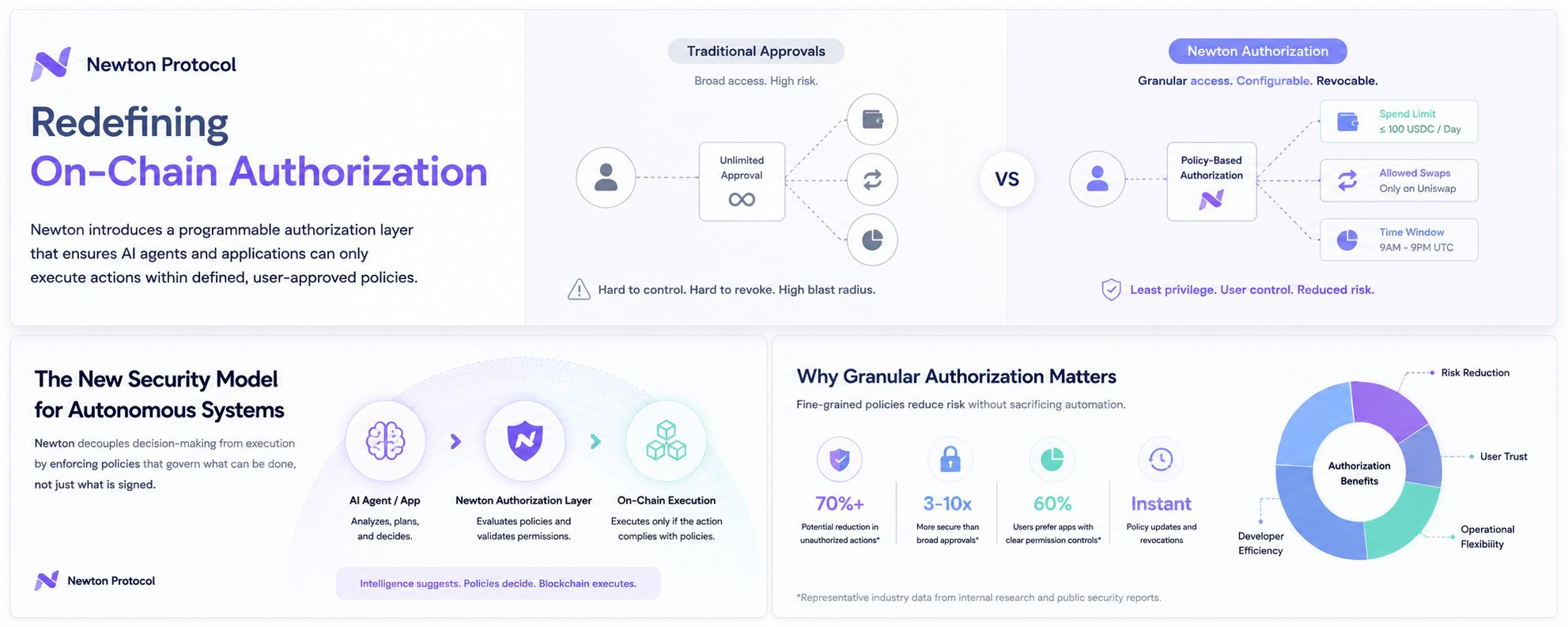
Rather than treating authorization as a single approval event Newton proposes a framework where permissions become programmable policies. These policies can define what an autonomous agent is allowed to do before execution occurs. The objective is not to replace cryptographic security but to add another layer of control that better reflects how AI systems operate.
This distinction matters because intelligence and authorization are not the same thing. Even a highly capable AI model can make unexpected decisions misunderstand context or encounter adversarial inputs. Improving model performance reduces risk but it does not eliminate it. Newton's approach assumes that automated systems should always operate within predefined boundaries regardless of how capable they become.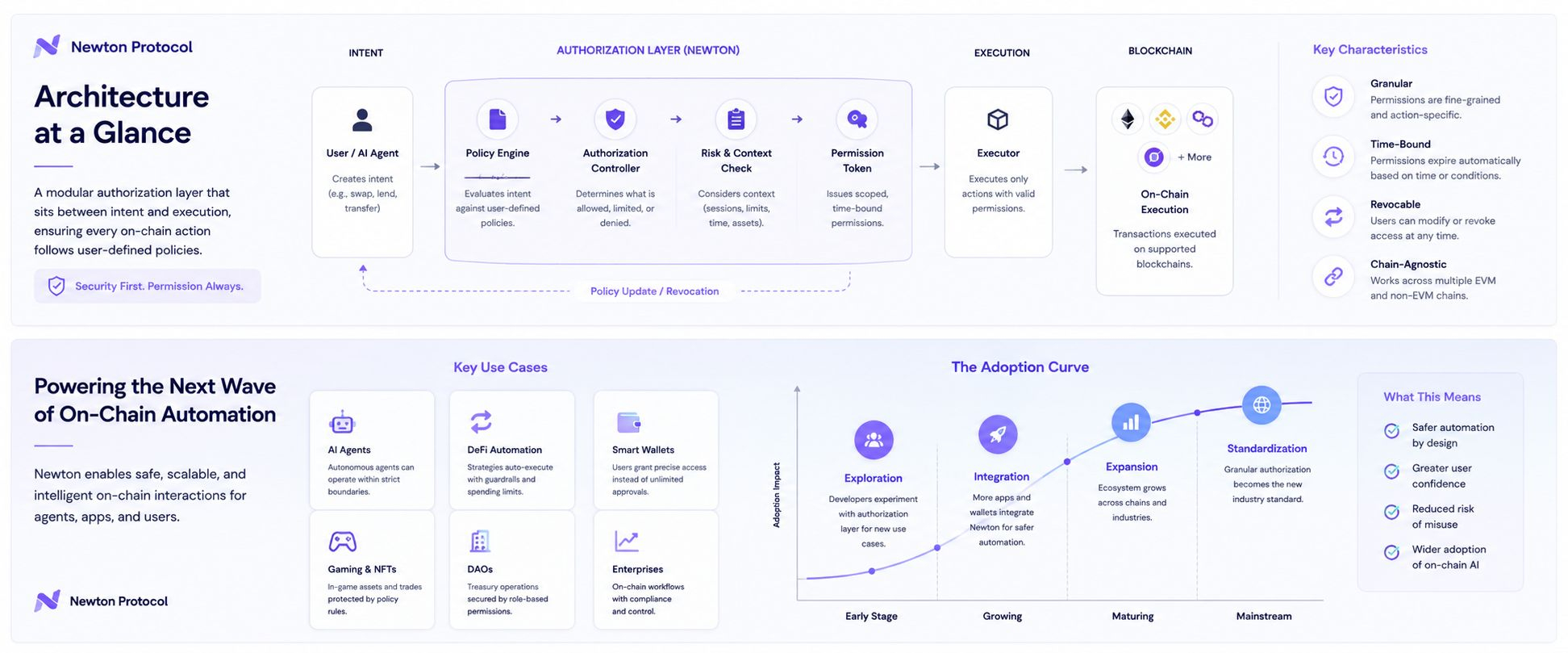
From a systems perspective this separates decision making from execution. An AI agent may determine that swapping assets or interacting with a protocol is appropriate but execution remains subject to authorization rules established beforehand. That architecture resembles mature enterprise security models where authenticated users are still limited by role based permissions rather than receiving unrestricted access.
For developers this could represent a shift away from broad wallet approvals toward more granular permission management. Instead of granting applications effectively unlimited authority over certain assets permissions could be tailored to specific operations spending limits approved contracts or execution conditions. The concept aligns with the broader security principle of least privilege where software receives only the permissions necessary to perform its intended function.
However authorization frameworks also introduce tradeoffs. More granular controls often mean greater implementation complexity. Developers must define meaningful policies wallets need intuitive interfaces for reviewing permissions and users must understand the consequences of the rules they create. Strong security mechanisms lose effectiveness if they become too difficult to configure or audit.
Another challenge is adoption. Authorization infrastructure becomes significantly more valuable when wallets applications and execution environments support compatible standards. Like many infrastructure protocols Newtons long term impact will likely depend not only on its technical design but also on whether the broader ecosystem embraces programmable authorization as a shared layer rather than a project specific feature.
There is also an important distinction between authorization and trust. Newton does not eliminate the need to trust AI models smart contracts or application developers. Instead it attempts to reduce the consequences of failure by limiting what autonomous systems are permitted to do. That is a different security philosophy from trying to build perfect software. It assumes that mistakes are inevitable and focuses on containing their impact.
As AI becomes more integrated with blockchain applications authorization may become just as important as execution itself. Newton Protocol is interesting not because it claims to make AI safer through better models but because it reframes security around predefined permissions. Whether this approach becomes a common infrastructure layer remains uncertain but it highlights a question the industry will likely need to answer: in autonomous systems who decides what software is allowed to do before it acts?

