
When I first came across Newton Protocol (NEWT) I thought it was simply another AI project trying to connect artificial intelligence with blockchain. At first glance, that idea sounded familiar because almost every week a new protocol claims to be building the future of AI in crypto.
After spending much more time reading about the project, its architecture, and the problems it wants to solve, my opinion changed. I realized Newton Protocol is not trying to build another chatbot or another trading bot. Instead, it focuses on something much more fundamental.
It asks a simple question.
How can people safely allow AI agents to perform financial actions on their behalf without giving away complete control?
I think this is a much harder problem than many people realize. Making AI smarter is one challenge. Making AI trustworthy enough to manage real assets is another.
That difference became the most interesting part of my research.
Most AI systems today are very good at generating information. Some can analyze markets, compare investment opportunities, or execute complex workflows. The problem starts when these systems are allowed to interact directly with money.
Imagine giving an AI permission to trade tokens, move assets between chains, provide liquidity, or interact with lending protocols.
If the AI makes a mistake, the damage is immediate.
If someone compromises the AI, the consequences become even worse.
Most existing systems rely heavily on centralized infrastructure, where users simply trust the operator to behave honestly. That may work for small applications, but I do not think it is a good foundation for decentralized finance.
This is exactly the gap Newton Protocol wants to fill.
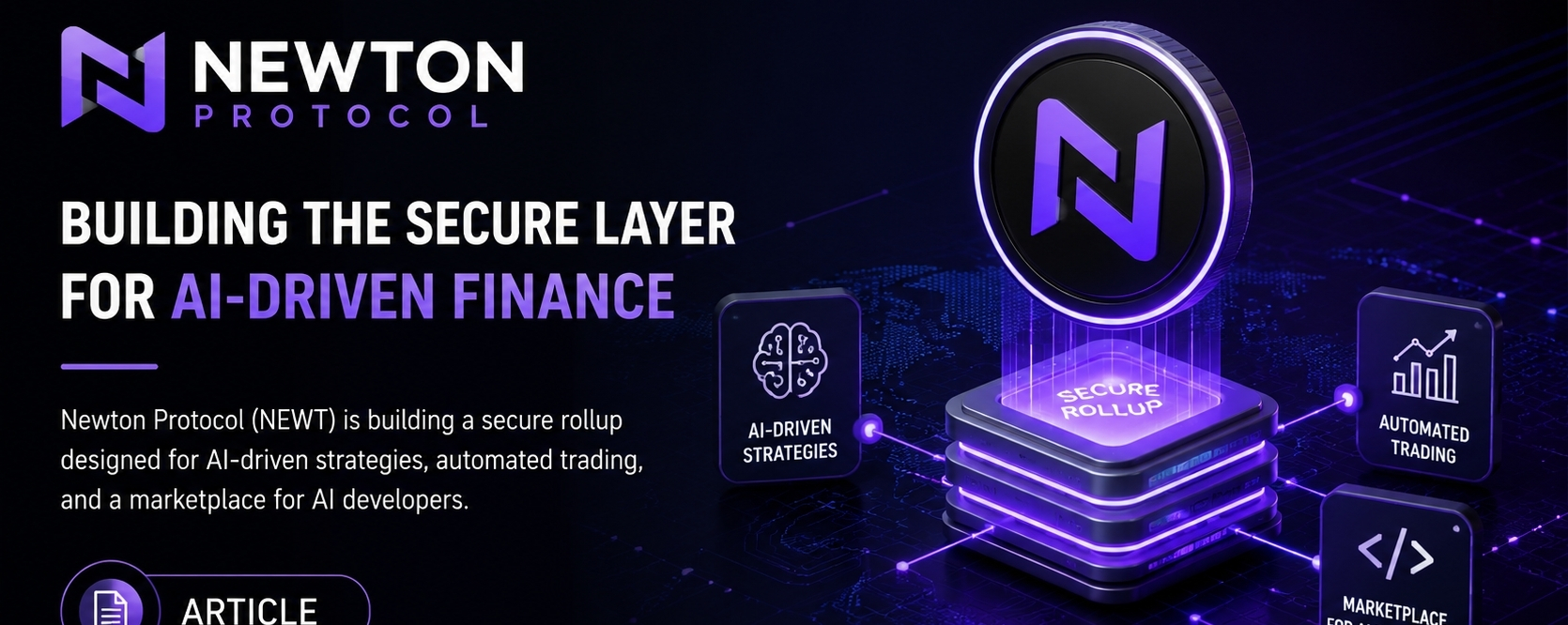
The project is building what it describes as a secure rollup designed specifically for AI-driven execution.
That sounds technical, so I tried breaking it down into simple language.
A rollup is a blockchain that processes transactions separately before settling them on another blockchain for security.
The basic idea is straightforward.
Instead of putting every transaction directly on the main network, the rollup handles most of the work itself while using a larger blockchain as its security foundation.
Why does this matter?
Because AI systems could eventually generate thousands of decisions every day.
Executing every action directly on a major blockchain would become expensive, slow, and difficult to scale.
A specialized rollup gives AI applications their own environment without sacrificing the security of the underlying blockchain.
I like this design because it recognizes that AI workloads are different from normal blockchain activity.
However, the architecture also introduces additional complexity.
Every additional layer creates more software, more infrastructure, and more components that must work correctly.
If any of those pieces fail, users could lose confidence very quickly.
One concept that stood out to me was programmable permission control.
In simple terms, users should be able to define exactly what an AI agent is allowed to do.
For example, instead of giving an AI unlimited wallet access, someone could create rules like these:
Trade only on approved decentralized exchanges.
Never spend more than a certain amount.
Never bridge assets to unknown networks.
Stop automatically after a daily limit.
Request manual confirmation before large transactions.
I think this is a much healthier approach than giving software unlimited authority.
It reminds me of setting spending limits on a company credit card.
Employees receive enough freedom to do their work, but important protections remain in place.
That balance feels practical.
Of course, permission systems are only useful if they cannot be bypassed.
This is where execution security becomes extremely important.
Newton Protocol attempts to verify whether AI actions actually follow predefined rules before those actions become final.
If implemented well, this could reduce many unnecessary risks.
If implemented poorly, it simply becomes another point of failure.
That is something I will continue watching.
Another area that caught my attention is the protocol's marketplace for AI developers.
Instead of every team building isolated AI infrastructure, developers can create reusable agents, automation tools, and strategies that others may eventually use.
I see this as similar to how app stores changed mobile software.
Developers focus on creating useful applications instead of rebuilding the entire operating system every time.
Whether this marketplace succeeds depends entirely on developer adoption.
Technology alone does not create an ecosystem.
People do.
Without enough builders creating valuable tools, even excellent infrastructure remains underused.
Security appears throughout almost every part of Newton Protocol's design.
This makes sense because AI introduces risks that traditional blockchain systems never had to consider.
A smart contract usually follows fixed rules.
An AI agent makes decisions based on changing information.
That flexibility is useful.
It also creates uncertainty.
One possible solution is requiring AI outputs to pass multiple verification steps before execution.
Another is creating transparent audit trails showing exactly why certain actions were taken.
I think both ideas are necessary.
Trust is much easier to build when users can verify decisions rather than simply believe them.
Privacy is another interesting challenge.
AI systems often need large amounts of data to make useful decisions.
Users, however, rarely want their personal financial information exposed.
Newton Protocol appears interested in separating sensitive information from publicly verifiable execution.
The goal is allowing users to benefit from intelligent automation without unnecessarily revealing private information.
This sounds promising.
Still, privacy is rarely perfect.
Every system involves trade-offs between transparency, verification, and confidentiality.
Finding the right balance is never easy.
Decentralization is another topic that deserves attention.
Many AI products today depend almost entirely on centralized servers.
If those servers disappear, everything stops working.
Blockchain tries to avoid exactly that situation.
Newton Protocol appears to move execution toward decentralized infrastructure instead of relying on one company.
I think this aligns much better with crypto's original philosophy.
The challenge is that decentralization often reduces efficiency.
Distributed systems usually move slower than centralized ones.
That trade-off may be worth accepting if it significantly improves security and resilience.
Governance also plays an important role.
Infrastructure like this cannot remain static forever.
Parameters will need updates.
Security improvements will become necessary.
Economic incentives may require adjustment.
Community governance gives token holders an opportunity to participate in those decisions.
At least in theory.
In practice, governance only works when people actually participate.
Many decentralized protocols struggle because voting becomes concentrated among a small number of large holders.
That is a risk Newton Protocol will also need to manage.
The NEWT token appears designed to support several functions inside the ecosystem.
Depending on protocol implementation, tokens may be used for governance participation, staking, transaction fees, incentives, and network security.
I generally prefer tokens that serve multiple operational purposes instead of existing only for speculation.
The real question is whether those utilities create sustainable demand.
A token becomes healthier when users genuinely need it because they actively use the network.
If activity depends only on market excitement, long-term value becomes much harder to maintain.
Staking is another important component.
Simple explanation first.
Staking usually means locking tokens to help secure the network or participate in protocol operations.
In return, participants receive rewards.
The benefit is aligning incentives between users and the network.
The downside is that staking rewards often introduce inflation if they are not balanced by real economic activity.
This is why emissions matter.
If new tokens enter circulation faster than genuine demand grows, long-term pressure can develop.
I always pay attention to emission schedules, unlock calendars, and value capture mechanisms before forming an opinion on any crypto project.
These details often matter more than marketing announcements.
Real-world applications are where Newton Protocol becomes especially interesting.
Imagine an investment fund using AI to rebalance portfolios across multiple chains.
Instead of managers manually executing every trade, AI could identify opportunities while protocol rules ensure predefined risk limits remain intact.
Another example involves decentralized businesses.
A treasury could automatically pay contributors, move stablecoins into yield strategies, and manage operational expenses while every action remains verifiable.
Even individual users could benefit.
Someone might create an AI assistant that continuously searches for better lending rates without ever receiving unlimited wallet permissions.
These examples feel much more practical than simply saying AI will change finance.
Automation becomes valuable when it saves time without sacrificing safety.
Scalability will also influence adoption.
If thousands of AI agents eventually operate simultaneously, the infrastructure must process enormous amounts of activity.
Specialized rollups offer one possible solution.
Still, high throughput alone does not guarantee success.
Reliability under stress matters just as much.
Competition is another reality.
Many blockchain projects are exploring AI infrastructure.
Some focus on decentralized computing.
Others concentrate on autonomous agents.
Some build AI marketplaces.
Others specialize in secure execution.
Newton Protocol enters a rapidly growing field.
Standing out will require more than good ideas.
Execution quality, developer adoption, security history, and ecosystem growth will ultimately determine success.
Every project also carries risks.
Regulation surrounding AI continues evolving.
Security threats become more sophisticated every year.
User expectations change rapidly.
AI itself is advancing so quickly that infrastructure built today may require significant adaptation tomorrow.
I do not see these as reasons to avoid the project.
I see them as factors every serious investor and researcher should monitor carefully.
What impressed me most during my research was that Newton Protocol seems focused on infrastructure instead of hype.
Rather than promising magical AI that solves everything, it concentrates on building the foundations that could make AI execution safer inside decentralized finance.
That feels like a more realistic direction.
The biggest unanswered question for me is adoption.
Strong architecture is valuable, but infrastructure only proves itself when developers actively build on top of it and users trust it with meaningful activity.
That evidence takes time.
After researching Newton Protocol, I came away more interested than I expected.
I appreciate the focus on secure execution, programmable permissions, decentralized infrastructure, and practical automation rather than flashy marketing narratives.
At the same time, I think the project still has important milestones ahead.
I will continue watching how the developer ecosystem grows, how security mechanisms perform in real-world conditions, whether governance remains genuinely decentralized, and whether the token economy supports sustainable network activity over the long term.
Those answers will ultimately determine whether Newton Protocol becomes another interesting experiment or an important piece of future AI-powered blockchain infrastructure.
