
I normally don't jump into new blockchain protocols without a practical reason. I prefer testing real workflows instead of following hype. That's exactly why @NewtonProtocol caught my attention. While researching safer ways to authorize on-chain actions, I discovered its Quickstart guide that promised a complete policy evaluation simulation in just a few minutes. Curiosity turned into genuine interest.
Rather than focusing on tokenomics or marketing, I wanted to understand the technology firsthand. I installed the TypeScript SDK and followed the guided steps. There was no pressure to deploy contracts or configure a complex blockchain environment. The process was refreshingly straightforward, allowing me to focus on the authorization logic itself.
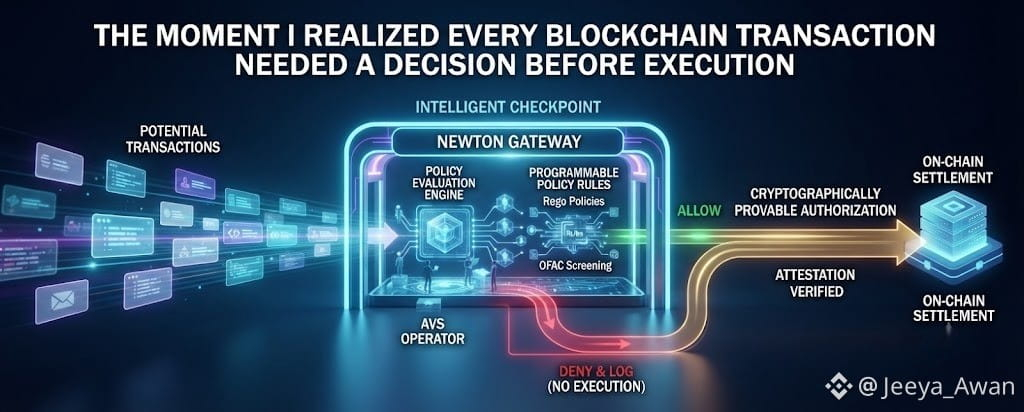
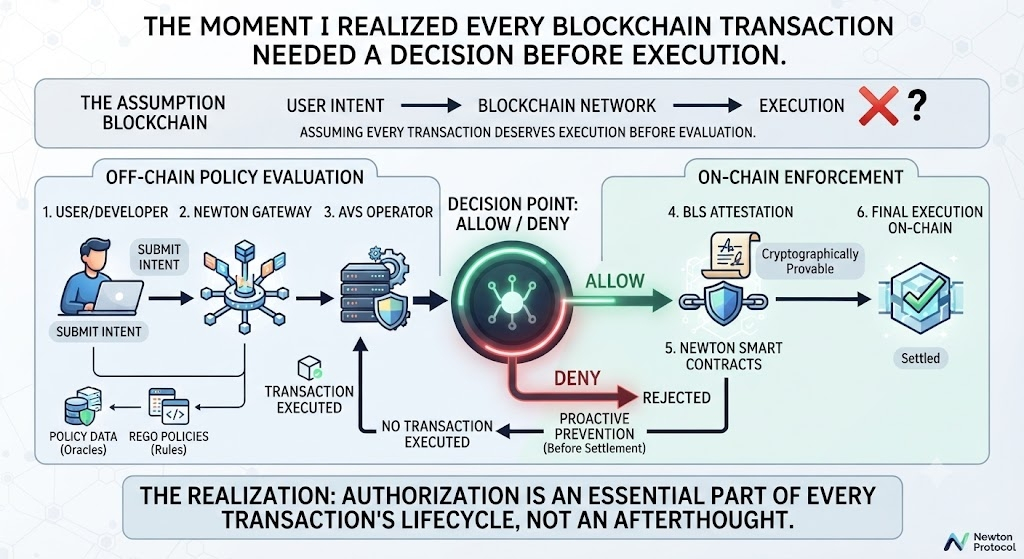
The example simulated an OFAC sanctions screening policy. At first, it sounded like a simple compliance demonstration, but I quickly realized it represented something much bigger. My script created an Intent and submitted it to the Newton Gateway. The gateway selected an available AVS operator, which executed the Rego policy using PolicyData before returning an allow or deny response. The simulation ended there because no blockchain transaction was executed.
That experience helped me understand Newton's architecture far better than any whitepaper could. Instead of assuming every transaction deserves execution, Newton introduces an intelligent checkpoint. Policies become programmable rules that determine whether an action satisfies predefined conditions before anything reaches the chain.
The biggest reason I continued exploring Newton was the production workflow. In a live environment, the evaluation doesn't stop with a simple response. Operators generate a BLS attestation that smart contracts verify on-chain before execution. That means authorization becomes cryptographically provable rather than based on trust alone. For me, this was the missing piece that connected off-chain policy evaluation with on-chain enforcement.
I also appreciated how the Quickstart balanced simplicity with realism. Even though it was only a simulation, every component reflected the production architecture. I could clearly see how the Gateway coordinated operators, how Rego policies evaluated requests, and how oracle-backed PolicyData influenced decisions. It felt less like a tutorial and more like a miniature version of a real decentralized authorization network.
The reason I chose Newton over many other infrastructure projects is simple. Most blockchain tools help developers monitor events after transactions have already happened. Newton focuses on preventing unsafe or unauthorized actions before settlement. That proactive approach makes far more sense for modern DeFi, institutional finance, and any application that requires programmable trust.
Looking back, the Quickstart wasn't just another developer exercise. It reshaped how I think about transaction security. Authorization shouldn't be an afterthought added around smart contracts, it should be an essential part of every transaction's lifecycle. Newton Protocol demonstrated that idea in a practical way, and that's why it remains one of the most memorable blockchain technologies I've personally explored.
