Advantage💓 and Disadvantage 💔of Bitcoin !
Bitcoin $BITCOIN is a complex financial instrument that functions as both a decentralized digital currency and an asset often referred to as "digital gold." As of 2026, its role in the global economy has matured, with increased institutional adoption and mainstream access via ETFs, though its fundamental characteristics remain a subject of intense debate.
Here is a breakdown of the primary advantages and disadvantages of Bitcoin.
Advantages of Bitcoin
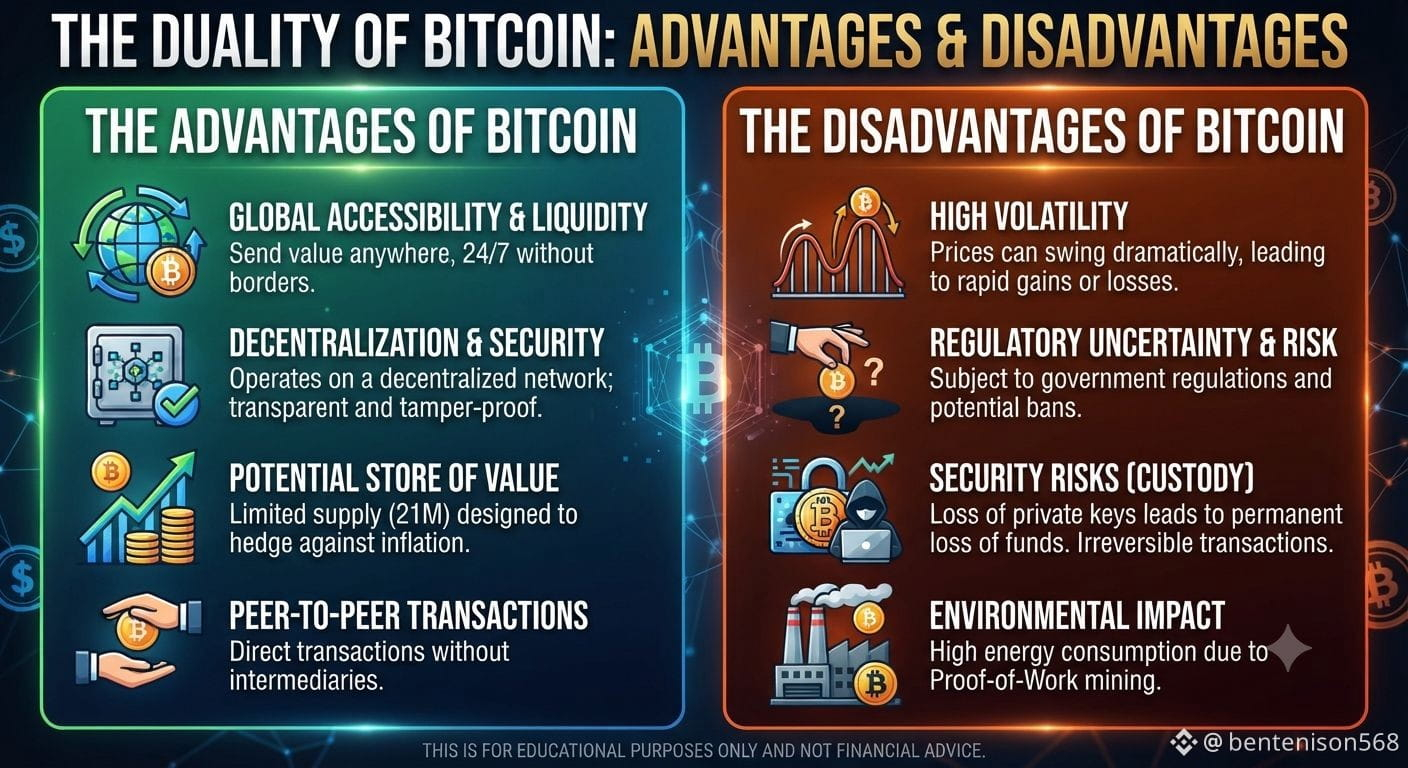
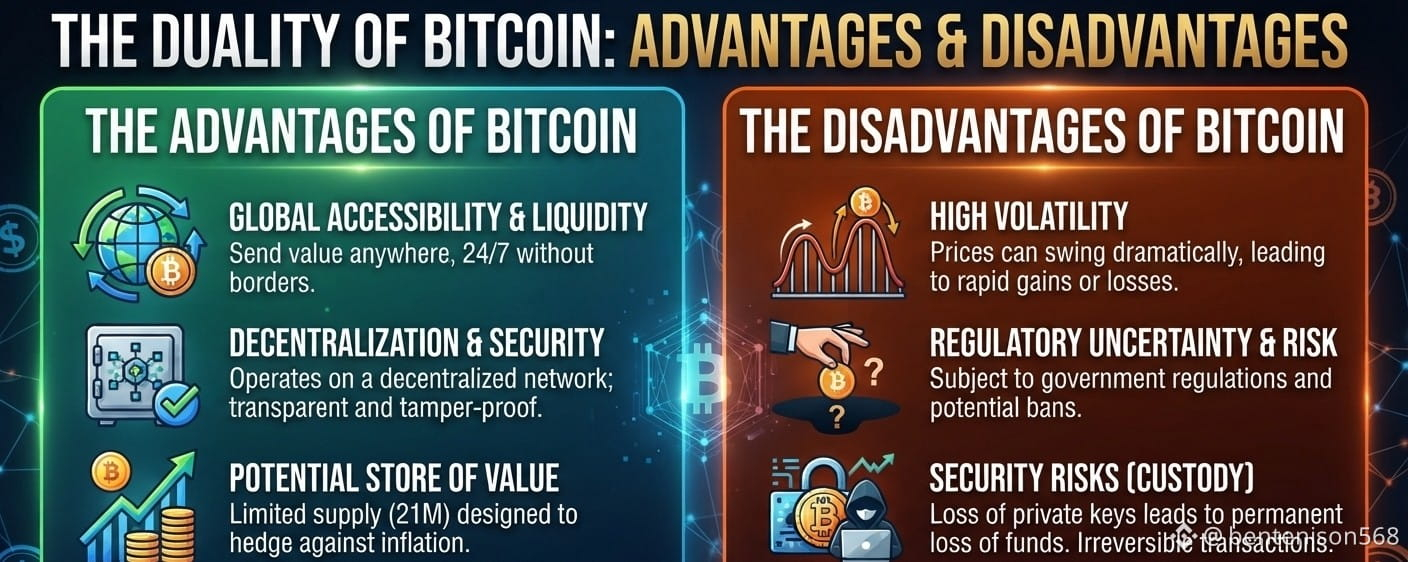
Store of Value & Scarcity: Bitcoin has a hard cap of 21 million coins. This algorithmic scarcity is designed to protect against the inflationary pressures often seen with fiat currencies, leading many to view it as a hedge against the debasement of traditional money.
Decentralization: Bitcoin operates on a peer-to-peer network without the need for central authorities (like banks or governments). This makes it censorship-resistant and gives users full control over their own assets.
Global Accessibility & Liquidity: As a borderless, digital asset, Bitcoin can be sent anywhere in the world 24/7. It also boasts high liquidity, meaning it can be converted to cash or other assets rapidly on global exchanges.
Transparency and Security: All transactions are recorded on an immutable public ledger (the blockchain). The underlying cryptographic security makes unauthorized changes to the transaction history virtually impossible.
Institutional Integration: With the approval of spot Bitcoin ETFs and increasing corporate treasury adoption, Bitcoin has moved toward mainstream financial legitimacy, making it easier for retail and institutional investors to add to their portfolios.


#Disadvantages of Bitcoin
Extreme Volatility: Price swings of 20–50% are not uncommon. For investors who require stability or have short-term financial goals, this volatility can lead to significant financial loss and psychological stress.
Custody Risks: "Not your keys, not your coins." If an investor loses their private keys or is the victim of a phishing attack, their funds are permanently unrecoverable. There is no "customer service" to reverse a transaction or reset a password.
Irreversibility: Once a transaction is sent on the blockchain, it cannot be reversed. If you send funds to the wrong address or are scammed, the loss is usually final.
Energy Consumption: Bitcoin’s "Proof-of-Work" consensus mechanism requires significant computational power. While miners are increasingly turning to renewable energy sources, the network's energy footprint remains a major point of criticism regarding environmental impact.
Regulatory Uncertainty: Although mainstream adoption is growing, Bitcoin remains sensitive to government regulations. Changes in tax laws, exchange requirements, or global bans can cause sudden market shocks.
Scalability and Transaction Efficiency: While layers like the Lightning Network are improving this, the base Bitcoin network is relatively slow compared to modern payment systems like Visa. Using it for daily micro-transactions can also incur fees that make it impractical for low-value purchases
#bitcoin #Bitcoin❗ #UpdateAlert #viralpost @Binance Pakistan @Mila Rose @shah noor12 @Binance Margin