
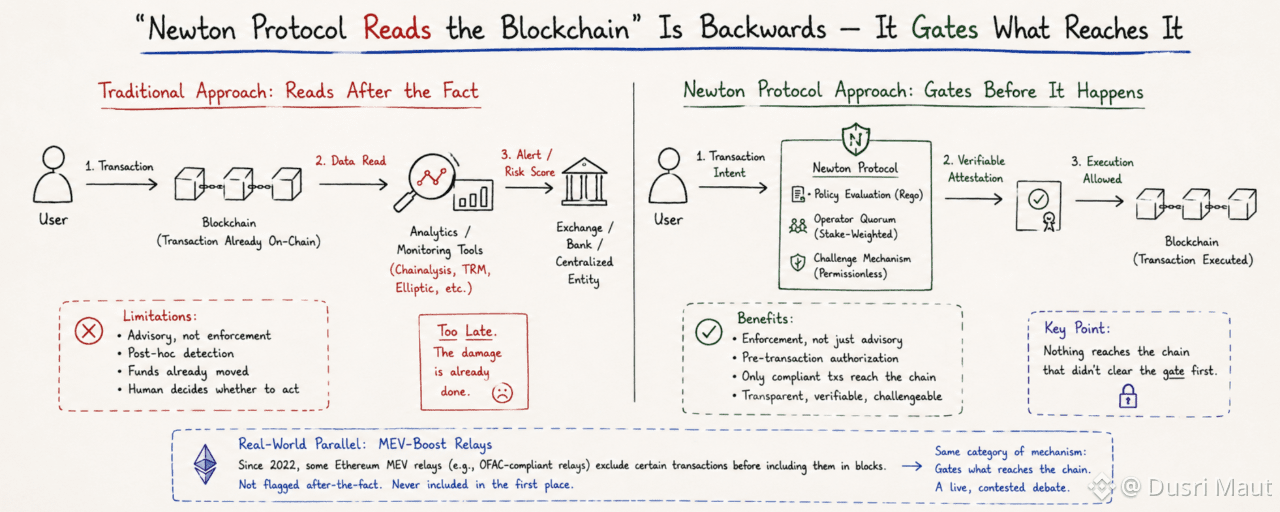
While researching Newton Protocol, I noticed one misconception that kept coming up in discussions. Many people describe it as a protocol that "reads the blockchain" to make compliance decisions. At first, that sounded reasonable to me because that's how most of us have learned to think about onchain compliance. But after digging into the whitepaper, I think that description actually misses the core of what Newton is trying to do.
When people hear "blockchain compliance," they usually think of companies like Chainalysis, TRM Labs, or Elliptic. Their job is to analyze transactions that have already happened. They cluster wallets, trace fund flows, identify suspicious patterns, and assign risk scores based on historical activity. Even when these platforms operate in real time, they're still providing recommendations to exchanges, banks, or other centralized organizations. The blockchain itself doesn't enforce those recommendations. By the time an alert appears, the transaction has already become part of blockchain history.
What stood out to me is that Newton's architecture works in the opposite direction. Instead of analyzing completed transactions, it evaluates a transaction before it ever reaches the blockchain. A user's transaction intent is checked against predefined policies, and only after a valid authorization is produced can the smart contract continue with execution. In other words, Newton isn't primarily reading blockchain history. It's acting as a gate before new history is written.
That doesn't mean Newton ignores onchain data. In fact, onchain behavior is one of the credential types its policy engine can evaluate. Transaction history, wallet age, and previous protocol interactions can all become inputs when a policy is being evaluated. But after reading through the documentation, I think that's an important distinction. Reading blockchain history is simply one possible input. It isn't the protocol's defining mechanism. The defining mechanism is deciding whether a transaction should be allowed to become blockchain history in the first place.
What made this even more interesting to me is that Ethereum has already been debating a similar idea for years. Since the Tornado Cash sanctions, parts of the Ethereum ecosystem have relied on MEV relays that exclude certain transactions before they are included in a block. Those transactions aren't flagged afterward. They simply never make it onchain. That is also a form of pre-execution gating, and it has become one of the most controversial discussions around censorship and decentralization.
This is where I think Newton's design deserves a closer look. The protocol isn't trying to hide the fact that it gates transactions before execution. The real question is how that gating is implemented. Instead of relying on a single centralized decision maker, Newton uses a stake-weighted quorum of operators. Policies are openly defined rather than hidden behind proprietary filter lists, and incorrect decisions can be challenged through a permissionless verification process. Whether that is enough to satisfy everyone is still an open question, but I think it changes the conversation.
My biggest takeaway is that saying "Newton Protocol reads the blockchain" actually understates what the protocol is designed to do. Reading history tells you what already happened. Gating determines what gets the chance to happen at all. That difference isn't just technical. It changes how we think about compliance, enforcement, and decentralization. The more I looked into Newton's architecture, the more I felt the real debate isn't whether pre-execution authorization is powerful. It clearly is. The real question is whether it can remain transparent, verifiable, and neutral as it scales. I think that's the discussion worth having.
@NewtonProtocol #Newt $NEWT $POND $RIF