
familiar promise: more automation, better efficiency, and smarter decisions. Artificial intelligence is following the same path, but it also raises a question that feels far more important than speed or convenience. If an AI system is making decisions that affect real assets, who verifies that those decisions are executed exactly as intended? Trust has always been one of the hardest problems in digital finance, and AI only makes that challenge more complex.
For years, blockchain and artificial intelligence have developed at an impressive pace, yet they rarely solved each other's biggest weaknesses. Blockchain offers transparency but struggles with heavy computation, while AI can analyze enormous amounts of information but often operates inside systems that users cannot easily inspect. As these technologies begin to intersect, the conversation is shifting away from building smarter AI models toward building environments where those models can operate more responsibly.
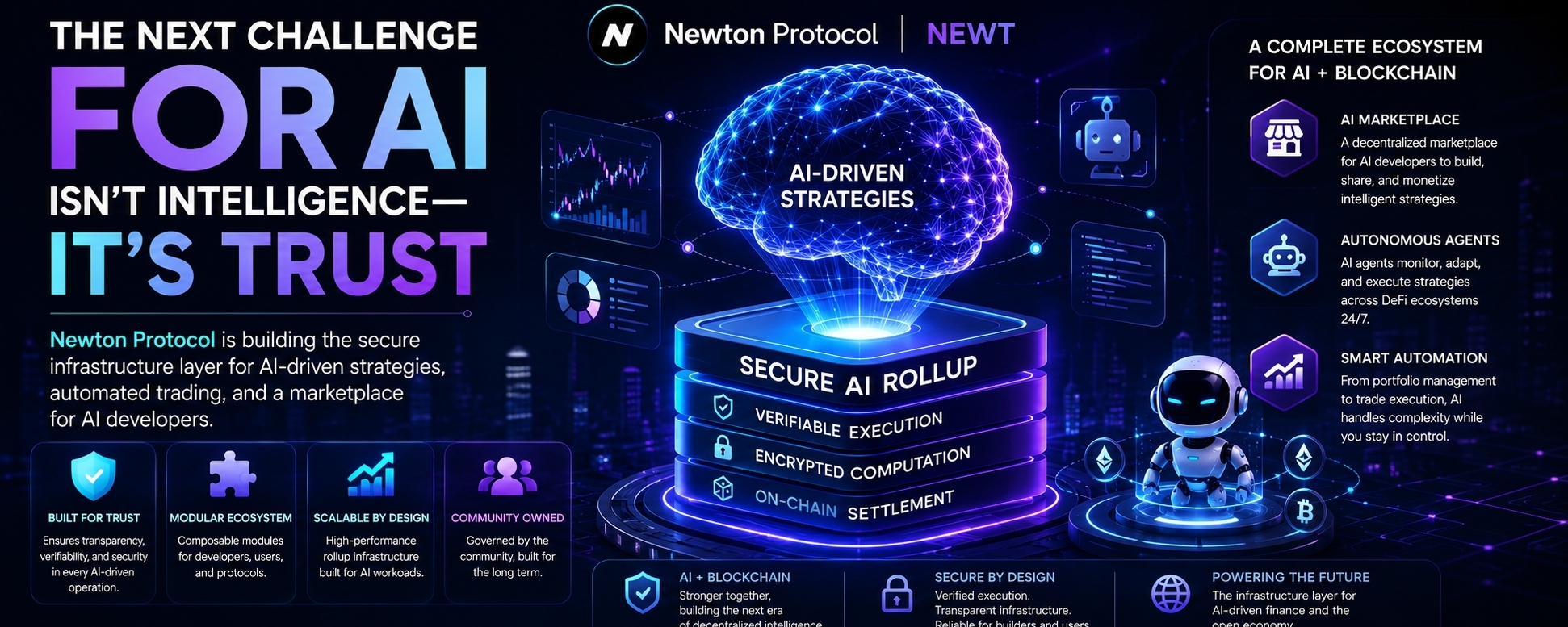
This is where Newton Protocol enters the discussion. Rather than presenting itself as another AI application, it focuses on the infrastructure behind AI-powered automation. The project explores how a secure rollup could support AI-driven strategies, automated execution, and a marketplace where developers contribute specialized AI services. Instead of asking users to blindly trust intelligent software, the idea is to make the execution process more transparent and verifiable within blockchain ecosystems.
One of the interesting aspects of this approach is its recognition that modern AI simply cannot run efficiently on public blockchains. The computing requirements are too large, too expensive, and too slow. Newton Protocol attempts to separate complex AI computation from blockchain settlement while still allowing results to be verified before they interact with decentralized applications. It is not trying to force blockchain to become an AI computer. Instead, it is trying to build a bridge between two technologies with very different strengths.
The ecosystem also imagines a future where developers create AI tools that others can discover and use instead of building everything from scratch. In theory, this could encourage collaboration while making advanced AI capabilities available to a wider range of projects. Whether such marketplaces can maintain quality, security, and fairness over time is still an open question, but the concept reflects a growing interest in treating AI services as reusable digital infrastructure rather than isolated products.
Automation is another important piece of the conversation. AI agents are increasingly expected to monitor markets, execute transactions, and respond to changing conditions without constant human involvement. That level of automation may improve efficiency, yet it also increases the importance of reliable execution. Even an intelligent strategy loses value if the surrounding infrastructure cannot guarantee that instructions are carried out securely and consistently.
Security remains one of the biggest challenges for any AI-powered ecosystem. Protecting digital assets is no longer only about safeguarding private keys or preventing network attacks. AI systems introduce new risks, including manipulated training data, unexpected model behavior, and vulnerabilities within execution environments. Infrastructure can reduce some of these risks, but no architecture can eliminate uncertainty entirely. Responsible design means acknowledging these limitations rather than pretending they do not exist.
Perhaps the most valuable part of Newton Protocol is not a single feature but the broader discussion it represents. The industry is gradually moving beyond asking whether AI belongs in blockchain and toward asking how AI should operate within decentralized systems. That shift may prove more important than any individual protocol because it encourages deeper thinking about verification, accountability, and the balance between automation and human oversight. As AI becomes a larger part of digital finance, the real challenge may not be building more intelligent systems, but building systems that people have good reasons to trust.