
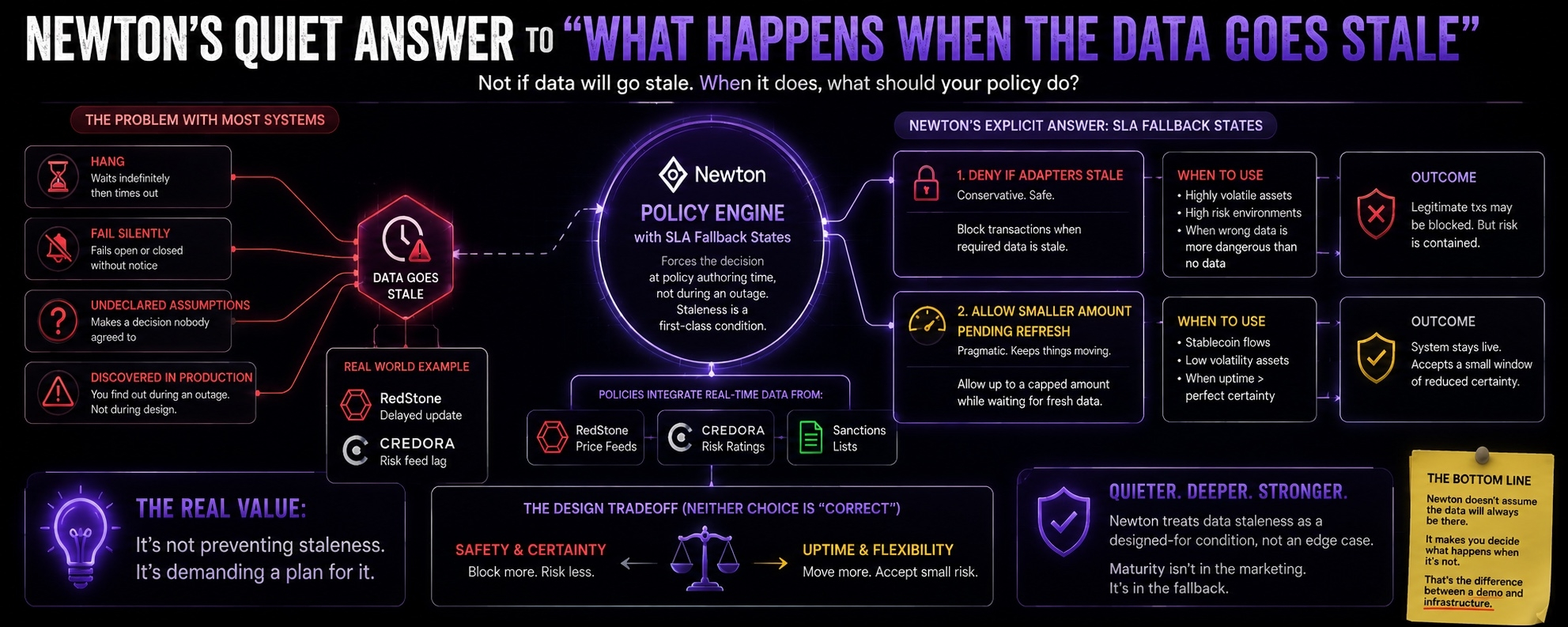
Every policy engine eventually runs into the same uncomfortable question. What happens when the system needs to check something and the thing it needs to check against simply is not available in that exact moment? Most compliance systems do not answer this well. They either hang, fail silently, or make an assumption nobody agreed to in advance. Newton's mainnet beta actually writes an answer into the policy itself, and the design decision behind it is worth slowing down on.
Buried in Newton's architecture is a concept called SLA fallback states. A policy is not just a rule like "block sanctioned wallets" or "cap daily spend at five thousand dollars." It can also specify what should happen if the oracle adapter feeding it real time data goes stale. A curator can write something like "deny if adapters stale" as an explicit condition, or something softer, like "allow up to a smaller amount pending adapter refresh." That second option is functionally the same CAP behavior other parts of Newton's risk domain use, but here it is applied specifically to the data freshness problem rather than the risk threshold problem.
I want to walk through why this matters more than it sounds. Picture a vault curator who never thought about this scenario, because most people building compliance logic assume the data feed will just always be there. Their policy checks a price feed, checks a risk rating, checks a sanctions list, and assumes all three respond instantly and correctly every single time. Then one day RedStone has a delayed update, or Credora's risk feed lags behind schedule during a network congestion spike, and the policy has nothing defined for that moment. Depending on how the underlying code handles an undefined case, the system either halts every transaction touching that vault, or worse, defaults to approving everything because nobody wrote an explicit denial path.
Newton forces this decision to be made explicitly, at the time a policy is authored, not discovered accidentally in production during an actual outage. That is the real value here. It is not that Newton prevents oracle staleness, no protocol can promise that. It is that Newton makes staleness a first-class condition a curator has to think through and declare a stance on, the same way a good contract forces you to define behavior for every edge case instead of letting undefined behavior slip through.
There is a real design tradeoff buried in here too. A "deny if stale" fallback is conservative and safe, but it means legitimate transactions get blocked purely because a data provider had a bad five minutes, not because anything was actually wrong with the transaction itself. An "allow smaller amount pending refresh" fallback keeps things moving but means a curator is explicitly accepting a small window of reduced certainty in exchange for uptime. Neither choice is objectively correct. A vault holding highly volatile assets probably wants the conservative fallback, because a stale price during a volatile moment is genuinely dangerous. A vault handling routine stablecoin transfers with low volatility might reasonably prefer the softer fallback, because the cost of unnecessary friction outweighs the marginal risk of a slightly stale check.
What strikes me is how much this resembles good infrastructure engineering outside crypto entirely. Any serious distributed system, a payments processor, a cloud service, a trading platform, eventually has to answer the exact same question: what do you do when a dependency you rely on is temporarily unavailable, and you cannot wait forever for it to come back? The mature answer is never "assume it will always work." The mature answer is a documented, deliberate fallback policy, chosen in advance, tested before it matters. Newton is applying that same discipline to onchain compliance, an area of crypto that has historically treated data availability as a given rather than a variable that needs a fallback plan.
None of this is visible in Newton's flashier marketing material about programmable compliance and institutional trust. It is a structural detail buried in the SLA design of the policy engine. But it is exactly the kind of detail that separates infrastructure built by people who have actually run production systems under real failure conditions from infrastructure that only looks robust in a demo. A demo never has a stale oracle. Production always eventually does.
Newton's fallback state design forces every policy author to explicitly declare how a rule should behave when the data behind it is not available, rather than leaving that decision to whatever the underlying code happens to do by default. It treats data staleness as a designed-for condition instead of an edge case discovered the hard way, and it leaves the actual tradeoff between conservative denial and graceful degradation in the hands of whoever understands the specific vault best. That is a quieter kind of engineering maturity than most compliance narratives in this space bother to talk about.
@NewtonProtocol $NEWT #Newt $TAIKO
