
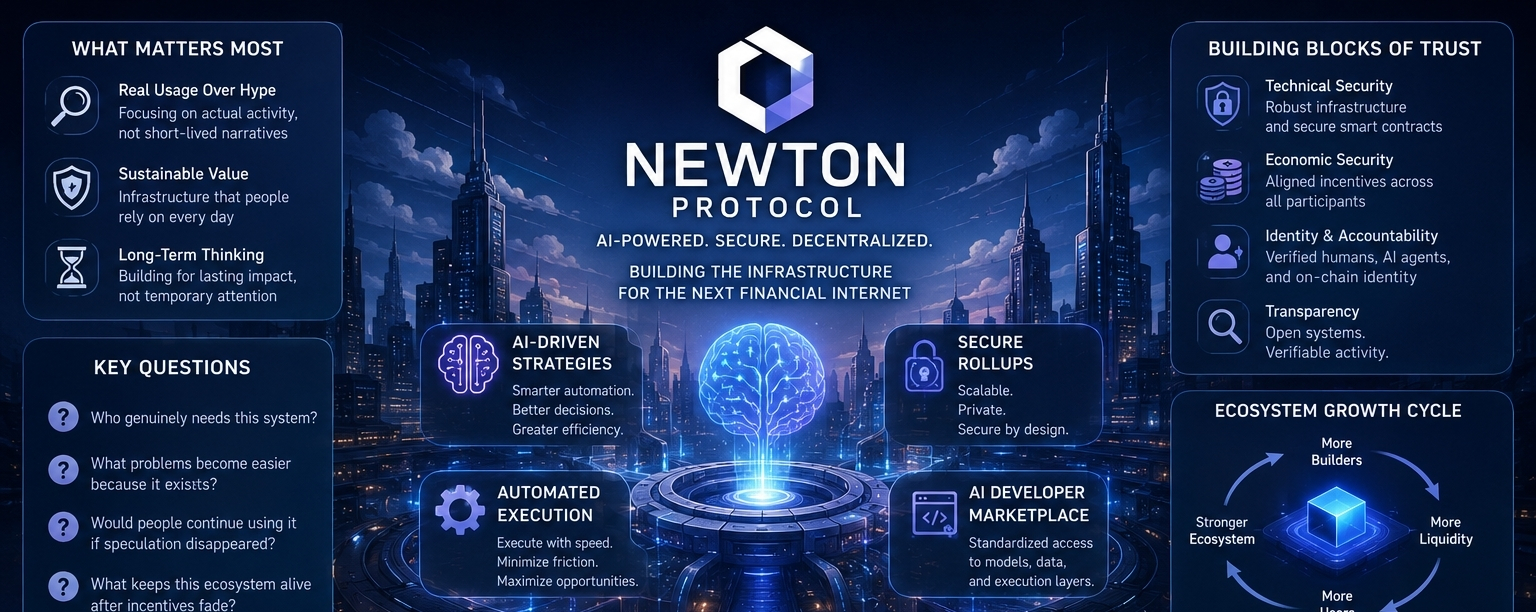
I've noticed that the projects holding my attention lately are not always the ones making the most noise. I started paying attention to real usage instead of short-lived narratives because the market has repeatedly shown me that attention alone rarely creates lasting value. When I look at Newton Protocol, I find myself asking the same questions I ask every infrastructure project. Who genuinely needs this system? What problems become easier because it exists? Would people continue using it if speculation disappeared for a while? Those questions matter more to me than token price because infrastructure only becomes meaningful when it quietly supports activity that people depend on every day.
The idea of combining AI-driven strategies with secure rollups and automated execution sounds ambitious, but ambition alone does not create economic activity. I keep thinking about whether developers actually have reasons to build on this foundation instead of choosing existing alternatives. Every blockchain eventually competes for developers, liquidity, users, and trust at the same time. Those four elements reinforce each other, but they cannot simply be manufactured through incentives forever. If developers arrive only because rewards are attractive, I wonder how many remain once those rewards become smaller. If liquidity appears because of temporary campaigns, I also wonder whether it stays when market conditions become less favorable.
One part that interests me is the marketplace for AI developers because AI continues expanding into more industries, yet coordination remains difficult. Different models, different data sources, and different execution environments create fragmentation. A protocol that helps standardize interactions could become useful if it genuinely reduces friction. Still, usefulness is something that should be visible through growing activity instead of marketing claims. I prefer watching transaction patterns, developer commits, integrations, and returning users rather than announcements. Sustainable ecosystems usually reveal themselves through consistent behavior rather than dramatic headlines.
Trust feels even more important when AI is involved. Automated strategies can execute decisions at speeds humans cannot match, but that also increases the consequences of mistakes. I keep wondering how much confidence users will have in systems that allow AI to manage financial actions. Technical security is only one layer. Economic security matters just as much because incentives influence behavior across every participant in the network. If validators, developers, traders, and application builders all benefit from keeping the system healthy, the protocol has stronger foundations. If incentives become misaligned, confidence can disappear surprisingly quickly.
Liquidity is another area I continue watching carefully. Infrastructure without liquidity often struggles to create meaningful economic activity because users need efficient markets to interact with applications. Healthy liquidity usually attracts more builders, while more builders create additional reasons for liquidity to remain. It becomes a cycle, but reaching that stage is difficult. I often ask myself whether liquidity exists because people genuinely use the protocol or because temporary capital is chasing rewards. Those are very different situations even if the numbers initially look similar.
Identity also seems increasingly relevant as AI becomes capable of generating content, executing transactions, and interacting with decentralized systems. Knowing whether an action belongs to a verified participant, an autonomous agent, or an anonymous actor could become an important piece of future blockchain infrastructure. I do not think every application requires strong identity, but financial coordination often benefits from greater accountability. If Newton Protocol can contribute to that balance without sacrificing openness, it could solve practical problems instead of theoretical ones.
I also think about adoption beyond crypto-native communities. Institutions, governments, and regulated financial entities generally move much slower than retail participants, but they also represent significant capital flows once confidence develops. Infrastructure projects that acknowledge compliance requirements while preserving decentralization may find opportunities as regulation becomes clearer across different regions. At the same time, excessive dependence on regulatory approval could reduce flexibility. Finding the balance between innovation and compliance is rarely simple, especially when AI introduces additional questions about responsibility and decision-making.
Developer activity often tells me more than community excitement. Consistent software updates, documentation improvements, open collaboration, and third-party integrations usually indicate that a project is evolving because people see long-term potential. I rarely assume that a growing social media presence automatically reflects meaningful adoption. Real ecosystems often spend years building quietly before wider recognition arrives. I try to separate visible attention from measurable progress because those two things frequently move at different speeds.
Token utility is another topic I examine with caution. Every protocol introduces a token, but not every token becomes economically necessary. I want to understand whether the asset plays an essential role in securing the network, coordinating participants, paying for services, or governing future development. If the protocol could function almost identically without its token, I become more skeptical about long-term demand. Sustainable value generally emerges when the token supports genuine economic activity rather than existing primarily as a speculative instrument.
Market behavior also reveals interesting signals over time. Sharp price movements often receive the most attention, but they rarely answer the deeper questions I care about. I pay more attention to whether users return after volatility fades. I look for evidence that developers continue building during slower markets because those periods often reveal genuine conviction. Bull markets make almost every narrative sound convincing, while quieter conditions expose which ecosystems continue creating value regardless of sentiment.
I also consider global economic conditions because capital rarely flows in isolation. Higher interest rates, tighter liquidity, changing regulations, and geopolitical uncertainty all influence investment decisions across digital assets. Infrastructure projects must compete not only with other crypto ecosystems but also with traditional investment opportunities. That reality makes sustainable adoption even more important. Projects that rely exclusively on speculative enthusiasm may struggle when broader financial conditions become less supportive.
The biggest question I continue asking myself is what keeps this ecosystem alive after incentives become ordinary instead of extraordinary. Every successful network eventually reaches a point where genuine demand replaces promotional campaigns. If users continue interacting because the infrastructure solves practical problems, then the foundation becomes stronger over time. If activity declines as rewards disappear, then the market has already answered an important question. That is why I remain patient. I am not trying to predict every short-term move. I am trying to understand whether Newton Protocol can develop into infrastructure that people quietly rely on because it consistently delivers value rather than because it temporarily captures attention.
