Artificial intelligence is becoming one of the most transformative technologies of our time. From writing content and analyzing data to executing financial strategies, AI is rapidly moving from an assistant to an autonomous decision-maker. In the blockchain industry, this evolution is opening the door to AI-powered wallets, automated trading, treasury management, and decentralized financial assistants. Yet one important question remains unanswered: Can we trust AI with digital assets without a way to verify its actions?
This question sits at the heart of Newton Protocol's mission. While many projects focus on making AI smarter, Newton Protocol focuses on making AI trustworthy. Its vision is not simply to automate blockchain transactions but to ensure every automated action follows clear, programmable, and verifiable rules.
As AI becomes more involved in managing digital assets, verifiable execution will be the difference between innovation that people embrace and automation they hesitate to trust.
The Rise of AI in Blockchain
AI is already transforming Web3. Intelligent agents can monitor market conditions, optimize DeFi positions, rebalance portfolios, detect opportunities, and automate repetitive tasks around the clock.
These capabilities save time and improve efficiency. However, blockchain transactions are permanent. Unlike traditional banking, there is often no option to reverse an incorrect transaction. Even a small mistake by an AI system could lead to significant financial loss.
This is why security and verification are becoming just as important as intelligence.
The Challenge of Blind Trust
Many current AI systems require broad wallet permissions to operate. Once permission is granted, users may have limited visibility into how decisions are made or whether transactions follow their intentions.
Blind trust introduces unnecessary risk.
Users need assurance that AI agents cannot exceed predefined spending limits, interact with unauthorized wallets, or violate security policies.
Verifiable execution addresses these concerns by ensuring that every blockchain action follows rules established before execution.
Newton Protocol's Approach
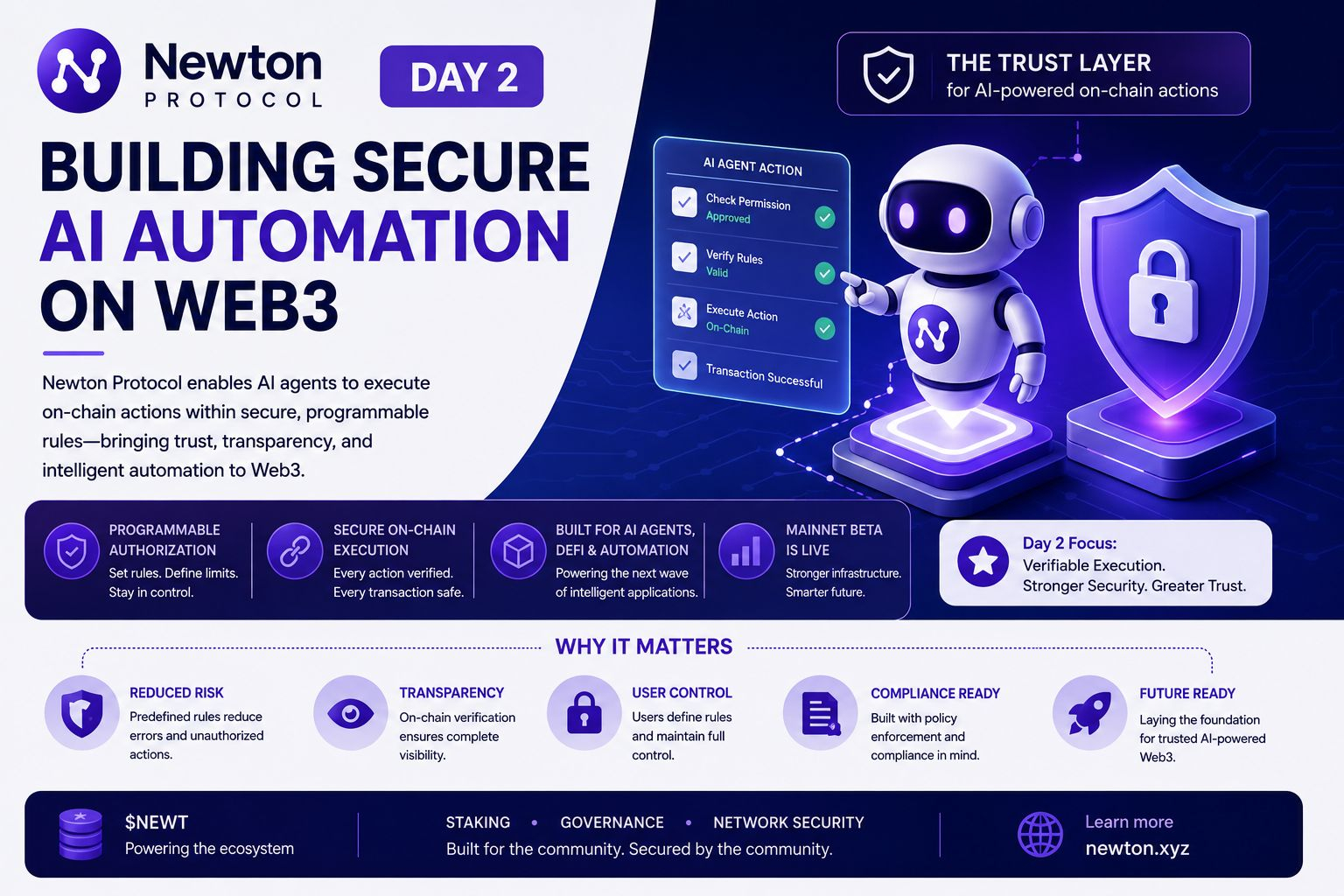
Newton Protocol introduces programmable authorization between AI agents and blockchain execution.
Instead of giving AI unlimited control, users define policies that determine exactly what actions are permitted. These rules are verified before transactions are executed.
This creates a security layer that protects users while still allowing AI to automate complex workflows.
Rather than replacing human control, Newton Protocol strengthens it through transparent automation.
Why Verifiable Execution Matters
Verification transforms AI from a system users hope will behave correctly into one that is required to follow predetermined rules.
This approach provides several advantages:
Greater transparency
Reduced operational risk
Stronger wallet security
Improved compliance
Better user confidence
As AI becomes more capable, these benefits become increasingly valuable.
Mainnet Beta Marks an Important Milestone
Newton Protocol recently introduced its Mainnet Beta, an important step toward delivering secure AI infrastructure for Web3.
The Mainnet Beta demonstrates the project's commitment to building practical solutions rather than theoretical concepts. It allows developers and users to experience programmable authorization within a live blockchain environment.
This milestone reflects steady ecosystem progress and reinforces Newton Protocol's long-term vision.
The Role of the NEWT Token
The NEWT token supports the Newton Protocol ecosystem in multiple ways.
It contributes to network security through staking, enables community participation through governance, and supports ecosystem growth as adoption expands.
Rather than existing only as a speculative asset, NEWT is designed to help power the protocol itself.
Building for Developers
Developers play a critical role in AI adoption.
Newton Protocol provides infrastructure that allows builders to integrate secure authorization into their applications instead of creating custom security systems from scratch.
This reduces development complexity while improving user protection.
As more AI-powered applications emerge, standardized authorization infrastructure may become an essential component of Web3 development.
Looking Ahead
AI and blockchain are evolving together.
The future will likely include autonomous financial assistants, intelligent payment systems, decentralized AI marketplaces, and advanced on-chain automation.
However, none of these innovations can achieve mainstream adoption without trust.
Newton Protocol recognizes that intelligence alone is not enough. Automation must also be transparent, secure, and verifiable.
By focusing on programmable authorization and secure execution, Newton Protocol is building infrastructure that addresses one of the most important challenges facing AI-powered Web3.
Conclusion
The future of blockchain will not depend solely on smarter AI but on trustworthy AI. Newton Protocol is creating the infrastructure needed to ensure automated blockchain actions remain secure, transparent, and accountable. With the launch of Mainnet Beta and the utility of the NEWT token supporting the ecosystem, the project continues moving toward its vision of trusted autonomous finance. As AI becomes more integrated into Web3, verifiable execution may become one of the industry's most valuable foundations.