
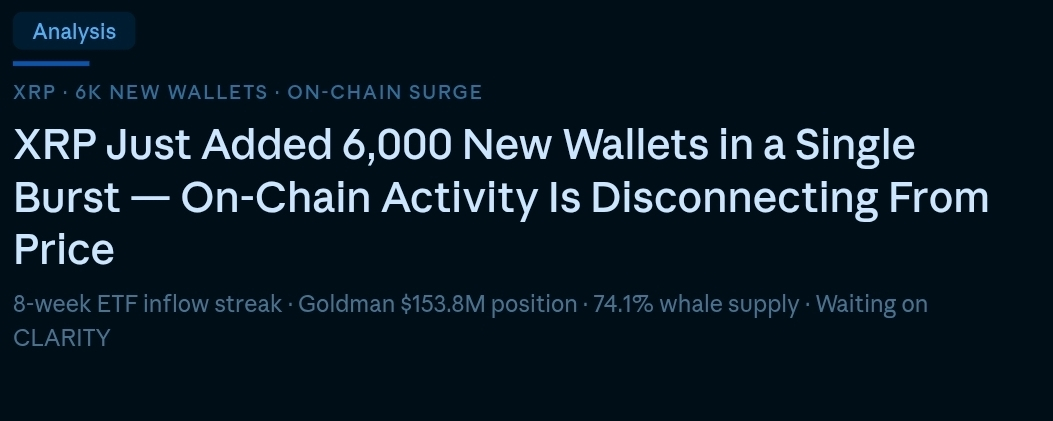
XRP network activity surged with a burst of 6,000 new wallets, currently trending on Binance's search leaderboard, and the story here is a genuinely interesting divergence between what's happening beneath the surface versus what the price chart shows.
The $XRP Ledger — Ripple's underlying blockchain — has been quietly one of the most consistently used networks in crypto in terms of pure transaction throughput, thanks to its sub-4-second settlement finality and near-zero transaction costs, which make it structurally attractive for payment-focused use cases even when the token's speculative price action is disappointing holders. A burst of 6,000 new wallets in a short window signals either a specific application or integration driving fresh onboarding, an airdrop or incentive campaign pulling in new addresses, or organic growth tied to one of Ripple's expanding institutional partnerships.
This fits the pattern I've been documenting around XRP for weeks now. XRP ETFs logged their 8th straight week of net inflows even while Bitcoin ETFs bled billions. Goldman Sachs disclosed a $153.8 million XRP ETF position. $RLUSD , Ripple's stablecoin, has grown to $1.43 billion market cap with BlackRock accepting it as collateral. Whale wallets holding over 1 million XRP control 74.1% of circulating supply and have been accumulating steadily. Every one of these data points describes structural, institutional-grade activity happening on and around the XRP Ledger, largely independent of the token's day-to-day price movement.
The honest complication remains unchanged: none of this on-chain and institutional activity has translated into a price breakout yet. XRP trades near $1.04, down significantly from its January 2026 peak of $2.40, and the broader macro selloff dragging every crypto asset lower has clearly overwhelmed whatever positive signal this network activity represents in isolation. New wallet growth is a leading indicator of network health and future utility, not a guarantee of near-term price appreciation — the two can and do diverge for extended periods.
What would need to happen for this on-chain strength to finally show up in price? The CLARITY Act remains the single biggest overhanging catalyst — and it just hit fresh Senate hurdles this week, directly tied to Trump's $1.4 billion crypto disclosure making Democratic senators more politically cautious about voting yes. Until that regulatory catalyst resolves one way or another, XRP looks likely to keep doing exactly what it's doing right now: building real network usage quietly while the price waits for permission to move.
Please subscribe, like, and share this article. It genuinely helps.