
The more time I spend learning about crypto, the more I realize we celebrate speed more than judgement.
Every new protocol talks about lower fees, higher TPS, better scalability, or stronger security. Those things matter, no doubt. But after reading about @NewtonProtocol Newton Protocol, I found myself asking a completely different question.
What actually decides whether an on-chain transaction should happen in the first place?
Blockchain has become really good at moving value. Every month, hundreds of billions of dollars flow across different networks through stablecoins, DeFi, tokenized real-world assets, and thousands of smart contracts. The volume keeps growing, and so does the complexity. Yet most blockchain applications still follow a simple pattern: if the programmed conditions are true, execute the transaction.
That works for code.
It doesn't always work for real-world finance.
Banks, payment networks, institutions, companies, and even governments don't just process transactions because someone requested them. They check permissions. They evaluate risk. They verify compliance. They look at internal policies before approving anything.
Somehow, that missing step hasn't really existed as a shared layer for blockchain.
That's what caught my attention about Newton Protocol.
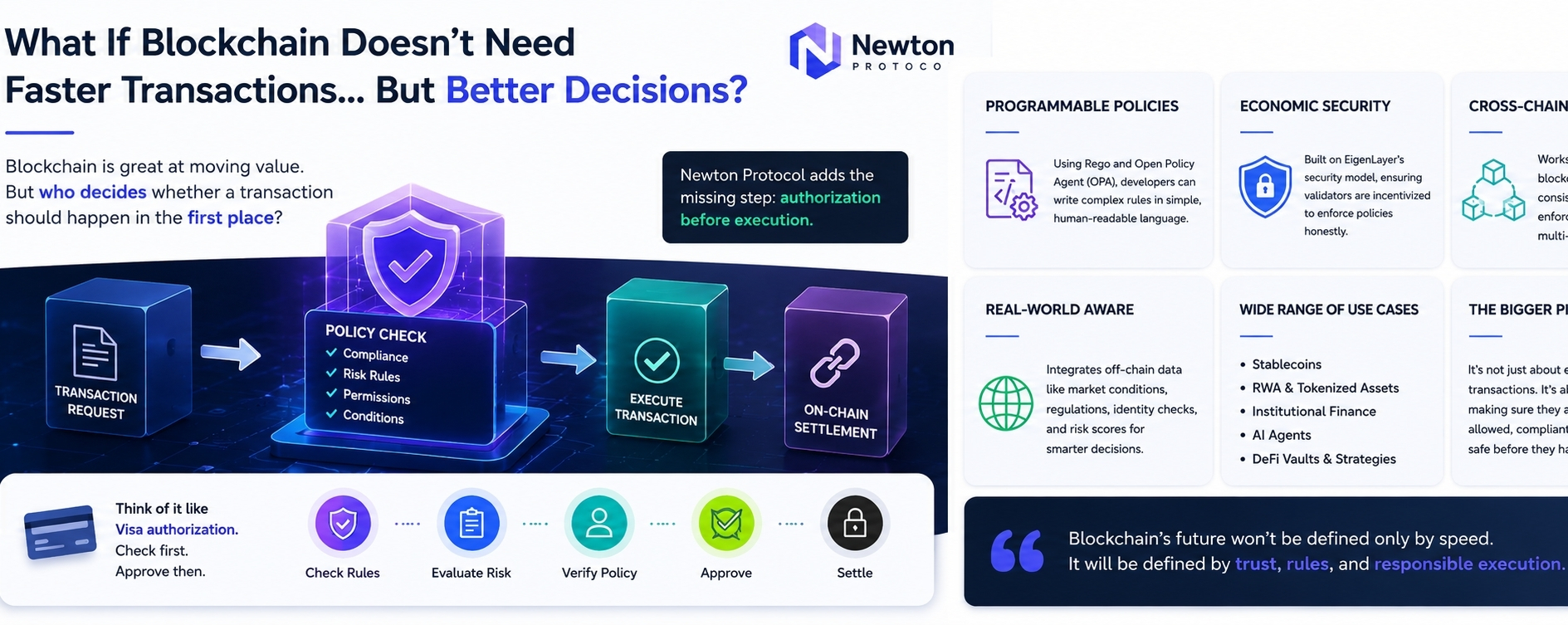
Instead of trying to become another Layer 1 or another DeFi application, it is trying to become something that sits before execution. Almost like an authorization network that decides whether an action satisfies predefined policies before value actually moves.
To me, that feels like a much different problem to solve.
A comparison that made everything click in my head was the payment card experience. When we tap a debit or credit card, money isn't instantly transferred. There is an authorization process happening behind the scenes. Limits are checked. Fraud systems evaluate risk. Rules are applied. Only then is the payment approved.
Newton is trying to bring that same philosophy into decentralized systems.
Rather than simply asking "Can this transaction execute?", it asks "Does this transaction satisfy the required policies?"
That may sound like a small difference, but I think it's actually a fundamental shift.
Another interesting part is how those policies are written. Newton uses Open Policy Agent and the Rego policy language, allowing developers to describe complex business logic instead of hardcoding everything inside smart contracts.
Imagine a treasury that only releases funds after multiple approvals. Or a stablecoin that follows different compliance rules depending on the region. Or an AI agent that can spend funds only under very specific conditions.
Those aren't impossible today, but Newton wants to make that type of authorization programmable, reusable, and decentralized.
Security also seems to be a major focus.
Instead of depending only on software behaving correctly, the protocol uses EigenLayer's economic security model so validators are financially encouraged to enforce policies honestly. That creates another layer of confidence beyond simply trusting the code.
I also think the cross-chain vision is important.
Crypto isn't moving toward one blockchain dominating everything. We're already seeing applications spread across multiple ecosystems. Assets move between chains, users interact with different networks every day, and institutions probably won't want separate compliance systems for every blockchain they use.
Having one policy framework that can work across different chains could become much more valuable than many people realize today.
Another detail I found interesting is the use of off-chain information.
Real businesses make decisions using more than blockchain data. Market conditions change. Regulations evolve. Identity checks happen outside the chain. Risk scores update constantly.
Newton wants those external signals to become part of the authorization process instead of pretending blockchain exists in isolation.
That makes the whole system feel closer to how financial infrastructure actually works in the real world.
The possible use cases are quite broad.
Stablecoin issuers could automate compliance directly into transactions. Organizations could enforce treasury rules without relying on manual approvals. Tokenized real-world assets could follow jurisdiction-specific requirements. AI agents could receive clear spending boundaries instead of unlimited permissions. Even DeFi vaults and automated trading systems could operate inside predefined risk limits.
Of course, having a big vision is one thing.
Building reliable infrastructure that developers trust is something completely different.
Every protocol eventually faces the same test. Will developers integrate it? Will applications depend on it? Will institutions actually adopt it? Can it perform consistently under real network conditions?
Those questions matter far more than any technical whitepaper.
Still, after spending time understanding the project, I don't think Newton Protocol is trying to compete on transaction speed or block production.
It's trying to solve something much quieter, but maybe much more important.
The future of blockchain probably isn't just about moving assets faster.
It may be about making sure every transaction follows the right rules before it ever reaches the chain.
If that vision becomes reality, Newton Protocol could end up becoming an invisible piece of infrastructure that most users never notice—but one that makes stablecoins, RWAs, institutional finance, DeFi, and even AI-driven economies significantly more reliable.
Sometimes the biggest innovation isn't making something happen faster.
Sometimes it's making sure it should happen at all.#NewtonProtocol#Newt $TLM $NFP $NEWT
