
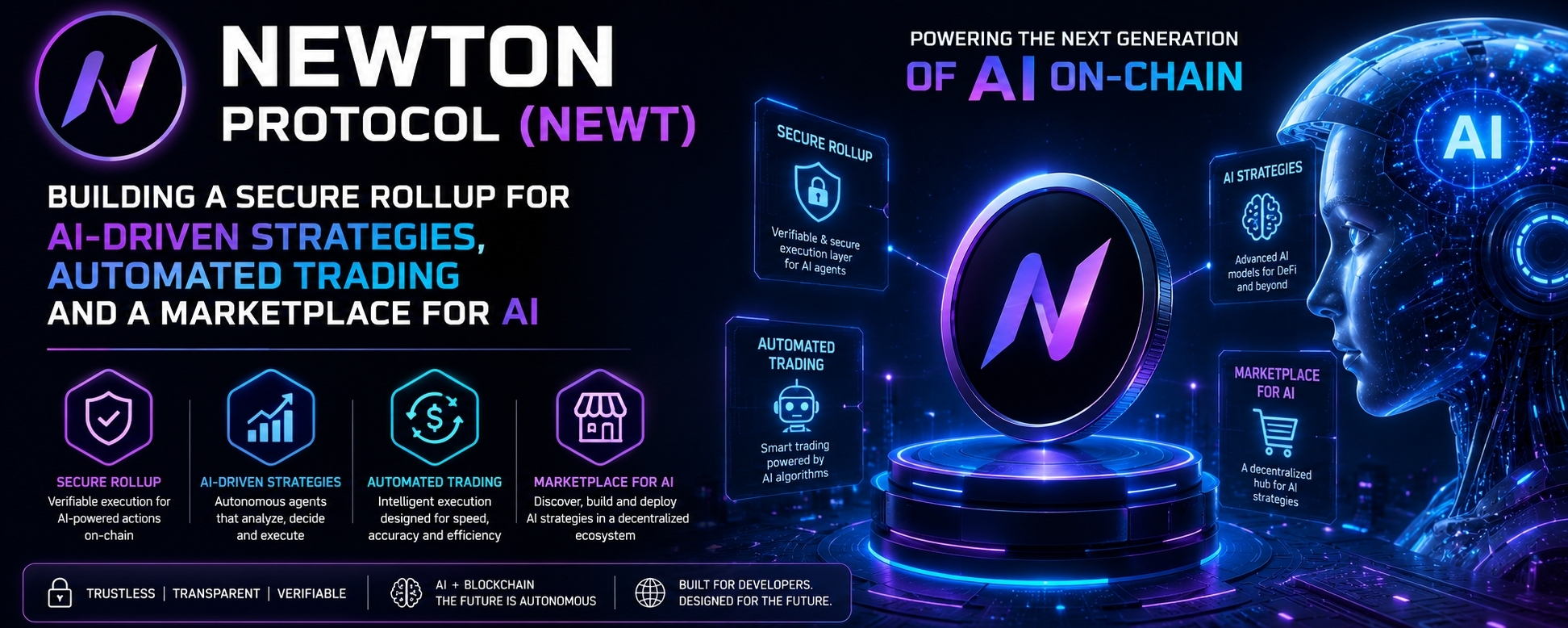
The rapid rise of AI has created plenty of excitement across the crypto industry, but one question keeps coming back: how can users trust AI agents with real financial decisions? That's where Newton Protocol (NEWT) becomes an interesting project to watch. Instead of focusing only on making AI more powerful, it is attempting to make AI-driven blockchain activity more secure, verifiable, and transparent.
Newton Protocol is building infrastructure designed for AI-powered strategies, automated trading, and decentralized applications that rely on autonomous decision-making. At the center of the project is the idea of a secure rollup that can verify AI-generated actions before they interact with blockchain networks. As AI agents become capable of managing assets, executing trades, and coordinating complex workflows, creating reliable execution and accountability may become just as important as improving AI models themselves.
One of the project's most compelling ideas is its marketplace for AI. Rather than limiting innovation to a single development team, Newton Protocol aims to create an ecosystem where developers can build, share, and deploy AI strategies. If this approach succeeds, it could encourage competition, improve the quality of available AI tools, and make advanced automation accessible to a much wider audience across decentralized finance.
The protocol also reflects a broader trend within the crypto industry. Infrastructure projects often receive less attention than consumer-facing applications, yet they frequently become the foundation on which larger ecosystems are built. Secure execution layers, transparent verification, and programmable AI workflows could eventually support trading platforms, lending protocols, asset management systems, and entirely new categories of decentralized applications.
That said, the opportunity comes with meaningful challenges. AI-generated decisions introduce new risks that traditional smart contracts were never designed to handle. Security vulnerabilities, unreliable models, inaccurate data, and unexpected behavior remain significant concerns. Newton Protocol's long-term success will depend not only on its technology but also on whether developers, institutions, and everyday users are confident enough to trust its infrastructure with valuable assets.
Competition is another important factor. AI and blockchain have become one of the fastest-growing sectors in Web3, with many projects racing to build autonomous agents and decentralized AI platforms. Standing out will require more than a compelling vision. Newton Protocol will need consistent technical execution, active developer participation, meaningful partnerships, and real-world adoption that extends beyond initial market excitement.
From my perspective, Newton Protocol is more interesting as an infrastructure project than as a short-term market narrative. Many crypto projects promise AI integration, but fewer are attempting to solve the difficult problems of verification, security, and trustworthy execution. If AI is going to manage increasingly valuable on-chain activities, building reliable infrastructure today could prove more valuable than simply launching another AI application.
Of course, the project is still early in its journey, and investors should evaluate its progress based on measurable development, ecosystem growth, and practical adoption rather than speculation alone. As with any emerging technology, long-term success will depend on execution rather than promises.
The intersection of artificial intelligence and blockchain is still evolving, and Newton Protocol is positioning itself to help shape that future. Whether it becomes a major infrastructure layer or simply contributes valuable ideas to the ecosystem, its focus on secure AI execution addresses a problem that will only become more important as autonomous systems continue to expand. The real question is no longer whether AI will influence cryptobut which projects will build the trust required for AI to operate safely on-chain.