
Most AI-related crypto projects start blending together after a while. I’ve spent enough time reading whitepapers, tokenomics breakdowns, and investor presentations to know the pattern by heart. A project mentions autonomous agents, throws around a few massive market-size projections, adds some language about the future of finance, and suddenly people are talking about billion-dollar valuations. After seeing that cycle play out again and again, I’ve become less interested in the promises and more interested in the actual problem being solved.
That’s what made me stop and pay attention to Newton Protocol.
Not because it was another AI token. If anything, that made me more skeptical at first. The AI narrative has become crowded, and I’ve learned that when a sector gets crowded, people often stop asking hard questions. What caught my eye was that Newton seemed focused on a problem most projects barely mention.
Control.
Everybody loves talking about what AI agents will eventually do. Fewer people spend time thinking about what happens when those agents make a bad decision. I kept coming back to that point while researching the project. It’s easy to imagine an AI agent moving funds between protocols, executing trades, or managing parts of a treasury. The technology is already moving in that direction. What’s harder to imagine is handing over real capital without putting boundaries in place.
That’s where Newton’s idea started making sense to me.
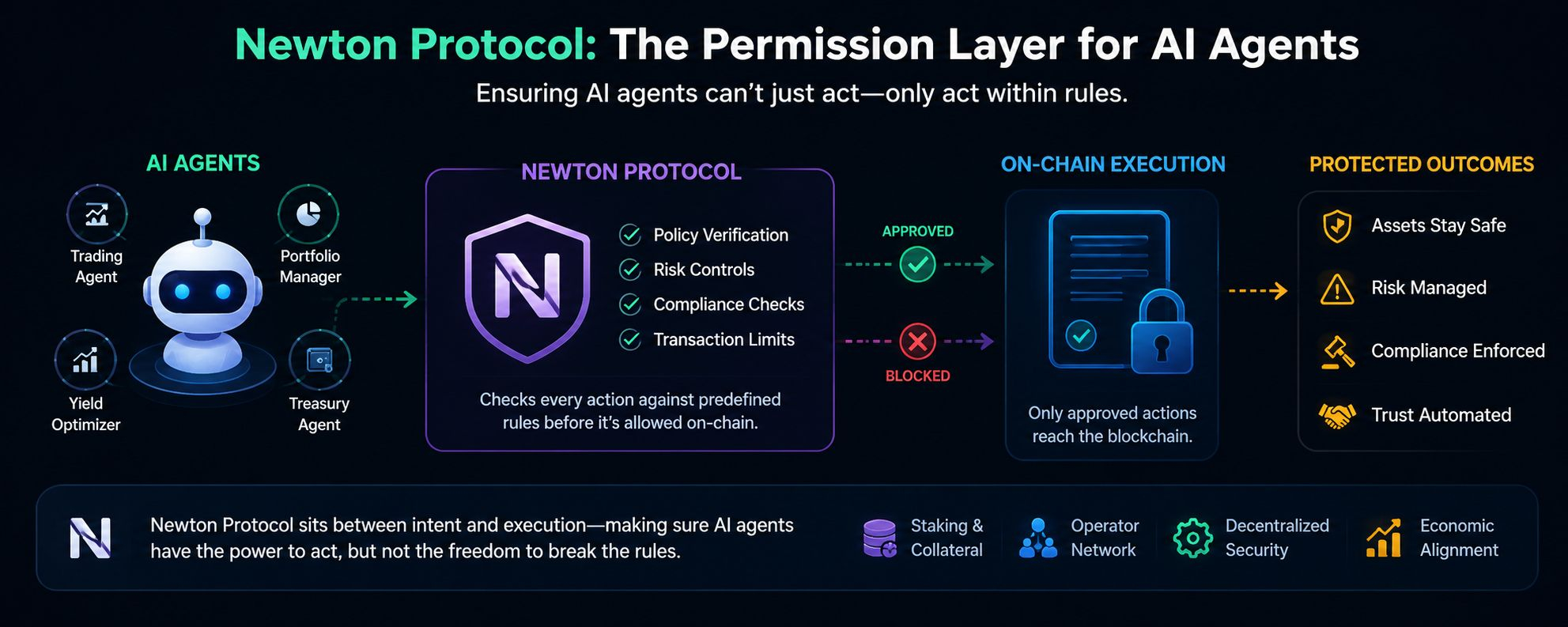
The way I see it, the project isn’t really trying to build the smartest agent or the fastest execution layer. It’s trying to sit one step above that. Instead of asking whether a transaction can happen, it asks whether it should happen according to a set of rules that already exist. The more I thought about it, the more it reminded me of how traditional finance operates behind the scenes. People often imagine markets as pure freedom, but anyone who has worked around serious capital knows there are limits everywhere. Risk controls, compliance checks, approvals, exposure limits. Those things aren’t exciting, but they exist for a reason.
Money tends to attract rules.
And more money usually means more rules.
That’s why I think Newton’s thesis deserves more attention than some of the louder AI narratives. If autonomous systems end up managing meaningful amounts of capital, somebody has to define what those systems are allowed to do. It sounds obvious when you say it out loud, but most discussions skip right past that part.
What I find interesting is that Newton is making a bet on that layer of the stack rather than competing in the overcrowded race to become another AI marketplace or agent platform. In my experience, infrastructure tends to be underestimated because it lacks the excitement of consumer-facing products. Yet infrastructure is often where the lasting value gets built.
Of course, identifying a real problem and building a successful network are two very different things.
That’s where my skepticism starts creeping back in.
I’ve watched plenty of projects correctly identify a future need and still struggle because adoption arrived slower than expected. Crypto investors have a habit of treating future demand as if it already exists. I remember seeing the same thing with previous narratives. The technology was real. The timelines weren’t. Markets got ahead of themselves, and reality eventually caught up.
Newton still has to prove that developers, institutions, and users actually want an external authorization layer instead of building those controls themselves. That’s not a small challenge. It’s one thing to agree that permissions matter. It’s another thing entirely to convince people to rely on your network for those permissions.
Then there’s the token itself.
Whenever I look at a project, I try not to get distracted by the story before understanding the supply dynamics. I’ve seen too many solid products weighed down by aggressive token emissions. A project can execute exactly as planned and still produce disappointing returns if supply expands faster than demand. That lesson gets relearned every cycle.
The same question applies here. Will network usage grow fast enough to absorb future supply? I don’t think there’s a shortcut around that question. Eventually the answer shows up in the numbers.
That’s also why I spend less time looking at social engagement and more time looking at actual usage. Partnerships sound nice. Announcements sound nice. Narratives sound nice. But real adoption leaves evidence behind. You see it in activity, participation, fees, and behavior. It becomes harder to fake.
The risk that keeps coming back to me isn’t even direct competition from another authorization protocol. I think the larger risk is that authorization becomes a built-in feature elsewhere. Wallets could develop better permission systems. AI frameworks could integrate these controls natively. Institutions could choose private solutions instead of decentralized ones. If that happens, Newton doesn’t necessarily fail because of poor execution. The market it’s targeting simply becomes smaller.
That possibility matters.
A lot.
After spending time researching the project, I don’t really think of Newton as an AI investment. At least not in the way most people use the term. To me, it looks more like an infrastructure bet. It’s a bet that autonomous systems handling real money will eventually need independent layers of oversight, permissions, and control. Everything else sits on top of that assumption.
Maybe that future arrives faster than expected. Maybe it takes years longer than investors hope. I honestly don’t know.
What I do know is that Newton is focused on a problem that feels real rather than hypothetical. In a market full of projects chasing attention, I find that refreshing. Whether that translates into long-term value is something the market will decide over time, but at least the conversation starts with an actual problem instead of a fantasy. And these days, that alone gets my attention.