
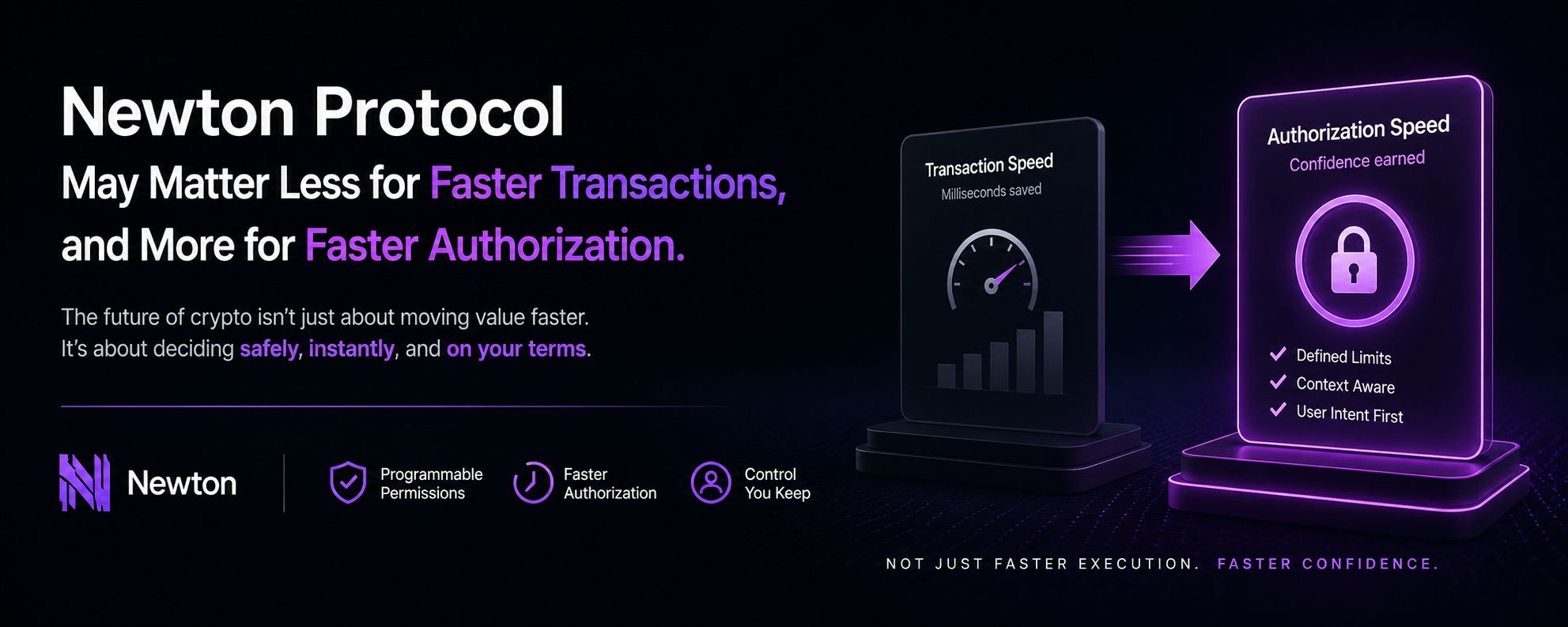
I've noticed that almost every blockchain conversation eventually comes back to the same metric: speed.
People compare transaction throughput, block times, gas fees, and settlement latency as if they're the only things that determine whether a network succeeds. I understand why. Faster systems usually create a better user experience.
But I don't think execution speed is where the biggest opportunity is anymore.
I think the real bottleneck is authorization.
To me, that's a much more interesting problem to solve.
A transaction taking a few extra seconds rarely changes my decision to use a protocol. What makes me hesitate is deciding whether I should authorize an action in the first place. That's the moment where I stop and think. That's where trust either exists or disappears.
That's why I've started looking at Newton Protocol from a different angle.
I'm less interested in whether it helps transactions execute faster. I'm more interested in whether it can make authorization faster without making it less secure.
Those aren't the same thing.
Execution is what happens after I've already made a decision.
Authorization is the decision.
I think crypto has spent years optimizing the second step while mostly accepting the first step as something users just have to deal with.
I'm not convinced that's the right priority anymore.
As more AI agents and automated applications enter crypto, I don't think people are going to ask, "How quickly can this transaction settle?"
I think they're going to ask, "How much control am I giving up?"
That's a very different question.
I've always believed automation only works when I understand its boundaries. I don't mind software acting on my behalf. What I do mind is giving it permissions that are broader than they need to be.
That's where trust starts breaking down.
Too many blockchain interactions still rely on a simple idea: approve first and hope nothing unexpected happens later.
I've never thought that was an ideal model.
I'd rather define clear limits from the beginning than give software unlimited freedom just because it's more convenient.
To me, convenience shouldn't come at the cost of confidence.
I think that's why authorization deserves more attention than it gets.
It's easy to celebrate faster block times because they're measurable. You can compare numbers, publish benchmarks, and declare winners.
Trust isn't measured that way.
It shows up when people stop second-guessing every approval they're asked to sign.
It shows up when users feel comfortable letting automation handle repetitive tasks because they've already decided what those tasks are allowed to do.
That's a different kind of speed.
It's not about moving assets faster.
It's about reducing the time it takes to make informed decisions.
I think that's where Newton Protocol could become more meaningful.
If it helps users authorize actions within clear, programmable boundaries, then it's solving a problem that matters long before transaction execution even begins.
The more I think about it, the more I believe blockchain's future depends on permission design just as much as transaction design.
We've become very good at moving value across networks.
I'm not sure we've become equally good at defining how value is allowed to move.
That's an important distinction.
As AI becomes more capable, this question only becomes more relevant.
I don't think smarter AI automatically means users should hand over more authority. If anything, I think the opposite is true.
The more capable automated systems become, the more carefully I want to define what they're allowed to do.
Intelligence without boundaries doesn't make me feel safer.
Clear authorization does.
That's why I don't see authorization as a boring infrastructure layer. I think it's becoming one of the most important parts of the entire user experience.
People often say crypto needs better wallets, cheaper fees, and faster chains.
I agree.
But I also think crypto needs better permission models.
Because no matter how fast a transaction settles, I still have to trust the action before I approve it.
For me, that's where Newton Protocol stands out.
Not because it might shave another second off execution.
But because it points toward a future where authorization becomes smarter, more flexible, and easier to trust.
And if I'm right, that shift could matter more than another incremental improvement in transaction speed.
Execution gets the headlines.
Authorization earns my confidence.
I'd argue confidence is what keeps people using a protocol long after the excitement around speed fades.