Most discussions about AI agents in crypto focus on what they can automate. A question that gets far less attention is what happens when an agent attempts something it was never meant to do.
That question becomes much more serious once an AI agent controls a wallet. If the model is compromised, manipulated through prompts, or simply produces an unexpected output, the result isn't just a software mistake. It can become an irreversible blockchain transaction.
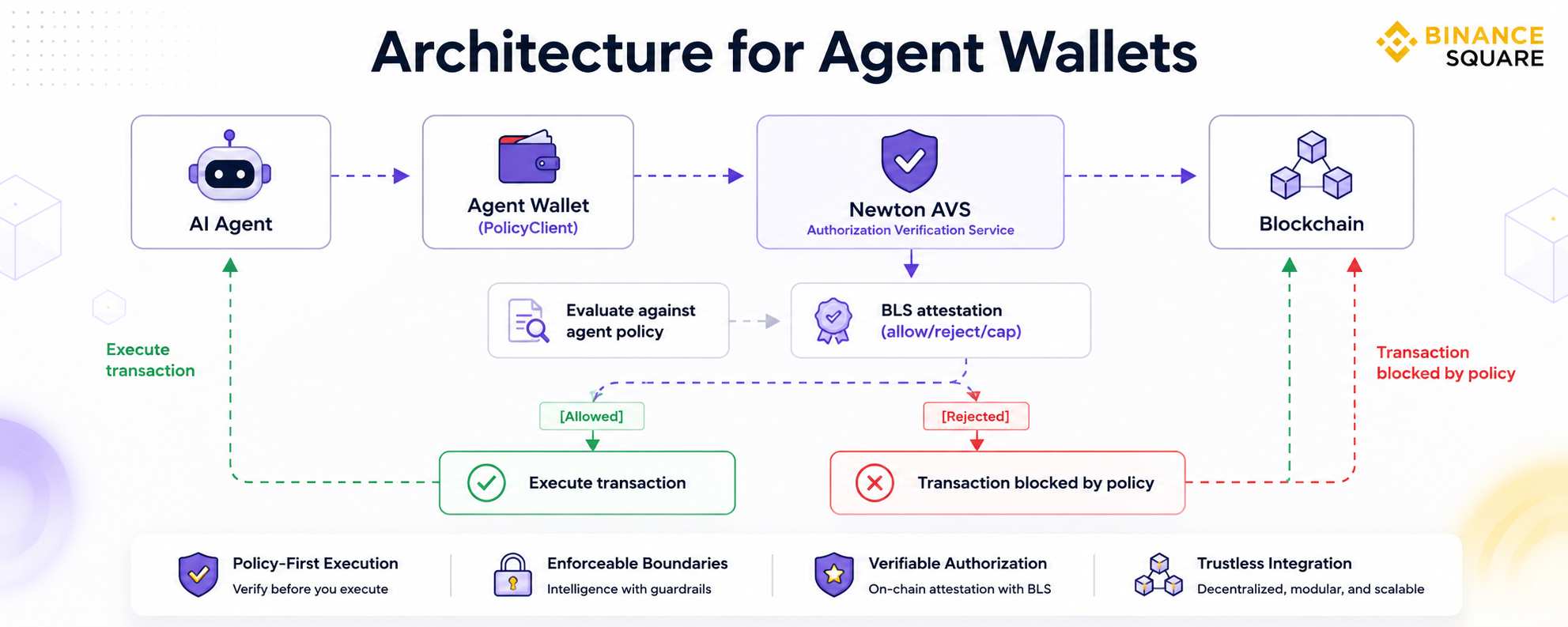
This is one area where Newton Protocol takes a different approach. Rather than assuming an agent's decision should automatically be trusted, it checks every agent-generated transaction against a predefined policy before the transaction is allowed to exexecute. Those rules are written in Rego, turning authorization into something that can be programmed, reviewed, and updated instead of relying on trust alone.
The distinction is subtle but important. AI generates a decision, while the policy decides whether that decision is allowed to become an on-chain action. Separating those two responsibilities reduces the amount of trust placed in the model itself. The system no longer depends entirely on the agent making the right choice every time.
Many wallet security models rely on fixed allowlists or manual approvals. They work for simple workflows, but they become harder to manage as autonomous agents take on broader responsibilities. Expanding permissions increases risk, while restrictive controls can limit the usefulness of automation.
Newton's policy layer tries to balance those competing needs. Instead of asking whether an AI agent wants to perform an action, it evaluates whether that action stays within predefined rules. A policy can define which contracts an agent may interact with, how much value it can move, or which actions require additional approval. If a transaction falls outside those boundaries, it never reaches execution.
That separation also improves accountability. When an agent behaves unexpectedly, the investigation is no longer limited to the model's reasoning. It becomes possible to verify whether the transaction itself complied with the authorization policy. In practice, that creates a clearer foundation for auditing autonomous systems because decision-making and permission are evaluated independently.
This doesn't remove every security challenge. Policies still need thoughtful design and regular updates. Weak rules may approve transactions they shouldn't, while overly restrictive ones can interfere with legitimate activity. The trust assumption doesn't disappear—it shifts toward the quality of the authorization policy, where it is easier to review, test, and refine.
As autonomous agents begin handling trading, treasury management, and other on-chain operations, verifying whether a transaction should happen may become just as important as executing it efficiently.Automation becomes easier to trust when intelligence is paired with enforceable boundaries rather than unrestricted authority.
If AI agents become a normal part of on-chain finance, should programmable authorization become a standard layer for every autonomous wallet, or will the industry adopt a different way of separating AI decisions from transaction authority?🤔