
I've been thinking about Newton's approach to operators, and it changed the way I look at decentralization.
For a long time, I assumed a decentralized network had to be completely permissionless. If anyone could join, that meant it was more decentralized. Simple.
Newton challenges that assumption.
Instead of opening the door to everyone, it relies on operators that are credibly vetted. They have to meet standards around reliability, responsiveness, geographic diversity, legal status, and operational readiness before they can participate.
My first reaction was that this sounded like a compromise.
The more I thought about it, though, the more it felt like a trade-off rather than a step backward.
Open participation is valuable, but it doesn't guarantee dependable infrastructure. A network can have thousands of participants and still struggle if too many of them aren't able to perform consistently when it matters.
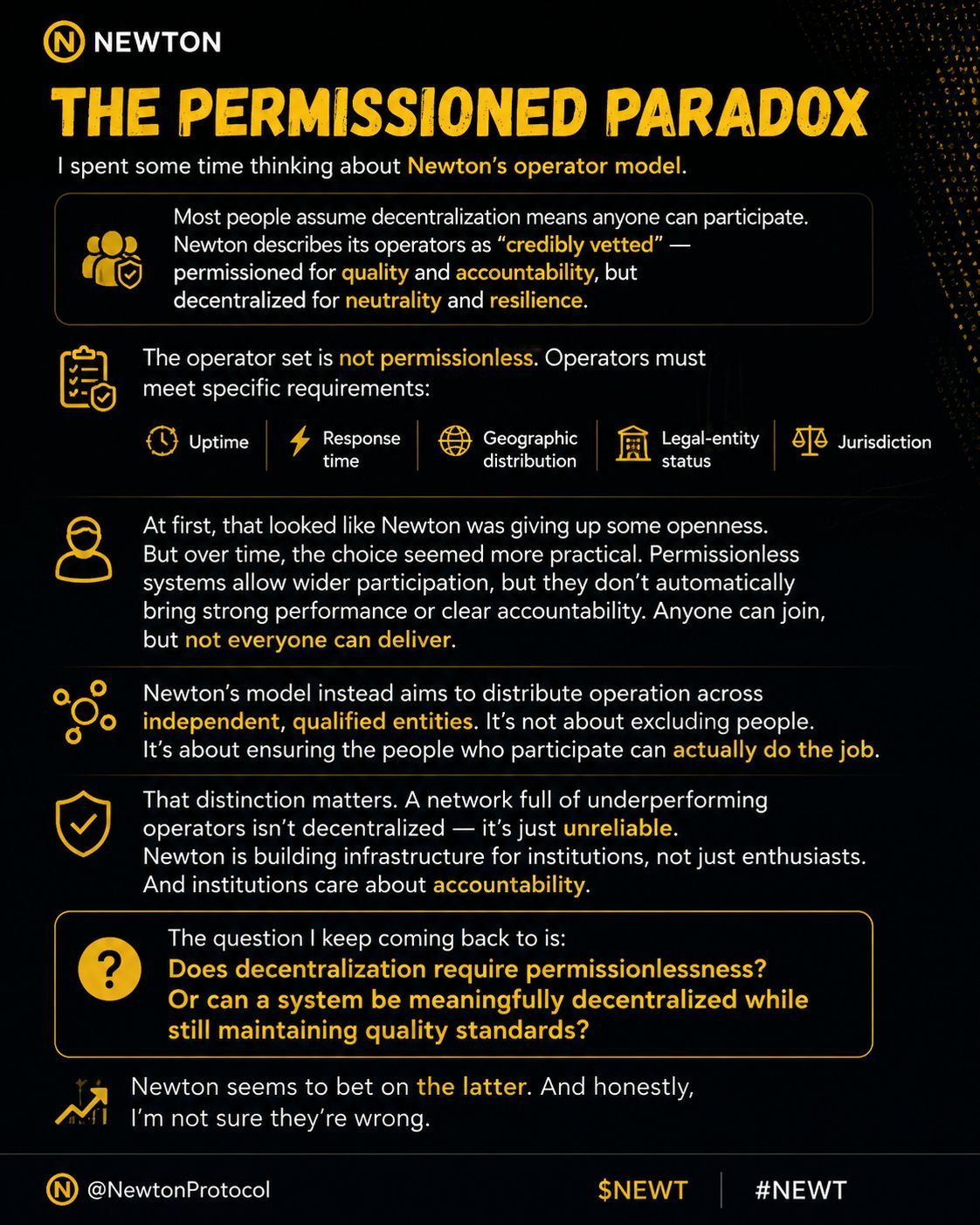
Newton's focus seems to be different. Rather than maximizing the number of operators, it's trying to build a network of independent operators that can actually be trusted to keep the system running.
For the kind of applications Newton is targeting, that approach makes sense. Reliability and accountability aren't optional—they're part of the product.
It also raises an interesting question.
Should decentralization be measured by how many people can participate, or by how resilient the network remains because of the people who do participate?
I'm still thinking about the answer, but I find Newton's perspective worth paying attention to.