
I was re-reading the same paragraph of Newton Protocol's whitepaper for the third time, coffee gone cold, when it finally clicked why the wording felt different from every other infra project I'd covered. Most chains are obsessed with proving what already happened. Newton kept circling a different question — what was actually allowed to happen in the first place. Small distinction. Took me longer than I'd like to admit to see why it mattered.
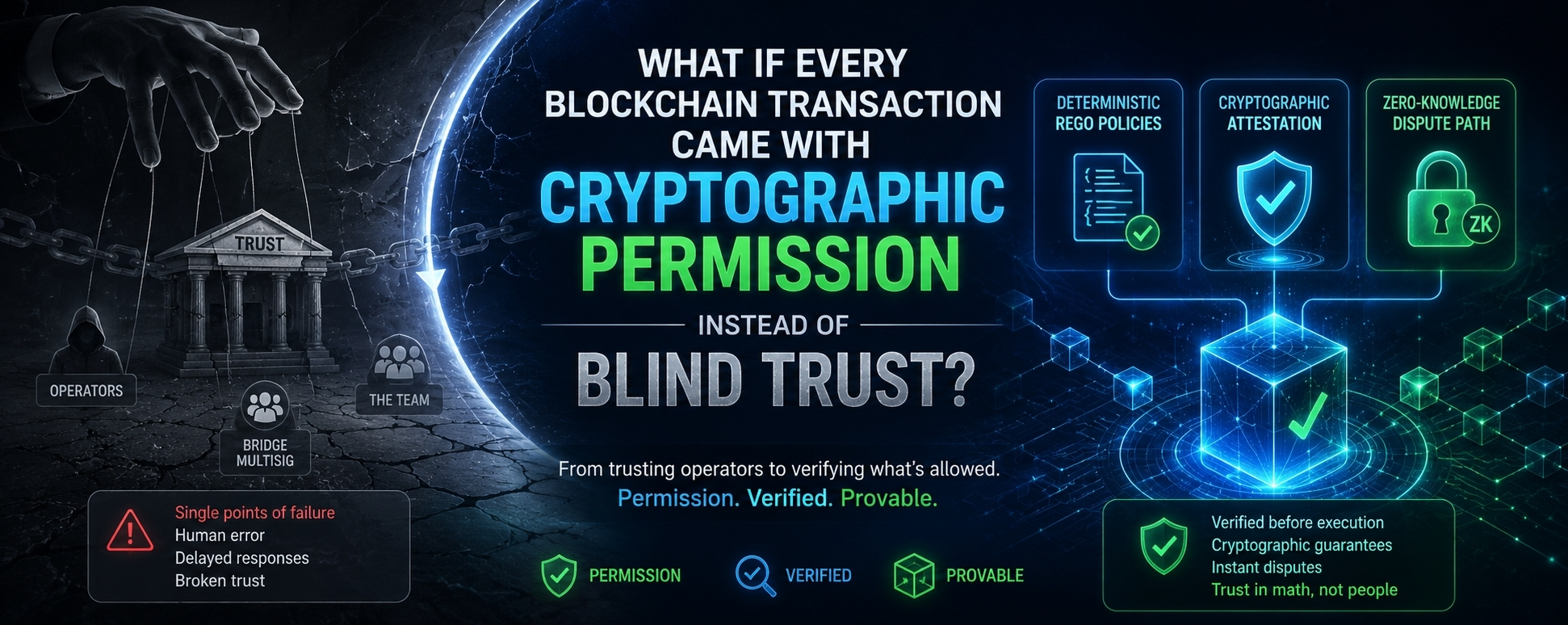
Here's the basic pitch, stripped of the whitepaper language: instead of trusting an operator, a bridge multisig, or "the team" to behave honestly, every transaction gets checked against deterministic Rego policies, and what comes out the other side is a cryptographic attestation rather than a reputation. If something goes wrong, there's a zero-knowledge dispute path instead of a Discord announcement and a governance vote three weeks later. That's the promise anyway — trust replaced by math.
I like the instinct. But I kept getting stuck on the same practical worry, which is that real-world financial rules are rarely as clean as a policy engine wants them to be. Deterministic evaluation is great until two institutions disagree on what "correct" even means, or until an AI agent does something the policy writer never anticipated. Agents are the part that actually worries me most here — they don't behave like humans clicking buttons, they generate weird, fast, compounding transaction patterns, and I'm genuinely unsure static Rego policies age well against that.
Latency is the other thing I couldn't stop poking at. Running policy checks before finalizing anything isn't free. EigenLayer's economic security backstops bad behavior after the fact through slashing, which is reassuring, but it doesn't really answer how this holds up under heavy trading volume in practice. Maybe it's fine. I just haven't seen the numbers that would convince me either way.
And governance — someone still has to write these policies, and someone still has to update them when a regulation changes overnight. A system designed to remove human trust doesn't actually remove humans, it just moves them one layer upstream, which is worth sitting with rather than glossing over.
Even with all that, I keep coming back to the timing of it. Stablecoins, tokenized treasuries, autonomous agents — all of it is pushing serious value through rails that were never built to ask permission before acting, only to record what already occurred.
So I'm left with a question I didn't have three days ago: is verifying what happened even the right problem anymore, or was the real gap always proving what should be allowed to happen before it does?