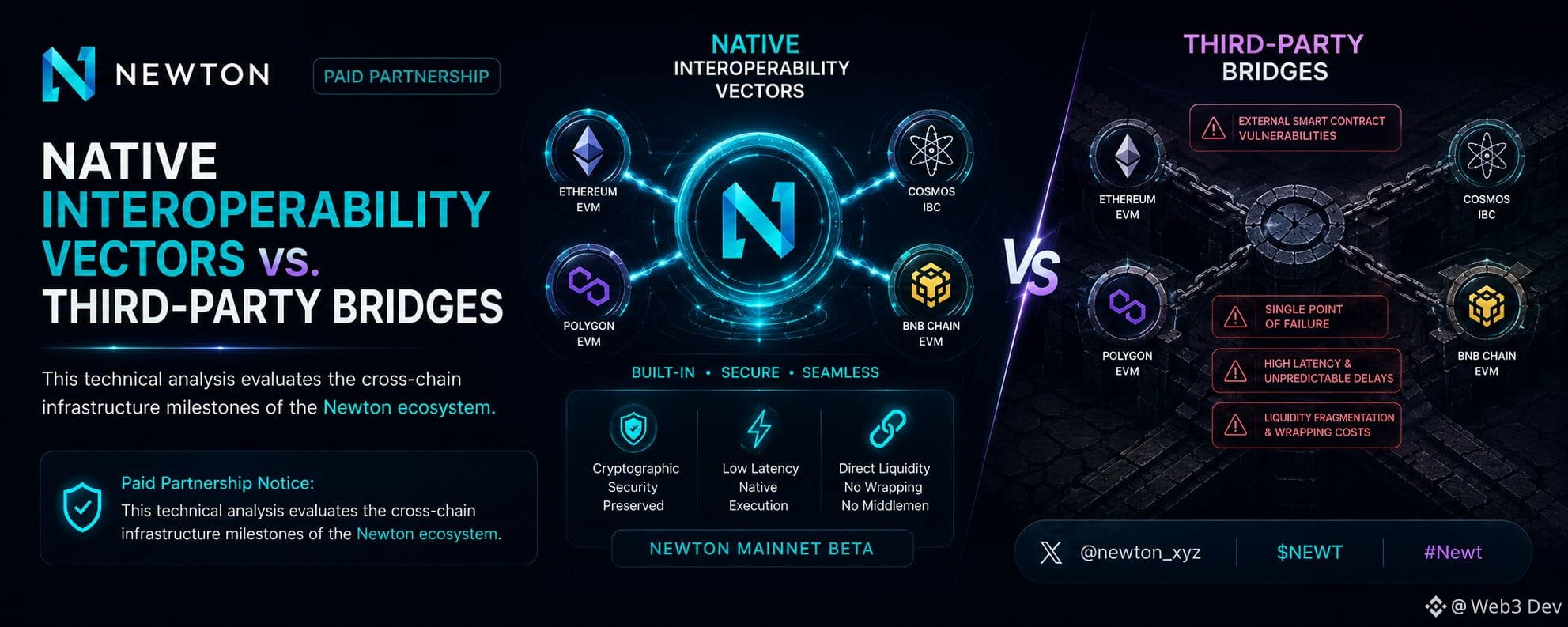
As blockchain ecosystems continue to expand, interoperability has become one of the defining challenges for decentralized infrastructure. Applications increasingly require assets, data, and smart contracts to communicate across multiple blockchain environments. Traditional interoperability has largely depended on third-party bridge protocols, but these solutions often introduce additional trust assumptions, execution complexity, and security risks.
Newton Protocol approaches this challenge differently. Rather than depending on external bridge infrastructure, Newton incorporates native interoperability directly into its protocol architecture. This design seeks to preserve the security properties of each connected network while enabling efficient communication between virtual machine ecosystems.
Why Third-Party Bridges Face Structural Challenges?
Conventional bridges typically lock assets on one blockchain while minting wrapped representations on another. Although this model has enabled cross-chain activity, it also introduces several architectural limitations:
Additional smart contract attack surfaces
External validator or multisignature trust assumptions
Higher operational complexity
Liquidity fragmentation
Increased transaction latency
Asset wrapping and redemption overhead
Every additional intermediary becomes another component that must remain secure throughout the asset transfer process. As blockchain adoption grows, minimizing unnecessary trust layers becomes increasingly important.
Native Interoperability as a Protocol-Level Design
Newton Protocol integrates interoperability directly into its infrastructure instead of treating cross-chain communication as an external extension.
This architectural approach allows different blockchain environments to communicate through protocol-native mechanisms rather than relying exclusively on third-party bridge operators.
By embedding interoperability into the protocol itself, Newton focuses on reducing complexity while maintaining consistency across supported virtual machine environments.
1. Cryptographic Security Preservation
One of the primary advantages of protocol-native interoperability is maintaining existing cryptographic security assumptions.
Instead of routing assets through multiple external bridge contracts, Newton's architecture is designed to preserve verification paths throughout cross-chain interactions. This reduces exposure to centralized coordination layers while allowing transactions to inherit stronger security guarantees from the underlying protocol.
For developers and users, this means fewer external trust dependencies during cross-chain execution.
2. Support Across Multiple Virtual Machine Environments
Modern decentralized applications rarely exist on a single blockchain.
Newton is designed with interoperability across multiple execution environments, including EVM-compatible ecosystems and Cosmos-based infrastructure. Supporting diverse virtual machine architectures allows builders to deploy applications while interacting across multiple blockchain networks through a unified protocol approach.
This flexibility improves scalability while reducing development friction.
3. Lower Liquidity Fragmentation
Liquidity fragmentation remains one of the largest inefficiencies in decentralized finance.
Traditional bridge systems often require wrapped assets, separate liquidity pools, and duplicated capital across multiple ecosystems.
Newton seeks to reduce these inefficiencies by enabling more direct interoperability paths. Native routing mechanisms can simplify liquidity movement while improving capital efficiency across participating ecosystems.
4. Developer-Focused Infrastructure
Beyond asset transfers, Newton emphasizes developer accessibility.
Integrated toolkits simplify cross-chain application development without requiring teams to build and maintain complex bridge contracts independently.
This allows developers to focus on application logic while leveraging protocol-native interoperability for secure communication between supported networks.
5. Performance and Scalability
Protocol-level interoperability can also improve network performance.
By reducing intermediary execution layers, transaction routing becomes more streamlined. Lower operational overhead contributes to reduced latency while supporting higher scalability as ecosystem activity expands.
Combined with Newton Mainnet Beta, these architectural improvements aim to provide a stronger foundation for decentralized applications requiring reliable multi-chain communication.
Looking Ahead
As blockchain infrastructure continues evolving, interoperability will become increasingly central to user experience and developer adoption.
Rather than relying entirely on external bridge ecosystems, Newton Protocol introduces a native interoperability model that emphasizes security preservation, reduced complexity, developer efficiency, and scalable cross-chain communication.
While interoperability remains an active area of innovation across the industry, protocol-native designs represent an important direction for building more resilient decentralized infrastructure.
Developers, liquidity providers, and ecosystem participants will be watching closely as Newton Mainnet Beta continues expanding its capabilities and demonstrates how native interoperability can support the next generation of Web3 applications.
$NEWT @NewtonProtocol #Newt $ESP