
Every so often, a crypto project appears that feels less like another shiny experiment and more like a response to a problem everyone knows exists but would rather not talk about.
Newton Protocol is one of those projects.
At first glance, the pitch sounds familiar enough: AI-powered strategies, automated trading, a dedicated rollup, and a marketplace for developers building intelligent agents. Crypto has heard plenty of ambitious promises before. The industry practically runs on ambition.
But beneath the buzzwords sits a more uncomfortable question.
What happens when we finally give machines permission to move money for us?
Not suggest. Not recommend. Actually act.
That changes everything.
For years, decentralization was about removing human gatekeepers. Now, strangely enough, we're entering an era where we're adding new ones except these gatekeepers aren't people. They're algorithms, models, and autonomous systems that never sleep, never get tired, and never stop looking for the next opportunity.
Sounds exciting.
It also sounds a little like handing your car keys to someone you've never met because they promise to drive better than you.
Newton Protocol seems to understand that tension.
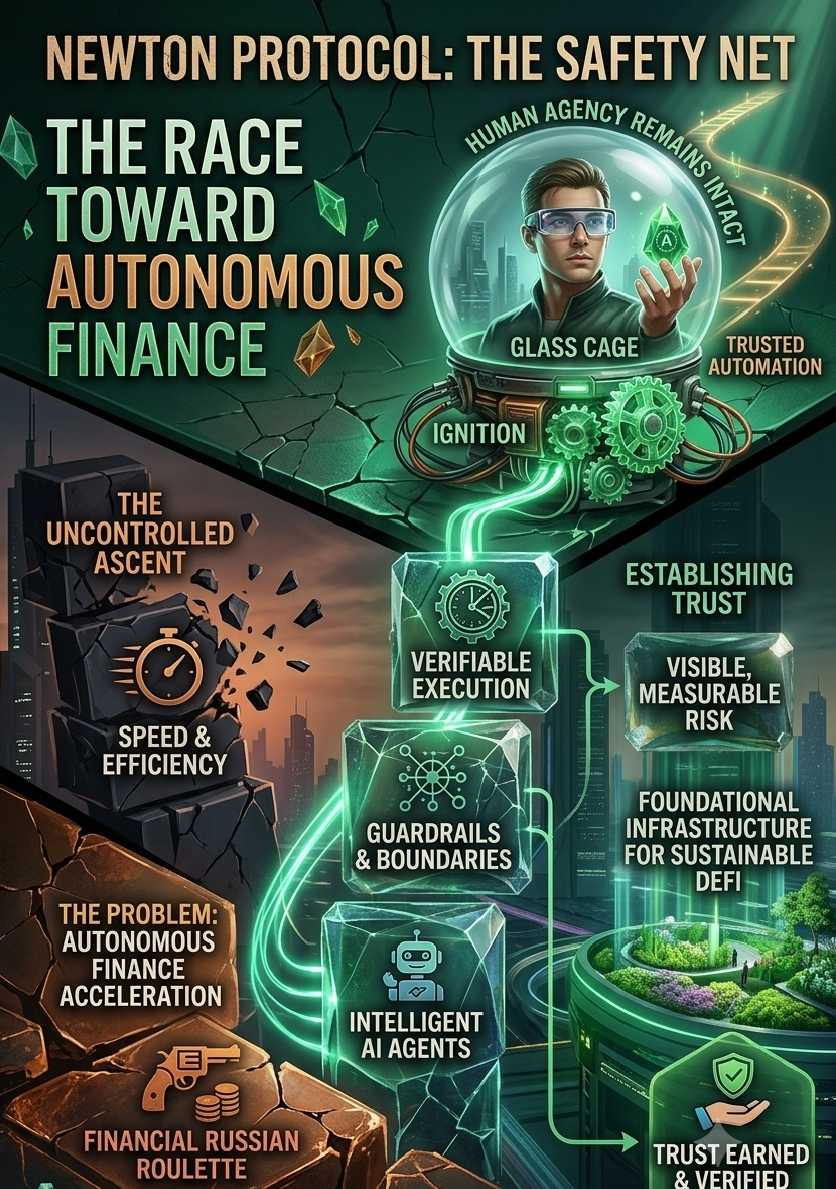
The project is building what it describes as a secure rollup for AI-driven execution. The goal isn't merely to make automation faster. Plenty of infrastructure already does that. The real challenge is making autonomous systems trustworthy without killing the advantages that make them attractive in the first place.
Because let's be honest.
Speed has never been crypto's biggest problem.
Trust is.
Imagine a future that honestly doesn't feel very far away. An ordinary user wakes up on Monday morning, drinks coffee, checks their phone, and discovers that an AI agent spent the entire night optimizing their portfolio. It moved liquidity, harvested yields, reduced exposure to risky assets, and took advantage of market conditions while its owner was asleep.
In theory, that's the dream.
In practice?
That could either be financial freedom or financial Russian roulette.
The difference comes down to one thing: boundaries.
Can the owner see what the agent is allowed to do? Can they limit its behavior? Can they verify why decisions were made instead of simply hoping the machine knows best?
Newton Protocol appears to be building its entire identity around those questions.
And that's probably smart.
The crypto industry has a long history of treating automation like a magic trick. The assumption often goes something like this: if humans make mistakes, then smarter algorithms must naturally make fewer mistakes.
Reality is messier.
A fast mistake is still a mistake.
An autonomous disaster simply arrives more efficiently.
The promise of a secure execution layer matters because it attempts to place guardrails around intelligent systems before those systems are trusted with serious value. It's less about removing risk entirely and more about building a glass cage around the ignition. The engine can still run at full speed, but everyone can see exactly what's happening inside.
That kind of transparency matters.
Maybe more than people realize.
The developer marketplace Newton envisions adds another interesting dimension. If AI creators can build specialized agents for different financial tasks, users could eventually choose between hundreds of distinct approaches. Some agents might prioritize aggressive returns. Others could focus exclusively on preservation and stability. A few might handle governance participation or automated treasury management.
The comparison that comes to mind isn't a traditional exchange.
It's closer to an ecosystem of digital financial advisors, each operating according to transparent rules.
The goal?
Turning intelligent automation into infrastructure rather than mystery.
But this is crypto.
And crypto has a habit of reminding everyone that good ideas still have to survive contact with reality.
A secure execution environment doesn't fix a bad trading strategy.
That's important to say.
You can create the safest highway in the world, but someone driving straight into a wall remains a problem. AI systems inherit the assumptions, incentives, and blind spots of the people who build them. No amount of elegant architecture changes that fundamental truth.
If a model chases unrealistic yields or fails to account for unusual market conditions, losses remain possible. Verification helps. Boundaries help. Transparency helps.
None of them perform miracles.
That's actually one reason the concept feels more credible.
Projects that acknowledge their own limitations usually understand their responsibilities better than those promising impossible outcomes. Newton's broader narrative isn't that AI eliminates risk. It's that intelligent systems need environments where risks become visible, measurable, and manageable.
Those are very different promises.
Competition, of course, represents another mountain to climb.
The intersection of blockchain and artificial intelligence has become one of the loudest corners of the entire industry. Every week seems to bring another protocol claiming to revolutionize autonomous finance. Attention is cheap. Adoption isn't.
Developers need reasons to build.
Users need reasons to trust.
Markets need reasons to care.
Building a dedicated rollup for AI execution sounds compelling, but execution the human kind, ironically enough will determine whether Newton Protocol becomes foundational infrastructure or simply another interesting experiment that arrived before its time.
Still, the underlying philosophy deserves attention.
Most conversations about AI focus on capability. What can autonomous systems do? How much work can they replace? How efficiently can they operate?
Newton asks a different question.
How do we keep human agency intact after machines become capable enough to act independently?
That's a much harder problem.
And probably a much more important one.
Because ownership means more than possessing digital assets. Real ownership includes understanding the forces acting upon those assets. It means maintaining influence over processes, permissions, and decisions, even when automation handles the heavy lifting.
Otherwise, people don't own sophisticated systems.
Sophisticated systems own their choices.
The future of finance may very well belong to intelligent agents operating at machine speed. That possibility feels increasingly inevitable. But trust cannot be automated into existence. It has to be designed, verified, and continuously earned.
Newton Protocol is betting that the next great layer of blockchain infrastructure won't simply help machines do more.
It will help humans remain in control while those machines do it.
And if that vision succeeds, the real innovation might not be artificial intelligence itself.
It might be teaching autonomous systems how to respect the boundaries that make trust possible in the first place.
