
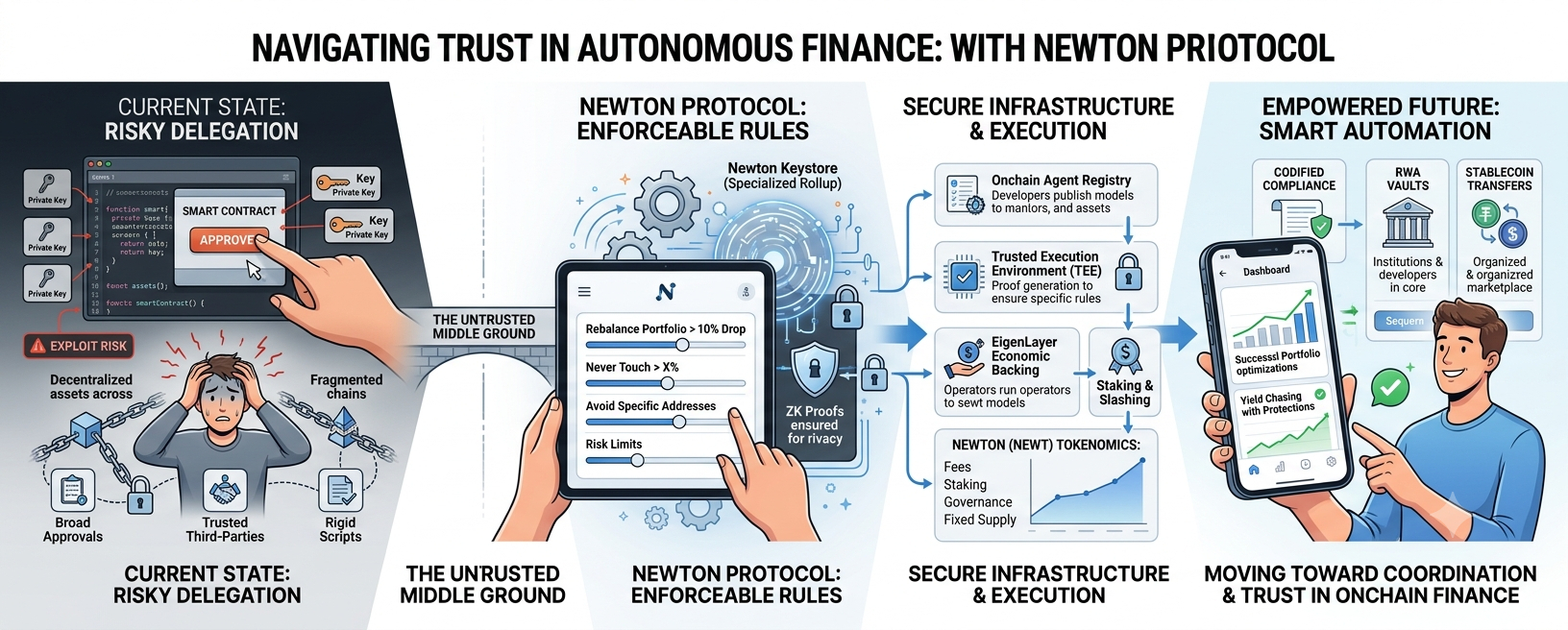

I've been thinking a lot lately about how crypto, for all its sophistication, still makes simple things feel hard. You accumulate some assets, spot opportunities across chains, maybe want to run a strategy or just keep things reasonably optimized—but doing it manually is exhausting, and handing control to an AI agent or bot feels like giving away the keys to your house with a polite "please don't rob me." That's the tension Newton Protocol (NEWT) is trying to ease, not with grand promises, but by building a more trustworthy middle ground for delegation.134806
phemex.com
It's not another "AI will revolutionize everything" story. At its heart, it's infrastructure aimed at a very human problem: we want our money to work smarter, but we don't want to lose sleep over it.
Why This Problem Feels So Real
Onchain volumes are impressive these days, with stablecoins and tokenized assets moving serious money. Yet most of us (and many institutions) are still babysitting positions or avoiding automation altogether because the risks feel too vague and high. Current workarounds—broad approvals, trusting third-party services, or rigid scripts—create exactly the kind of fragility that leads to exploits or missed opportunities. Newton tries to change that by letting you set clear, enforceable rules around what an agent can actually do, verified cryptographically before anything executes.e80c68
phemex.com
Imagine defining something like: "Rebalance my portfolio if this asset drops more than 10%, but never touch more than X%, avoid these addresses, and respect these risk limits." The system checks it, produces a verifiable record, and you keep the ability to revoke access instantly. It's the difference between hoping for the best and having guardrails you can actually inspect.
How It Actually Works (Without the Jargon Overload)
The main innovation is a specialized rollup called the Newton Keystore—essentially a secure, dedicated place for managing permissions and policies rather than running every possible smart contract. Developers can publish agent models in an onchain registry (think reusable "if-this-then-that" logic tailored for trading, yield, or compliance). Users grant narrow permissions tied to those models, and the network validates that actions stay within bounds.207061
phemex.com
They draw on zero-knowledge proofs so certain rules stay private, trusted execution environments for offchain bits that still need proof, and smart account tech for flexible control. Security leans on staking (with slashing for bad behavior) and draws from EigenLayer for some economic backing. NEWT itself powers fees, staking for validators and operators, and governance down the line. Fixed supply, sensible vesting, and a community-heavy allocation—all the details that suggest they're thinking beyond launch hype.9998a2
phemex.com
It's pragmatic: settle on Ethereum (or similar) for finality while optimizing the permission layer for speed and cost. Cross-chain ambitions are there too, which could make it useful beyond one ecosystem.
Real Applications That Could Stick
For everyday users, this might mean finally setting thoughtful automation—portfolio rebalancing, DCA with protections, or yield chasing—without constant vigilance. For bigger players, it's about codifying compliance, risk policies, or investor rules directly into vaults, stablecoin transfers, and RWAs in a way auditors can verify. A marketplace for agent models could let skilled developers earn from their work while operators put skin in the game.a57b04
newton.xyz
In the bigger picture of blockchain's growth, this fits a pattern I've noticed: we're moving past raw infrastructure toward tools that handle coordination, trust, and real-world messiness. Authorization and policy enforcement have been afterthoughts for too long. If Newton delivers something reliable and integrable, it could quietly help more capital flow onchain by making the experience feel safer and less expert-only.
The Balanced Take
I like the ambition here because it feels grounded. The opportunities are meaningful—better capital efficiency, safer AI integration, shared policy rails that reduce duplication across protocols. In a maturing market, these kinds of layers often determine whether adoption stays niche or broadens.
That said, it's no sure thing. Building reliable ZK + TEE + rollup systems at scale is hard work. Users need it to be intuitive, not another complicated setup. Attracting developers to build agents and protocols to integrate takes time and real product-market fit. Competition in automation exists, and like many infrastructure projects, it could hum along usefully without ever becoming a household name—or it could struggle if the economics don't align or if adoption lags.dafd9a
phemex.com
Overall, Newton reads to me like the work of people who have stared at the same pain points many of us have and tried to engineer a practical response. In crypto's long game, those thoughtful, problem-first approaches tend to age better than the loud ones. Whether it becomes foundational plumbing or another interesting experiment will depend on execution over the coming years, but the direction feels worth following. It's the kind of quiet development that could make the whole ecosystem a bit more usable for actual humans.



#SupremeCourtBlocksTrumpFromRemovingFedCook #DowHitsRecordClose
