

The More I Studied Newton Protocol, the More I Realized DeFi's Biggest Limitation Isn't Execution—It's Authorization.
For a long time, I thought the greatest strength of smart contracts was their ability to execute transactions automatically without relying on human intervention. But after reading Newton Protocol's architecture, I started looking at automation differently. Automatic execution doesn't necessarily mean the right decision is being made. A transaction can satisfy every onchain condition while still violating an application's risk policy or operational requirements.
The reason is fairly straightforward. Traditional smart contracts only evaluate information that already exists onchain. They can verify signatures, balances, and predefined contract logic, but they have no native way to understand whether market conditions have become abnormal, whether an identity check has been completed, whether jurisdictional rules apply, or whether an application's internal risk limits have been exceeded. As a result, execution is based on a limited view of reality.
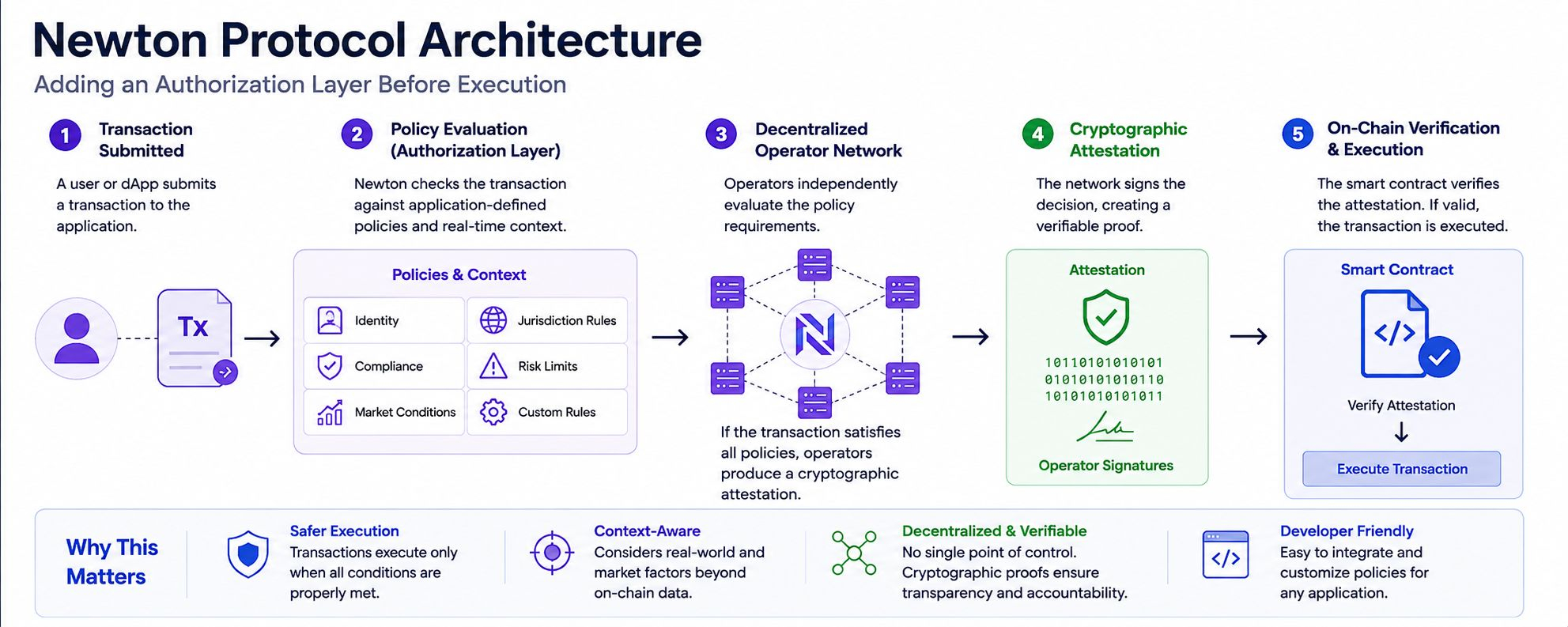
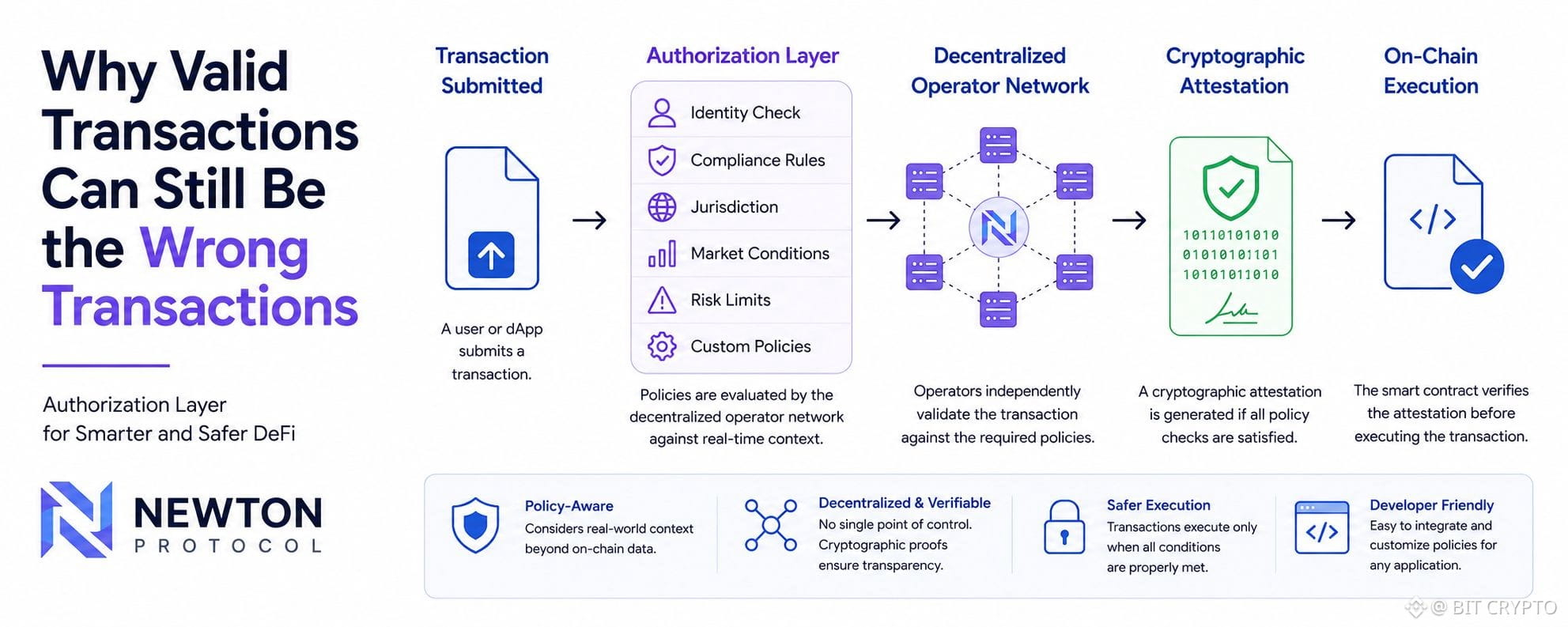
Newton Protocol addresses this by introducing an authorization layer before execution. According to its architecture, applications can define programmable policies covering identity verification, compliance requirements, jurisdiction rules, market conditions, spending limits, or any custom risk parameters. When a transaction is submitted, Newton's decentralized operator network evaluates those policies. If the transaction satisfies every requirement, the network generates a cryptographic attestation. The smart contract verifies that attestation before allowing the transaction to execute. Instead of trusting an external service, the contract verifies cryptographic proof that the required policy checks have already been completed.
What I find most interesting is that Newton doesn't decide the policies itself. It simply provides the infrastructure that allows every application to define its own authorization rules... That separation makes the system flexible enough for banks, DeFi protocols, AI agents, stablecoin issuers, or tokenized asset platforms without forcing them into the same compliance model...
Of course, this architecture isn't without challenges. Authorization is only as reliable as the data used to evaluate those policies. If external inputs are inaccurate, manipulated, or delayed, authorization decisions can also become unreliable.... That means decentralized validation, trustworthy data sources, and low-latency infrastructure will be just as important as the authorization layer itself.
Even so, I think Newton is asking one of the most important questions facing onchain finance today. For years, blockchain innovation has focused on how fast transactions can execute. Newton shifts the discussion toward something equally important: whether a transaction should execute at all before irreversible actions take place. In my view, that's a meaningful step toward making blockchain infrastructure more suitable for the next generation of financial applications.