
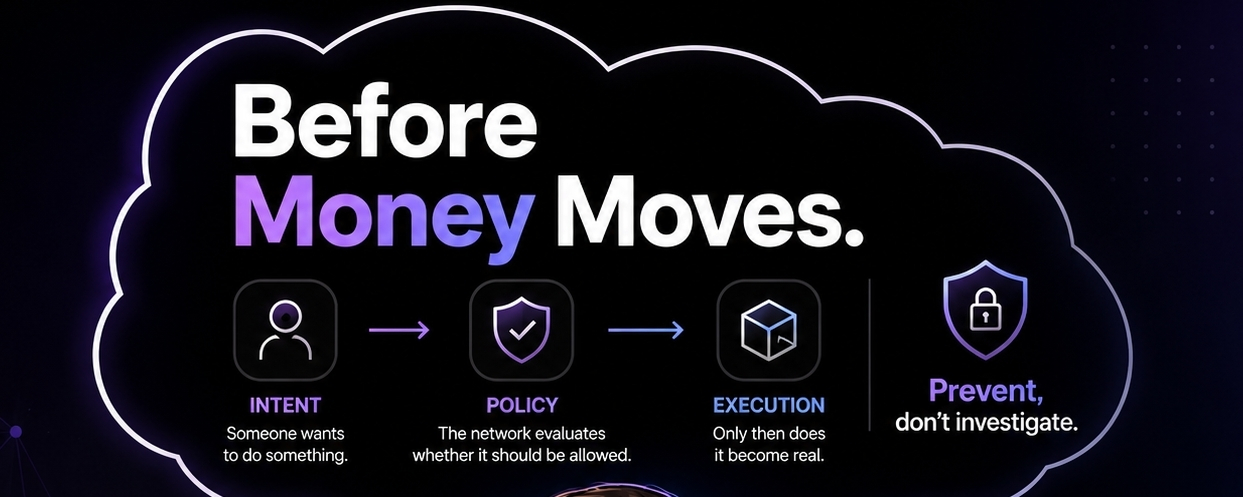
Guys, when I noticed something about @NewtonProtocol , I wasn't thinking about wallets, compliance, or even blockchain.
I was thinking about a question that feels much older than crypto itself.
When should a system decide that an action is unacceptable?
Most people assume the answer is obvious: after the action happens.
If someone commits fraud, investigate it.
If sanctioned funds move, freeze them.
If money is stolen, trace it.
If something goes wrong, explain what happened.
That assumption has quietly shaped almost every financial system we've ever built.
The strange part is that we've become incredibly good at reconstructing history.
Banks have investigators.
Exchanges have compliance teams.
Governments have regulators.
Analytics firms can trace assets across chains with astonishing precision.
We're becoming experts at understanding the past.
But understanding the past isn't the same as protecting the future.
The more I thought about it, the more I realized we've optimized for recovery instead of prevention.
And those are not the same problem.
A payment can be reversed.
A fraudulent account can be frozen.
A report can be written.
But none of those erase the fact that the event was allowed to exist in the first place.
That's where I think many conversations around blockchain infrastructure become surprisingly shallow.
Everyone debates speed.
Everyone measures throughput.
Everyone compares transaction costs.
As if moving value faster automatically means building a better financial system.
I don't think that's the real bottleneck anymore.
Because speed is neutral.
A network that settles legitimate transactions faster also settles fraudulent ones faster.
Technology doesn't distinguish between good and bad intentions.
It simply executes.
That raises a more uncomfortable question.
Maybe infrastructure shouldn't only become better at executing decisions.
Maybe it should become better at evaluating whether certain decisions deserve execution at all.
That's the idea that made me pause while looking into Newton.
Not because it's introducing another feature.
But because it seems to move compliance away from being a reaction and closer to becoming part of the execution process itself.
That's a subtle difference.
Yet it completely changes the architecture of responsibility.
Instead of asking whether a completed transaction was compliant, the system asks whether the intended action satisfies predefined policies before settlement ever occurs.
That changes compliance from hindsight into infrastructure.
And I think that's a much bigger philosophical shift than people realize.
For years, crypto has celebrated permissionless systems.
The assumption was simple.
If nobody controls access, innovation moves faster.
That idea unlocked enormous progress.
But it also exposed something we rarely discuss.
Permissionlessness removes gatekeepers.
It doesn't remove consequences.
Real financial systems still have obligations.
Sanctions exist.
Fraud exists.
Consumer protection exists.
Institutional requirements exist.
Ignoring those realities doesn't make them disappear.
It simply pushes the problem somewhere else.
Maybe that's why so many blockchain applications still rely on manual reviews, centralized intervention, or after-the-fact enforcement.
We've decentralized execution.
But we haven't truly reimagined permission.
Of course, there's another side to this conversation.
A programmable policy layer sounds elegant.
Until you ask who writes the policies.
Who updates them?
Who audits them?
Who challenges them when they're wrong?
Software doesn't magically become objective because it's automated.
In fact, invisible rules can become even harder to question than visible human decisions.
That's the paradox.
The more programmable permission becomes, the more accountability matters.
Efficiency alone isn't enough.
Transparency has to scale alongside automation.
Otherwise we've simply hidden discretion inside code instead of removing it.
That's the part I hope projects like Newton continue exploring.
Not just faster policy evaluation.
Not just more sophisticated enforcement.
But governance around the rules themselves.
Because if infrastructure is going to decide what is allowed to exist before value moves, then the process defining those decisions becomes just as important as the technology enforcing them.
We've spent years making money programmable.
Maybe the next chapter isn't programmable money at all.
Maybe it's programmable permission.
And if that's true,
then the most important question isn't how fast value moves.
It's this
Who gets to define the rules that decide whether value should move in the first place?$NEWT
