
I've been scrolling through crypto chatter at odd hours for more years than I care to admit, and most of it blends together after a while. The same stories recycled with fresh coats of paint: this time it's different, this integration will unlock everything, trust the tech. You watch projects launch with big visions, raise quietly or loudly, deliver roadmaps that stretch into the horizon, and then... life happens. Markets turn, incentives misalign, or the hard parts of reality—security, adoption, actual reliability—catch up. So when something like Newton Protocol and its NEWT token crossed my feed, I didn't jump. I just sat with it for a bit, the way you do when a familiar problem gets poked in a way that feels slightly less superficial than usual.
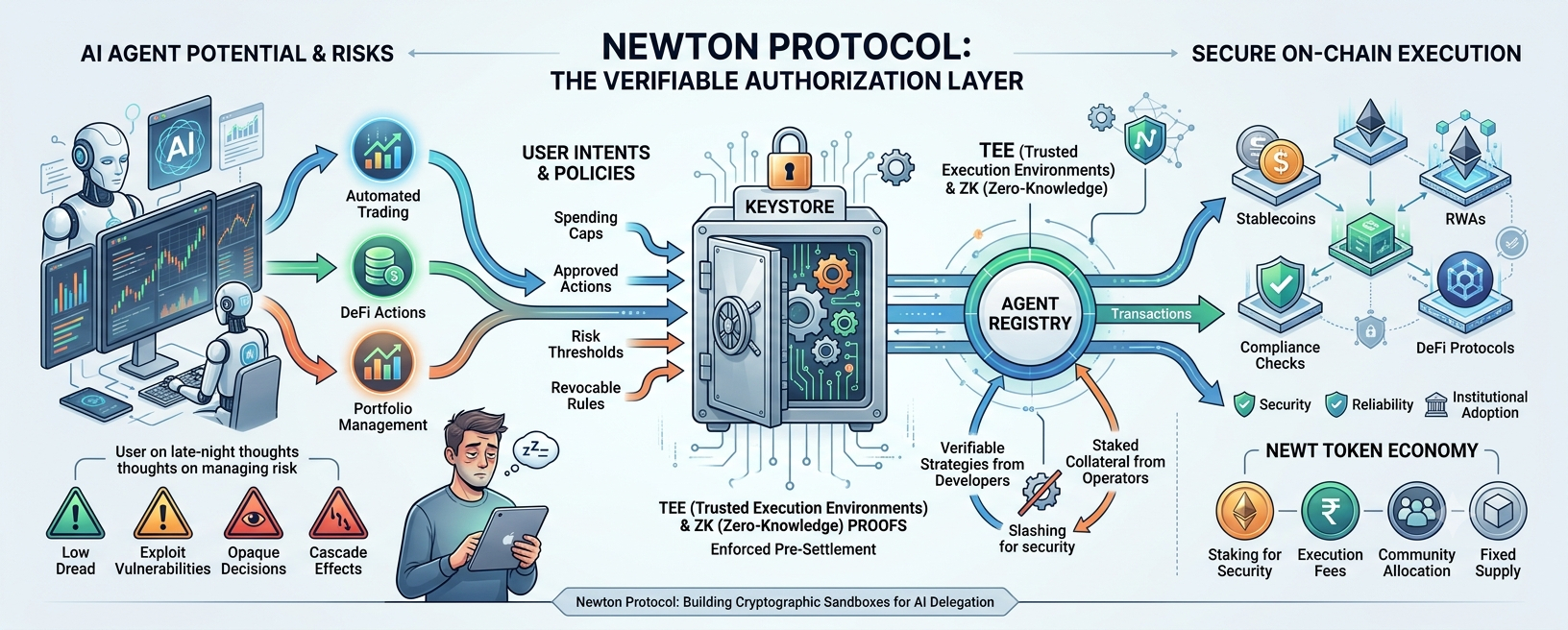
The core itch it’s trying to scratch is one I’ve felt personally. Automated trading, AI-driven strategies, letting something smarter than my tired eyes handle rebalancing or opportunistic moves across chains while I’m not glued to charts. In theory, beautiful. In practice, I’ve seen too many close calls. You grant approvals that feel narrow at the time, an exploit slips through, or the bot does something unpredictable when volatility spikes. Handing over any real control to third-party services or even your own scripts has always carried that low-level dread. AI agents amp that up—faster, more adaptive, but also opaque in ways that keep me up. One wrong prompt interpretation or data feed glitch, and it’s not just a bad trade; it’s a cascade.
What Newton seems to be building is a dedicated rollup setup, their Keystore thing, centered on permissions that are granular and revocable. Not “here’s my seed phrase, good luck,” but policies you define—spending caps, approved actions, risk thresholds—that get enforced before anything hits the chain. They mix in TEEs for running computations securely, ZK stuff for proving it happened right, and a registry for agent models so developers can offer verifiable strategies. The marketplace angle is there too: builders create agents, operators stake collateral that can get slashed if things go wrong, users pay in NEWT for execution. It’s positioned as infrastructure that could stretch beyond retail traders into stablecoins, RWAs, compliance checks—stuff where verifiable authorization before settlement actually matters at scale.
I keep coming back to how stubborn these problems are. Crypto loves talking decentralization, but so much of the day-to-day still runs on implicit trust: oracles, bridges, team multisigs, offchain promises. AI layers on top of that mess. Models can be biased or manipulated; agents need guardrails that don’t break composability or add insane fees. Newton isn’t pretending to solve AI itself—just trying to create a narrower, cryptographic sandbox where delegation feels less like gambling. The token has a fixed supply, staking for security and fees, some community tilt in allocations, and vesting that at least gestures toward alignment. Their launch emphasized transparency more than most, which stands out when you’ve watched endless “fair” launches that weren’t.
Still, doubts creep in naturally. Another specialized rollup means another thing to bridge, another validator set (even if it starts controlled and talks progressive decentralization), more surface area for the usual issues—latency, economic attacks, fragmentation. Policies sound powerful until real-world messiness hits: changing regs, edge-case market events, offchain data that doesn’t play nice. I’ve seen protocols nail the happy path and crumble under stress. Will developers actually build agents here instead of on bigger, more liquid ecosystems? Will users bother setting up detailed intents when simpler (riskier) options exist? The friction of good security has sunk plenty of better ideas before.
There’s something quietly different in the emphasis, though. Not another general-purpose chain chasing TVL theater, but a focused attempt at the authorization layer that’s been missing. Onchain finance is moving serious volume now, yet most transactions still lack that pre-settlement policy check. For institutions or anyone managing real capital with AI assistance, that gap is a non-starter. Magic Labs bringing wallet experience to this helps it feel grounded rather than purely speculative. They’re shipping beta stuff, integrating risk partners, pushing multichain—tangible steps amid the noise.
I’m not here declaring victory or loading up. Too many cycles have taught me that execution over years matters more than whitepaper elegance. The AI-crypto overlap is exciting precisely because it’s hard: security vulnerabilities in agent frameworks, accountability questions, the limits of what’s verifiable versus what lives in a model’s weights. Newton could carve a useful niche or fade like others that solved part of the puzzle elegantly. For now, it’s one of the pieces I find myself thinking about when the feed gets too loud—less hype, more quiet wrestling with genuine friction. Late-night thoughts like these usually end in cautious watching. This one feels worth that much, at least. We’ll see how the guardrails hold when real money and unpredictable agents collide.


#AvalancheTreasuryFlagsGoingConcernRisk #BlackRockIBITHoldingsFallNearly100000BTC @NewtonProtocol #Newt