
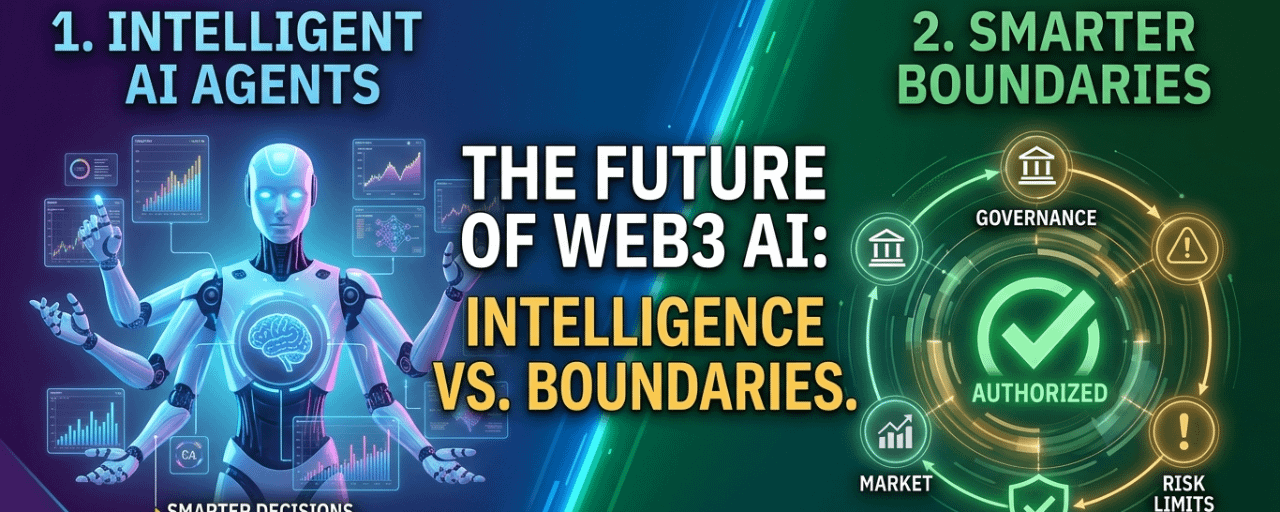
I found myself thinking about a problem that doesn't receive much attention when people talk about AI and blockchains.
Most discussions revolve around capability.
Can an AI analyze markets faster than a human?
Can it execute trades more efficiently?
Can it coordinate complex workflows?
Those are interesting questions, but they all assume the same thing: that the AI should be allowed to act once it decides what to do.
The more I thought about it, the more that assumption seemed incomplete.
Perhaps the harder challenge isn't building autonomous agents.
Perhaps it's deciding, in a decentralized environment, when those agents should not be allowed to act.
That realization completely changed how I started looking at protocols designed for AI-driven automation.
Instead of asking how they make AI smarter, I started asking how they make autonomous decisions safer.
That shift in perspective led me to an interesting observation.
As AI systems become increasingly capable, permission may become a more valuable resource than computation itself.
From Identity to Intent
Traditional blockchain security is built around identity.
A wallet signs a transaction.
The network verifies the signature.
If the signature is valid and the transaction satisfies consensus rules, execution proceeds.
This model works remarkably well when humans initiate most actions.
Humans pause.
Humans reconsider.
Humans occasionally notice that something feels wrong before clicking "Confirm."
Autonomous software behaves differently.
An AI trading strategy doesn't get tired.
It doesn't sleep.
It doesn't hesitate.
It simply continues making decisions according to its objectives.
That consistency is one of its greatest strengths.
It's also one of its biggest risks.
If an autonomous system receives broad authority, it can make thousands of perfectly valid transactions that collectively produce an undesirable outcome.
Nothing may be technically incorrect.
The signatures remain valid.
The protocol behaves exactly as designed.
Yet the result may still violate the intentions of the application's creator.
This suggests that identity alone is becoming a weaker security primitive.
Knowing who submitted a transaction tells us less than understanding whether the transaction should happen under current conditions.
Permission Is Becoming Dynamic
One idea that stood out while studying AI-oriented blockchain architectures is that authorization no longer has to be static.
Historically, permissions looked simple.
An account either possessed access or it didn't.
A contract either accepted a caller or rejected it.
Autonomous systems introduce far more nuance.
Perhaps an agent should only execute trades when volatility remains below a threshold.
Perhaps transfers should pause if external risk indicators deteriorate.
Perhaps borrowing should require multiple independent conditions before capital can move.
These aren't questions of identity.
They're questions of context.
The interesting consequence is that authorization begins resembling continuous evaluation rather than a one-time approval.
Permission becomes something earned repeatedly instead of granted once.
Why Separate Decision-Making From Authorization?
At first this separation felt unnecessary.
If an AI already decides what action to take, why introduce another layer?
The answer became clearer after thinking about how engineering systems often evolve.
Modern operating systems don't assume every application should access every file.
Cloud platforms don't assume every service should communicate with every database.
Large organizations rarely allow every employee unrestricted access simply because they logged in successfully.
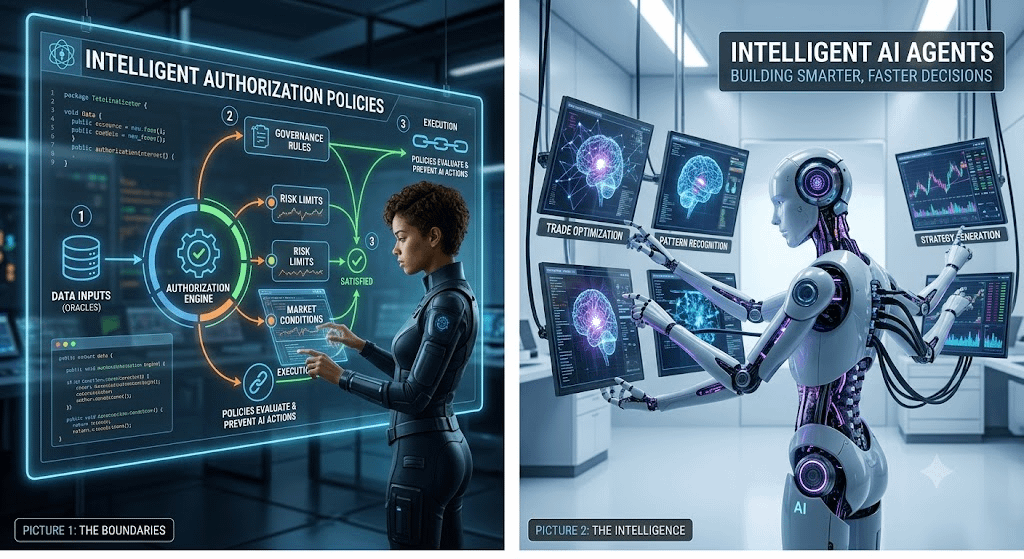
Complex systems increasingly separate capability from permission.
AI-driven blockchain applications appear to be moving in the same direction.
An intelligent agent may generate opportunities.
A policy layer evaluates whether executing those opportunities satisfies predefined rules.
Neither layer replaces the other.
Instead, each specializes.
One focuses on optimization.
The other focuses on control.
That separation reduces the number of responsibilities assigned to any single component.
The Hidden Assumption
But this architecture quietly introduces an assumption.
Policies require information.
Sometimes that information already exists onchain.
Account balances.
Token ownership.
Contract state.
These are relatively straightforward because blockchain nodes already agree on them.
Other situations become more complicated.
Suppose an authorization rule depends upon market conditions.
Or compliance requirements.
Or organizational approvals.
Or enterprise risk metrics.
Those inputs originate elsewhere.
Even if they are retrieved securely and evaluated carefully, someone still has to maintain the infrastructure producing them.
That observation kept pulling my attention away from the authorization logic itself.
The real question wasn't whether policies could become expressive.
It was whether their supporting information remained trustworthy over time.
Better Decisions Depend on Better Context
An autonomous agent rarely fails because it lacks computational ability.
More often it fails because it receives incomplete or misleading context.
Human decision-making works similarly.
A brilliant analyst working with outdated information may reach poor conclusions.
The same principle applies to software.
Adding policy evaluation doesn't magically improve judgment.
It improves the quality of constraints placed around automated behavior.
Those constraints, however, inherit the strengths and weaknesses of the information feeding them.
This doesn't invalidate the architecture.
It simply reminds us that decision quality depends upon context quality.
Tradeoffs Rarely Disappear
One pattern appears repeatedly throughout computer science.
Problems often relocate instead of disappearing.
Virtualization reduced hardware complexity while increasing orchestration complexity.
Cloud computing simplified deployment while introducing operational dependencies.
Microservices improved modularity while making distributed systems harder to observe.
AI authorization follows a similar pattern.
Rich policy engines reduce the risk of unrestricted automation.
However, they increase the importance of policy maintenance.
Developers now have additional responsibilities.
Policies require testing.
External dependencies require monitoring.
Unexpected conditions require graceful handling.
None of these responsibilities indicate flawed design.
They're evidence that flexibility has a cost.
Every abstraction shifts complexity somewhere else.
Why This Matters Beyond Trading
It's tempting to associate AI authorization only with automated trading.
The broader implications seem more interesting.
Imagine decentralized organizations using autonomous treasury management.
Supply chains coordinating payments automatically.
Insurance protocols evaluating claims.
Consumer applications scheduling recurring financial activity.
Healthcare systems handling sensitive permissions.
In each scenario, the question isn't merely whether automation exists.
It's whether automation remains aligned with evolving objectives.
Static permissions struggle in environments where acceptable behavior changes over time.
Dynamic authorization attempts to solve precisely that problem.
Whether it succeeds depends less on the sophistication of AI models than on the quality of governance surrounding them.
Engineering for Failure
One aspect I appreciate about layered authorization models is that they acknowledge something engineers sometimes overlook.
Every component eventually encounters failure.
Networks experience outages.
External services become unavailable.
Unexpected data arrives.
Software behaves unpredictably.
The interesting question isn't whether failures occur.
It's whether the system continues behaving safely after they occur.
Designing around failure often produces stronger architectures than designing exclusively around success.
An authorization layer becomes valuable not only when everything functions perfectly but also when uncertainty increases.
In those moments, refusing action may represent the safest decision.
That principle feels surprisingly relevant as AI systems gain greater operational autonomy.

A Different Way to Measure Progress
Technology discussions frequently emphasize speed.
Lower latency.
Higher throughput.
More transactions.
Larger models.
Greater efficiency.
Those improvements matter.
Yet I wonder whether they're causing us to overlook another metric.
Perhaps mature AI infrastructure should also be measured by the quality of its restraint.
How effectively can it prevent undesirable actions?
How transparently can it explain authorization decisions?
How predictably does it behave when assumptions stop holding?
Those questions may prove just as important as raw performance.
After all, powerful automation without dependable boundaries doesn't necessarily produce trustworthy systems.
It simply produces faster ones.
Closing Thought
The longer I studied architectures that combine AI with blockchain execution, the less convinced I became that intelligence is the defining challenge.
Capability continues improving across the industry.
Permission remains far more difficult.
Designing systems that continuously evaluate whether autonomous actions remain appropriate requires careful thinking about trust, context, governance, and failure—not just algorithms.
Perhaps that's the more important engineering problem.
If AI agents eventually become commonplace across decentralized applications, will the systems that succeed be those with the smartest models—or those that define the smartest boundaries around what those models are allowed to do?